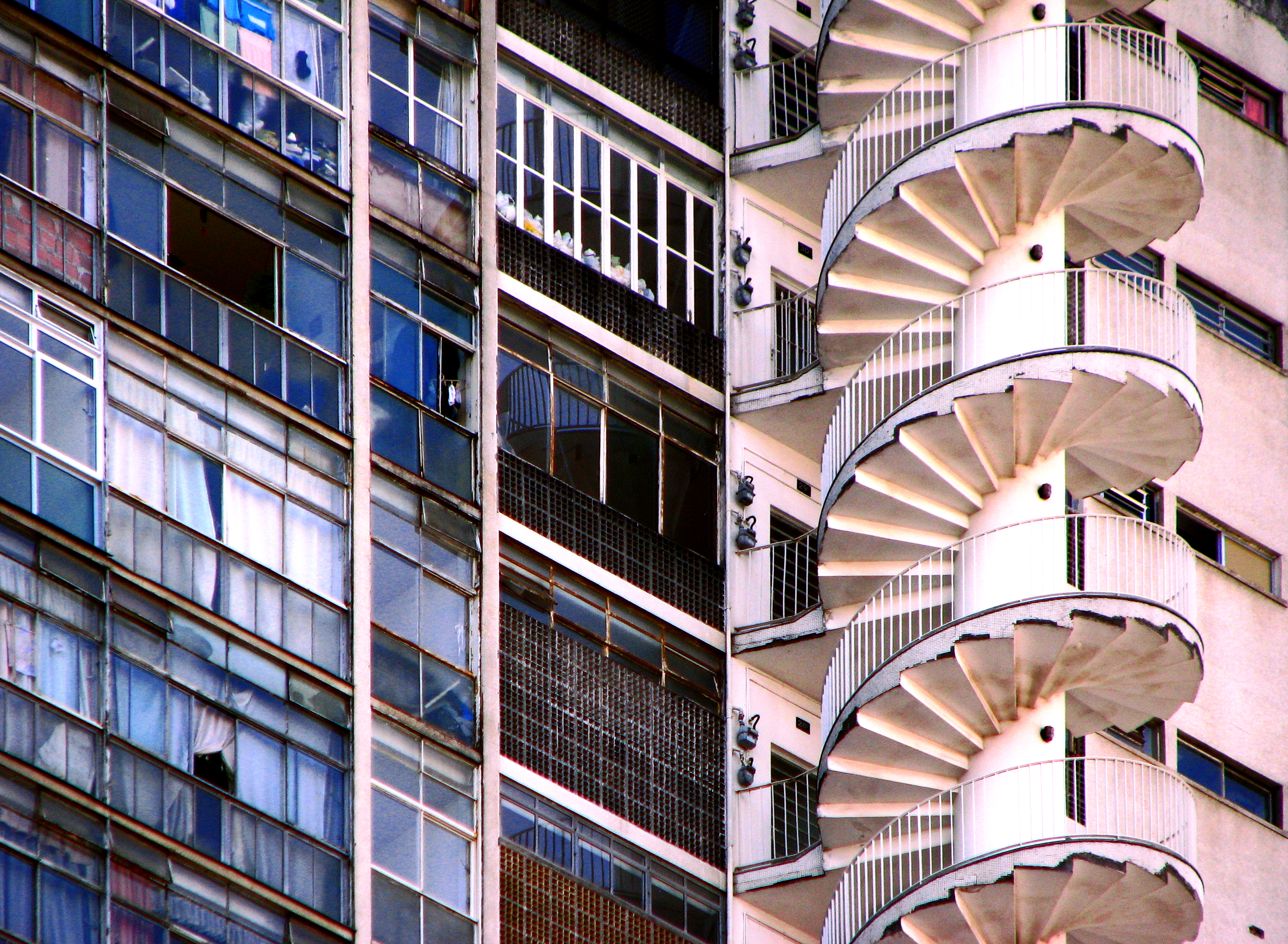
Edifício Copan
The building has its own postal code. That fact alone says something about the scale of Edifício Copan, the sinuous residential tower that curves through downtown São Paulo like a concrete wave frozen mid-break. Designed by Oscar Niemeyer and completed in 1966, Copan holds 1,160 apartments, more than 2,000 residents, 72 ground-floor businesses, and enough complexity that the Brazilian postal service assigned it CEP 01046-925 — a zip code all its own. It is not merely a building. It is a vertical neighborhood, a small city stacked thirty-two stories high on Avenida Ipiranga.
Niemeyer's Signature in Concrete
Oscar Niemeyer never trusted straight lines. The architect who would go on to design Brasília's most iconic structures brought that same philosophy to Copan, which he conceived in the early 1950s as part of celebrations for São Paulo's Fourth Centenary. The building's famous S-shaped facade — a sweeping, undulating curve that refuses to sit still against the skyline — was Niemeyer's personal contribution to the design. Structural engineer Joaquim Cardozo, his longtime collaborator, made it possible in reinforced concrete, creating what remains the largest such structure in Brazil. The north-facing side is lined with horizontal brise-soleils, sun-breaking fins that give the facade its distinctive ribbed texture while channeling airflow through the apartments. On the opposite side, a glass curtain wall catches light. The effect from the street is unmistakable: while the surrounding towers stand rigid and rectangular, Copan flows.
A Fourteen-Year Construction
Copan's history is one of ambition meeting reality. The original plan, commissioned by the Companhia Pan-Americana de Hotéis e Turismo — whose acronym gives the building its name — envisioned two structures: a residential tower and a hotel. Construction began in 1952, but financial difficulties, ownership changes, and design revisions dragged the project through fourteen years of starts and stops. Architect Carlos Lemos joined to help carry the work forward. When the building was finally inaugurated in 1966, only the residential tower had been built. The hotel was never constructed. Yet even as a single building, Copan exceeded expectations — 115 meters tall, 32 floors, 120,000 square meters of built area divided into six distinct blocks, each with its own elevator bank.
Life Inside the Curve
Living in Copan means belonging to a community with the population of a small town. The building's 1,160 apartments range from compact studios to spacious three-bedroom units, served by 20 elevators and 221 underground parking spaces. More than 100 employees maintain the building — porters, cleaners, security, maintenance crews — running what amounts to a private municipal operation. The ground floor hums with the activity of 72 businesses: restaurants, a bookstore, a travel agency, an evangelical church established in the 1990s. Residents share a single address but inhabit radically different versions of it. The six blocks that compose the building each have their own character, and the social range runs from working-class families to professionals to artists drawn by Copan's reputation and the surreal density of its communal life.
The Plans That Never Were
Niemeyer's original vision for Copan was more expansive than what stands today. His design included a park at the building's base, a second garden on the first floor's open terrace, and a communal roof deck offering panoramic views of São Paulo. None survived contact with commercial reality. The ground-level park was consumed by a bank building. The first-floor garden and rooftop terrace were closed to residents. Even the building's facade, whose mosaic tiles once gave it a shimmering surface, has required extensive intervention — since 2014, sections have been draped in protective netting to prevent loose tiles from falling on pedestrians below. The gap between Niemeyer's ideal and the building's lived reality is part of what makes Copan fascinating: it is a utopian gesture that became, over six decades, something messier and more human than any architect could have planned.
A City Within a City
Copan has entered the broader cultural imagination in ways that reflect its outsized presence. It appeared on The Amazing Race 9, where contestants sprinted up its fire escapes and rappelled down its walls. The 2013 video game SimCity included it as a buildable landmark. Author Regina Rheda set her short story collection Arca sem Noé inside the building, treating it as a microcosm of Brazilian society. From the air, Copan's S-curve is immediately recognizable amid São Paulo's sprawl — a single building with enough mass and character to hold its own against one of the world's largest cities. In a metropolis that reinvents itself relentlessly, Copan endures: a reminder that when Niemeyer bent concrete into a curve, he made something too alive to ever be merely a building.
From the Air
Located at 23.55°S, 46.64°W on Avenida Ipiranga in central São Paulo. The building's distinctive S-shaped curve is visible from altitude amid the dense high-rise grid of downtown. Nearest airports: Congonhas (SBSP) approximately 7 km south, Guarulhos International (SBGR) approximately 26 km northeast. Best viewed at 2,000-4,000 feet AGL, where the sinuous facade contrasts sharply with the rectangular towers surrounding it.