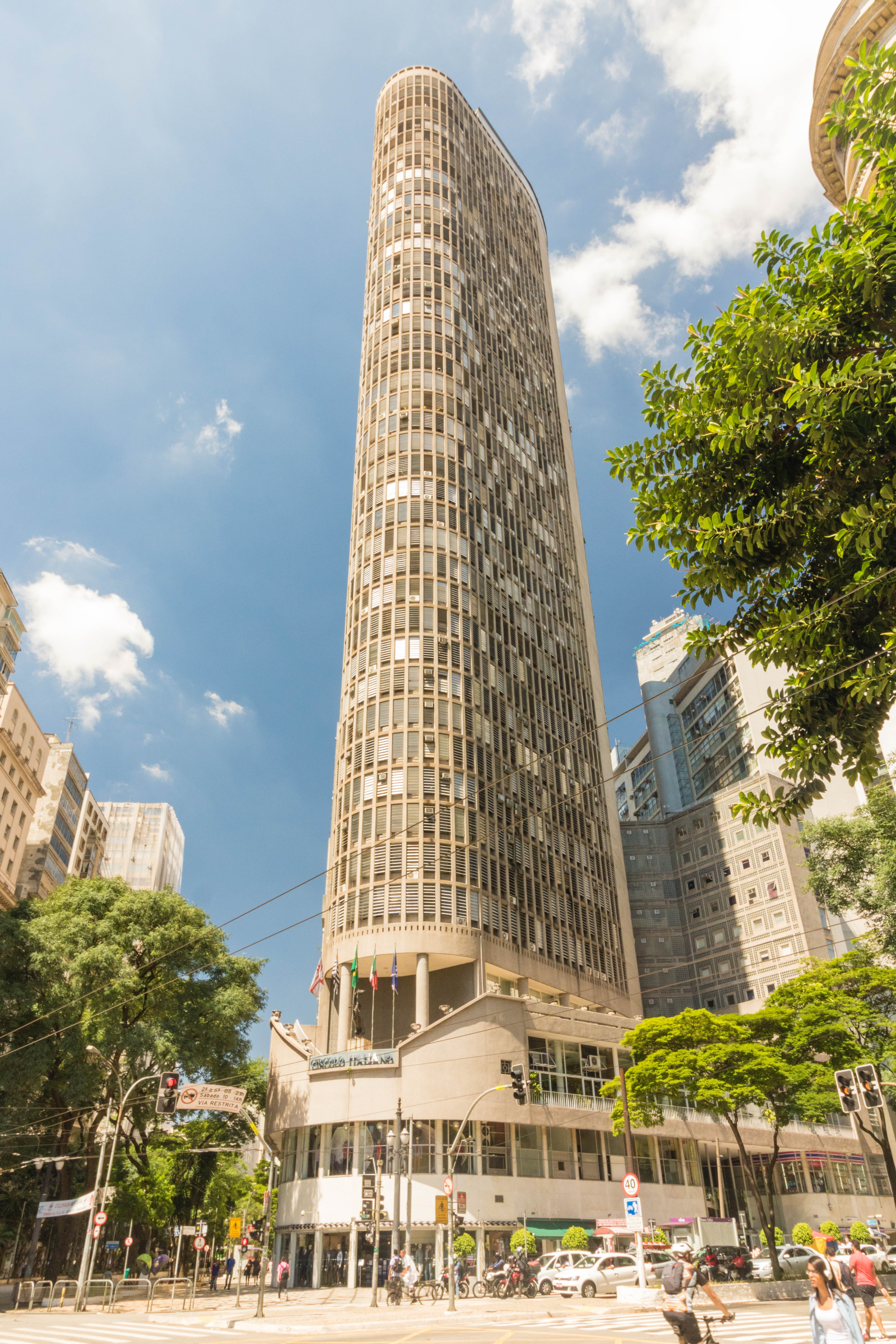
Edifício Itália
In 1894, a young Queen Elizabeth II would not yet exist for another three decades, and the intersection of Avenida Ipiranga and Avenida São Luís was just a quiet corner in a growing Brazilian city. But the Italian immigrants already arriving in São Paulo by the hundreds of thousands had plans that stretched far higher than the low colonial skyline. When the Circolo Italiano di San Paolo—founded in 1911 to bind together a scattered immigrant community—finally raised its skyscraper headquarters on that very corner in 1965, the building rose 165 meters and 46 stories into the subtropical air. It was a declaration written in reinforced concrete: the Italians had not merely arrived in São Paulo. They had built it.
A Community's Ambition, Cast in Concrete
The Circolo Italiano acquired the land at Avenida Ipiranga as early as 1923, but decades would pass before the tower took shape. World War II froze the project. Anti-Italian sentiment complicated matters further. It was not until the 1950s that the community revived its vision, commissioning a design competition that German-born architect Franz Heep won with a modernist plan featuring a curving, glass-clad facade. Heep's design was practical as well as striking—the facade's geometry created natural ventilation and shielded tenants from direct tropical sunlight without sacrificing the panoramic views that would become the building's calling card. Construction ran from 1956 to 1965, and when the Edifício Itália finally opened, it stood as the second-tallest building in São Paulo, a visible symbol of immigrant achievement anchored at one of the city's most famous crossroads.
Dinner at the Top of the World
Two years after the tower opened, the Terraço Itália Restaurant began serving meals on the 41st floor. Inaugurated on September 29, 1967, it quickly became one of São Paulo's most celebrated dining rooms—not because of what was on the plates, but because of what surrounded them. Floor-to-ceiling windows frame the city's southern sprawl in every direction, an ocean of concrete and light that shifts from haze-softened gray at midday to glittering amber after dark. One floor above, the Bar do Terraço faces north toward the Serra da Cantareira mountain range, offering live music against a backdrop of forested ridgelines. In November 1968, Queen Elizabeth II visited the restaurant during a royal tour of Brazil and was reportedly stunned by the panoramic view. When a queen accustomed to the world's grandest vistas finds herself impressed, the view is doing something right.
Where Ipiranga Meets São Luís
The building's address places it at one of Brazilian popular culture's most iconic intersections. Caetano Veloso immortalized the corner of Ipiranga and Avenida São João—just steps away—in his 1978 song "Sampa," and the neighborhood surrounding the Edifício Itália pulses with the contradictions that define central São Paulo. The modernist Copan Building, designed by Oscar Niemeyer, curves nearby. The Altino Arantes Building—São Paulo's answer to the Empire State Building—rises 161 meters to the east. Pedestrianized streets teem with vendors. Corporate towers crowd against century-old facades. Standing at the base of the Edifício Itália, you are at the gravitational center of a city that never finished deciding what it wanted to be, and decided instead to be everything at once.
Still Standing, Still Italian
More than six decades after its inauguration, the Edifício Itália remains both a working office building and a cultural landmark protected by São Paulo's historic heritage authority. The Circolo Italiano still operates from its upper floors, hosting social and corporate events in the Sala São Paulo on the 41st floor. The rooftop observation deck remains open to tourists, offering what is arguably the most accessible high-altitude view of the city. From the terrace, São Paulo reveals itself as it truly is: not a single city but an endless accumulation of neighborhoods, each one dense enough to be a city of its own. The Italian community that raised this tower has long since woven itself into the broader Paulistano identity—their pizza, their espresso, their family-run trattorias now as Brazilian as they are Italian. The building they left behind still marks the skyline, a vertical reminder that immigrants do not just settle in cities. They reshape them.
From the Air
Edifício Itália sits at 23.545°S, 46.644°W in the República district of central São Paulo. At 165 meters, it is one of the tallest structures in the downtown core and visible from approach altitudes. The building stands near the intersection of Avenida Ipiranga and Avenida São Luís. Nearest major airports: Congonhas (SBSP/CGH), approximately 8 km south; Guarulhos International (SBGR/GRU), approximately 25 km northeast. São Paulo sits on a plateau at 760 meters elevation with subtropical highland climate. Afternoon thunderstorms are common during the wet season (October–March).