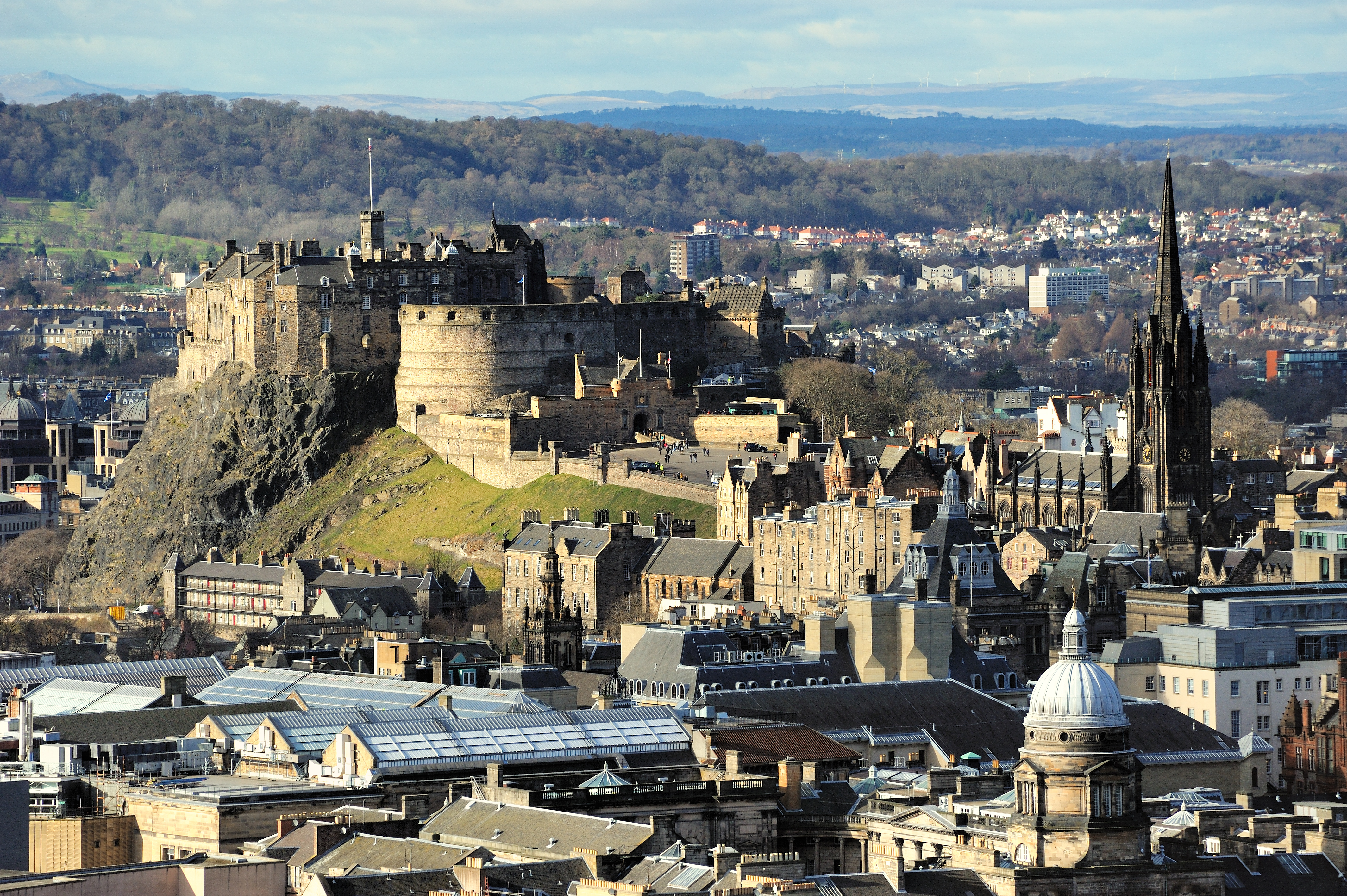
Edinburgh Castle
Every day except Sunday, Christmas, and Good Friday, a gun fires from the battlements of Edinburgh Castle at precisely one o'clock. The tradition began in 1861 as a time signal for ships in the Firth of Forth, two miles away. In 1916, the same gun was fired -- in vain -- at a German Zeppelin during an air raid, its only known use in war. This combination of the ceremonial and the deadly, the theatrical and the functional, is Edinburgh Castle in miniature. It has been besieged 26 times across 1,100 years, making it arguably the most attacked place in Great Britain, and it remains Scotland's most visited paid attraction, drawing over 2.2 million visitors a year.
The Volcano Beneath
The castle stands on a volcanic plug that rose some 350 million years ago during the lower Carboniferous period. Castle Rock is dolerite -- a type of basalt so hard that glaciers carved around it, leaving sheer cliffs to the north, south, and west and a gentler slope to the east: the classic crag-and-tail formation that gave Edinburgh's Old Town its spine. The summit sits 130 meters above sea level, with cliffs dropping 80 meters to the surrounding landscape. The geological advantage is obvious, but dolerite is nearly impermeable, and water was a chronic problem. A 34-meter-deep well often ran dry during droughts and sieges, and during the Lang Siege of 1573, the garrison's thirst became as formidable an enemy as English cannons.
Mons Meg and the Black Dinner
The castle's history reads as a compressed chronicle of Scotland itself. In 1314, Thomas Randolph recaptured it from the English by scaling the north face of the rock at night with thirty men, guided by a soldier who knew a hidden path. Robert the Bruce immediately ordered the castle slighted to prevent reoccupation. In 1440, the sixteen-year-old William Douglas, 6th Earl of Douglas, and his younger brother were invited to dine with ten-year-old King James II at David's Tower. After the so-called Black Dinner, both boys were dragged outside and executed on trumped-up charges. The great bombard Mons Meg arrived in 1457, a gift from Philip III of Burgundy. On 3 July 1558, when Mary Queen of Scots married the French dauphin, Mons Meg was fired in salute -- and one of its stones landed at Wardie Muir, fully two miles away.
Crown, Stone, and Memorial
The Honours of Scotland -- the crown, sceptre, and sword of state -- are the oldest surviving set of crown jewels in Britain. They were sealed away after the 1707 union with England and forgotten until Sir Walter Scott received permission to search the castle in 1818. Breaking into a sealed room and unlocking a chest, he found them intact. The Stone of Scone, upon which Scottish monarchs were traditionally crowned, was returned to the castle in 1996 after seven centuries in Westminster Abbey. St Margaret's Chapel, dating from the early 12th century, is regarded as the oldest building in Edinburgh. And on the highest point of Castle Rock stands the Scottish National War Memorial, opened in 1927, where a sealed casket holds Rolls of Honour listing over 147,000 names from the First World War alone.
The Tattoo and the Skyline
Each August, the castle esplanade becomes the stage for the Royal Edinburgh Military Tattoo, a performance that began in 1950 and now draws 217,000 live spectators and a television audience estimated at 100 million across 30 countries. The climax is always the same: a lone piper on the battlements, playing a pibroch in memory of fallen comrades, his silhouette backlit against the floodlit castle walls. Below the esplanade, the castle's gatehouse features statues of Robert the Bruce and William Wallace added in 1929, and above the gate runs the Latin motto: Nemo me impune lacessit -- no one provokes me with impunity. For a fortress that has endured 26 sieges, it is less a boast than a statement of fact.
From the Air
Edinburgh Castle dominates the city skyline at 55.949N, 3.200W, sitting atop Castle Rock at the western end of the Royal Mile. The volcanic plug and fortress are unmistakable from any altitude. The esplanade extends to the east. Nearest airport: Edinburgh (EGPH), approximately 6 nm west. Visible from cruising altitude in clear weather; best detail at 2,000-4,000 ft.