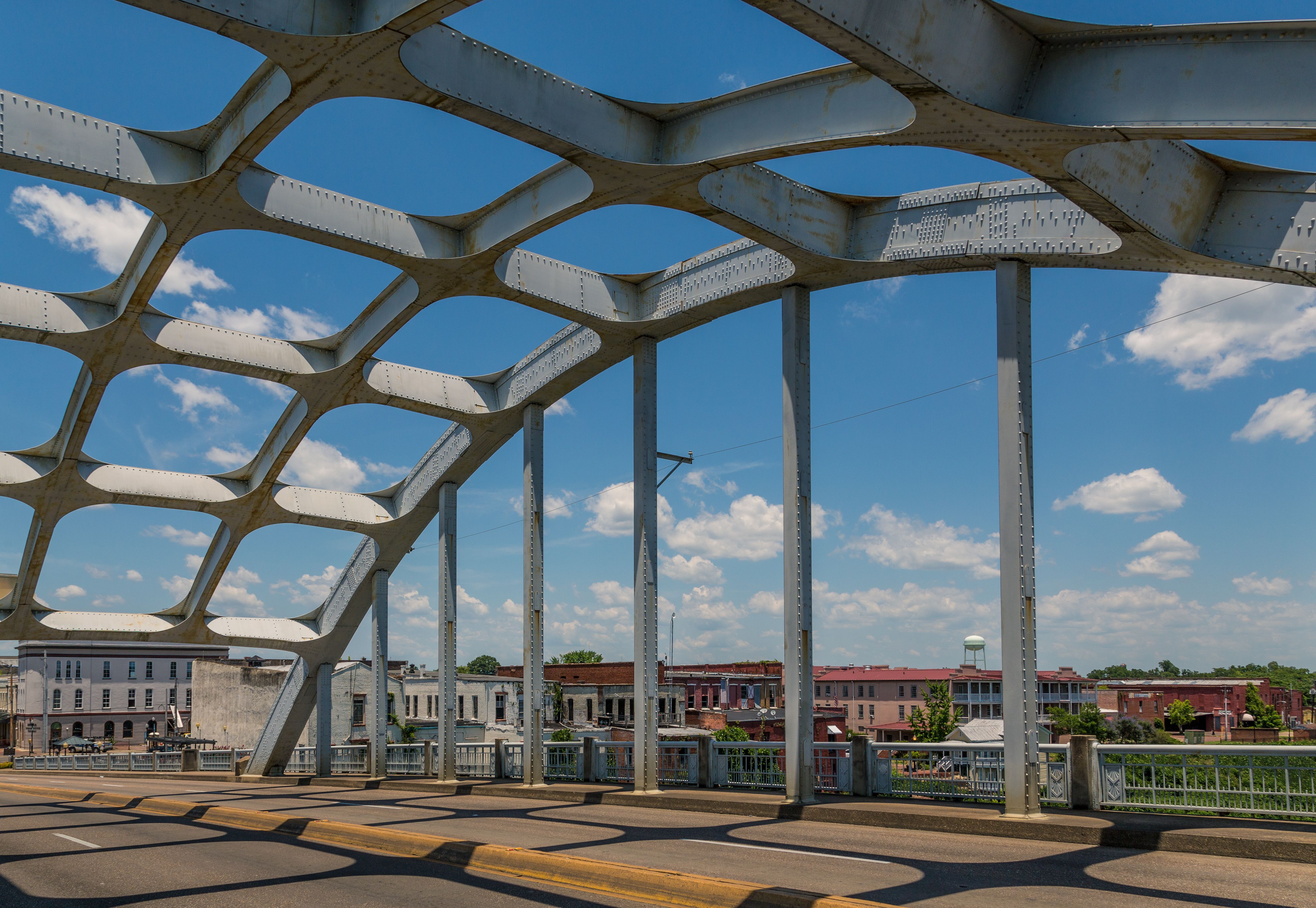
Edmund Pettus Bridge
On March 7, 1965, six hundred people walked two abreast toward the crest of a bridge they could not see over. The steel arch rose above the Alabama River in Selma, blocking any view of what waited on the other side. What waited was a wall of Alabama state troopers in gas masks, Dallas County deputies on horseback, and a reckoning that would reshape American democracy. The Edmund Pettus Bridge, built in 1940 and named after a Confederate general who led the Alabama Ku Klux Klan, became the unlikely stage where the brutality of voter suppression was broadcast into living rooms across the nation. By nightfall, 17 marchers lay in hospitals, tear gas still hung in the air, and the world had a new name for state-sanctioned violence: Bloody Sunday.
A Bridge Built on Contradiction
The bridge itself is a study in unintended symbolism. Its steel through-arch design lifts the roadway high above the Alabama River, creating a blind summit that prevents anyone on the west side from seeing what lies ahead on the east. Selma sits on a bluff, so the western approach rises sharply before the road crests and descends toward Dallas County. This topography turned the bridge into a trap in 1965, and into a metaphor ever since. The structure carries four lanes of U.S. Route 80 Business across 11 spans, with the main steel arch centered over the river and ten concrete spans extending eastward. It replaced an 1885 iron camelback truss bridge that had stood one block east, complete with a swing span for river traffic and a bridge tender's house that still stands today. Designed by Selma native Henson Stephenson, the current bridge opened to traffic in 1940, bearing the name of Edmund Pettus, a Confederate brigadier general, U.S. senator, and Grand Dragon of the Alabama Ku Klux Klan.
The Day the Country Watched
The marchers had reason to walk. In Selma in 1965, voting rolls were 99 percent white and 1 percent African American, despite Black residents comprising roughly 30 percent of the population. Weeks earlier, in nearby Marion, state troopers had confronted 400 unarmed demonstrators. A 26-year-old church deacon named Jimmie Lee Jackson was shot in the stomach and died eight days later. His death galvanized activists including Martin Luther King Jr. and SCLC Director of Direct Action James Bevel, who planned a peaceful 54-mile march from Selma to the state capital in Montgomery. That march required crossing the Pettus bridge. As the column crested the arch, troopers charged with billy clubs, bullwhips, and tear gas. Horseback deputies drove marchers back toward Selma. Television cameras captured it all. The footage aired that evening, interrupting the ABC broadcast of Judgment at Nuremberg, a film about crimes against humanity. The juxtaposition was devastating.
From Selma to the Voting Rights Act
Two weeks after Bloody Sunday, under federal court protection and with national outrage mounting, thousands marched again. They crossed the bridge on March 21, 1965, and walked for four days to Montgomery, their numbers swelling to 25,000 by the time they reached the state capitol. That summer, President Lyndon B. Johnson signed the Voting Rights Act of 1965, dismantling the legal machinery of voter suppression that had kept Black citizens from the ballot box across the South. The bridge had done what its namesake never intended: it accelerated the very freedom Edmund Pettus had spent his career opposing. John Lewis, the young Student Nonviolent Coordinating Committee chairman who was beaten unconscious on Bloody Sunday, would go on to serve 17 terms in the U.S. Congress. He returned to the bridge repeatedly over the decades, and when he died in July 2020, his casket was carried across it one final time in a horse-drawn caisson.
A Name That Refuses to Be Simple
The question of what to call this bridge has no easy answer. After John Lewis's death, calls surged to rename it in his honor. But Lewis himself had opposed the change, writing with Congresswoman Terri Sewell in 2015: "Keeping the name of the Bridge is not an endorsement of the man who bears its name but rather an acknowledgement that the name of the Bridge today is synonymous with the Voting Rights Movement which changed the face of this nation and the world." The tension is part of the bridge's power. It forces a confrontation with history rather than a comfortable erasure of it. In March 2015, on the 50th anniversary of Bloody Sunday, President Barack Obama stood at the foot of the bridge and led a march across it alongside former President George W. Bush, John Lewis, and 103-year-old Amelia Boynton Robinson, a civil rights pioneer who had been beaten unconscious on the bridge half a century earlier. An estimated 40,000 people joined them.
Crossing Today
The bridge still carries traffic across the Alabama River, though it was listed as functionally obsolete in 2011, meaning it no longer meets modern design standards for its traffic load. From the air, its steel arch is unmistakable against the brown-green ribbon of the river, with Selma's downtown grid spreading west from the bluff. The approach road climbing toward the blind crest is visible at lower altitudes, and the scale of that climb helps explain why the marchers could not see what waited for them. Every year, commemorative marches retrace the 1965 route. The 1996 Olympic torch passed over it on the way to Atlanta. The bridge has appeared in the award-winning documentary Eyes on the Prize, the 2014 film Selma, and John Lewis's graphic memoir March. It remains what it has been since 1965: a place where concrete and steel carry the weight of something far heavier than cars.
From the Air
Located at 32.4056N, 87.0186W in Selma, Alabama. The steel arch spanning the Alabama River is visible from the air, especially at altitudes of 2,000-4,000 feet AGL. Selma sits on a bluff on the west bank, making the bridge's asymmetric profile distinctive. Nearest airport is Craig Field (KSEM), 4 miles southeast of Selma. Montgomery Regional Airport (KMGM) lies approximately 50 miles east along the historic march route. Best viewed in clear conditions approaching from the south or east to see the arch profile against the river.