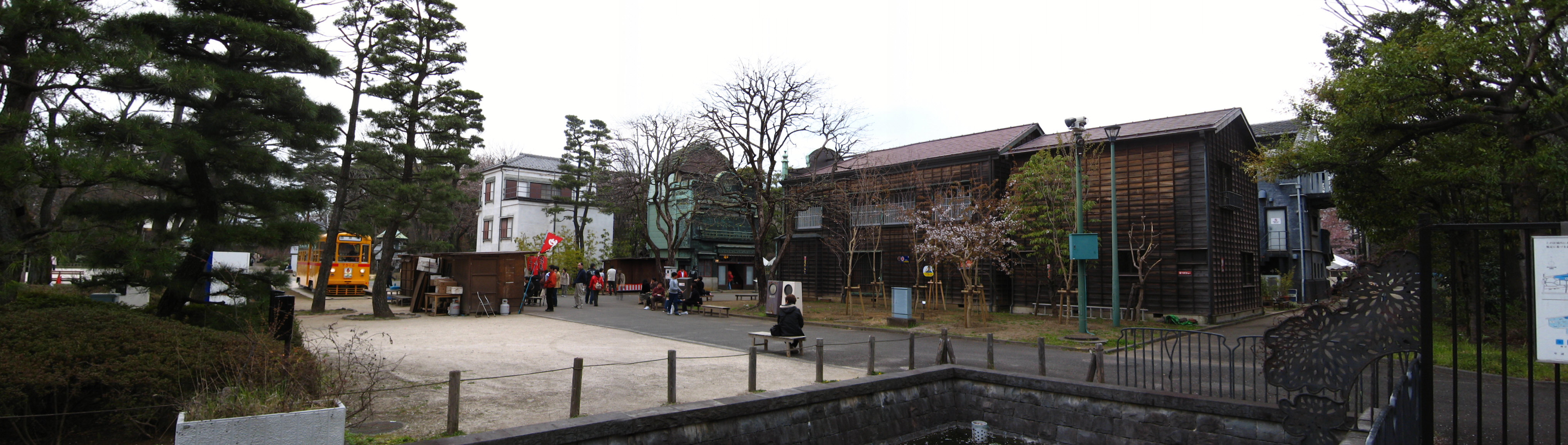
Edo-Tokyo Open Air Architectural Museum
Hayao Miyazaki kept coming back. The animator, whose Studio Ghibli is based in nearby Koganei City, visited the Edo-Tokyo Open Air Architectural Museum again and again while developing Spirited Away, sketching the ornate interior of a 1929 public bathhouse, the drawer-lined walls of a Meiji-era stationery shop, and the narrow lanes of a reconstructed downtown district. The buildings that fired his imagination had already been saved once, relocated from demolition sites across Tokyo and painstakingly reassembled inside Koganei Park. Miyazaki's visits gave them a second life in the global imagination. But even without their Studio Ghibli connection, these thirty structures tell a story of a city that has reinvented itself so many times that its past survives only through deliberate acts of rescue.
Rescuing What Tokyo Keeps Rebuilding Over
Tokyo's relationship with its own architecture is defined by destruction and renewal. Earthquakes, firebombing, and relentless modernization have erased most of the city's pre-war built environment. The Edo-Tokyo Open Air Architectural Museum exists because a handful of historically significant buildings faced demolition and had nowhere else to go. Opened in 1993 as a branch of the Edo-Tokyo Museum, the outdoor site within Koganei Park gathers structures that span roughly three centuries, from the Edo period through the mid-Showa era. The museum's origins trace back even further, to a 1934 local history exhibition hall in Arisugawa-no-miya Memorial Park. That collection moved to Inokashira Park in 1948, then to Koganei Park in 1954 as the Musashino Folklore Museum, before its 1993 transformation into the current institution.
Three Zones, Three Worlds
The museum grounds are divided into three distinct zones, each evoking a different facet of Tokyo's vanished landscape. The western zone assembles the rural world of Musashino: thatched-roof farmhouses and the refined homes of the Yamanote residential hills, buildings that recall the agricultural villages that once surrounded the city. The central zone gathers prestigious structures, the homes of politicians, entrepreneurs, and architects, buildings that display the ambition and eclecticism of Japan's modernizing elite. The eastern zone is the most atmospheric: a reconstructed downtown Shitamachi street lined with shops, a flower store, a soy sauce dealer, and the ornate Kodakara-yu bathhouse, its interior decorated with painted tiles and a grand mural of Mount Fuji above the communal baths. Walking this lane feels less like visiting a museum and more like stepping through a door in time.
The Bathhouse That Became a Masterpiece
Kodakara-yu, originally built in 1929 in the Senju district of Adachi ward, is perhaps the museum's most famous resident. Its gorgeously tiled interior, wooden lattice ceiling, and the sweeping Mount Fuji mural above the bathing pools became one of the primary inspirations for the fantastical bathhouse at the heart of Spirited Away. Nearby, the Takei Sanshodo stationery shop, founded in the early Meiji era and reconstructed alongside the Hanaichi flower shop just as the two buildings originally stood in the Chiyoda area, provided another key reference. Its walls, covered floor to ceiling with small wooden drawers, inspired the boiler room of the character Kamaji. Miyazaki was so connected to the museum that he designed its mascot, a character called Edomaru. The Shitamachi street of the eastern zone became the template for the mysterious spirit town that Chihiro's family stumbles into at the film's opening.
Living Architecture
Beyond its Ghibli fame, the museum serves as a serious preservation institution and a rare window into everyday Japanese life across the centuries. These are not grand temples or castles but the houses where ordinary and moderately prosperous people lived, the shops where they bought stationery and flowers, the bathhouses where they gathered at the end of the day. Each structure was dismantled at its original site, transported piece by piece, and reassembled with meticulous attention to original materials and techniques. The collection is managed by the Tokyo Metropolitan Foundation for History and Culture, and the site is designated a Tokyo Metropolitan Tangible Cultural Property. In a city where the built environment turns over with astonishing speed, the Edo-Tokyo Open Air Architectural Museum is one of the few places where Tokyo's vanished streetscapes can still be experienced in three dimensions.
From the Air
Located at 35.72N, 139.51E within Koganei Park in western Tokyo. The museum grounds are nestled inside the large green rectangle of the park, visible from the air as an open area with scattered historic structures among tree cover. Chofu Airport (RJTF) is approximately 3 km to the south, making it the closest airfield. Yokota Air Base (RJTY) lies 15 km to the northwest, and Tokyo Haneda (RJTT) is about 25 km to the southeast. Best viewed at 2,000-3,000 feet to pick out the museum layout within Koganei Park's distinctive greenery.