Edo Wonderland Nikko Edomura
The samurai cat watches you from every gift shop, every signpost, every brochure. Nyanmage -- named for the Japanese onomatopoeia for a cat's meow crossed with the topknot hairstyle of Edo-period warriors -- is the mascot of a place that treats 17th-century Japan not as a museum piece but as a living performance. Edo Wonderland Nikko Edomura, tucked into the Kinugawa Onsen hot spring district of Nikko, opened on April 23, 1986, and has spent nearly four decades reconstructing the golden age of the Tokugawa shogunate as something you can walk through, dress up in, and throw shuriken at. It is part theme park, part film studio, and part elaborate act of cultural reenactment -- staffed entirely by people who stay in character as Edo-era citizens from opening bell to closing.
A Town That Never Existed
The park's design draws on the Genroku era, the cultural high point of the Edo period spanning roughly 1688 to 1704, when kabuki theater, ukiyo-e woodblock prints, and the pleasure quarters of Yoshiwara flourished under relative peace. Edo Wonderland reconstructs this world not as a single historical site but as an idealized composite: rural lodgings sit alongside urban samurai residences and government buildings, all populated by costumed staff who speak, bow, and interact according to the social hierarchies of the period. Visitors encounter lower-class merchants, middle-class artisans, and upper-class warriors, each playing their role with rehearsed conviction. The Henshin Costume House takes this further by letting visitors dress as Edo-period characters and walk the streets in costume. The staff adjusts their behavior accordingly -- bow deeper to a visitor in samurai garb, treat a costumed merchant with appropriate familiarity. It is theater without a fourth wall.
Seven Stages, One Era
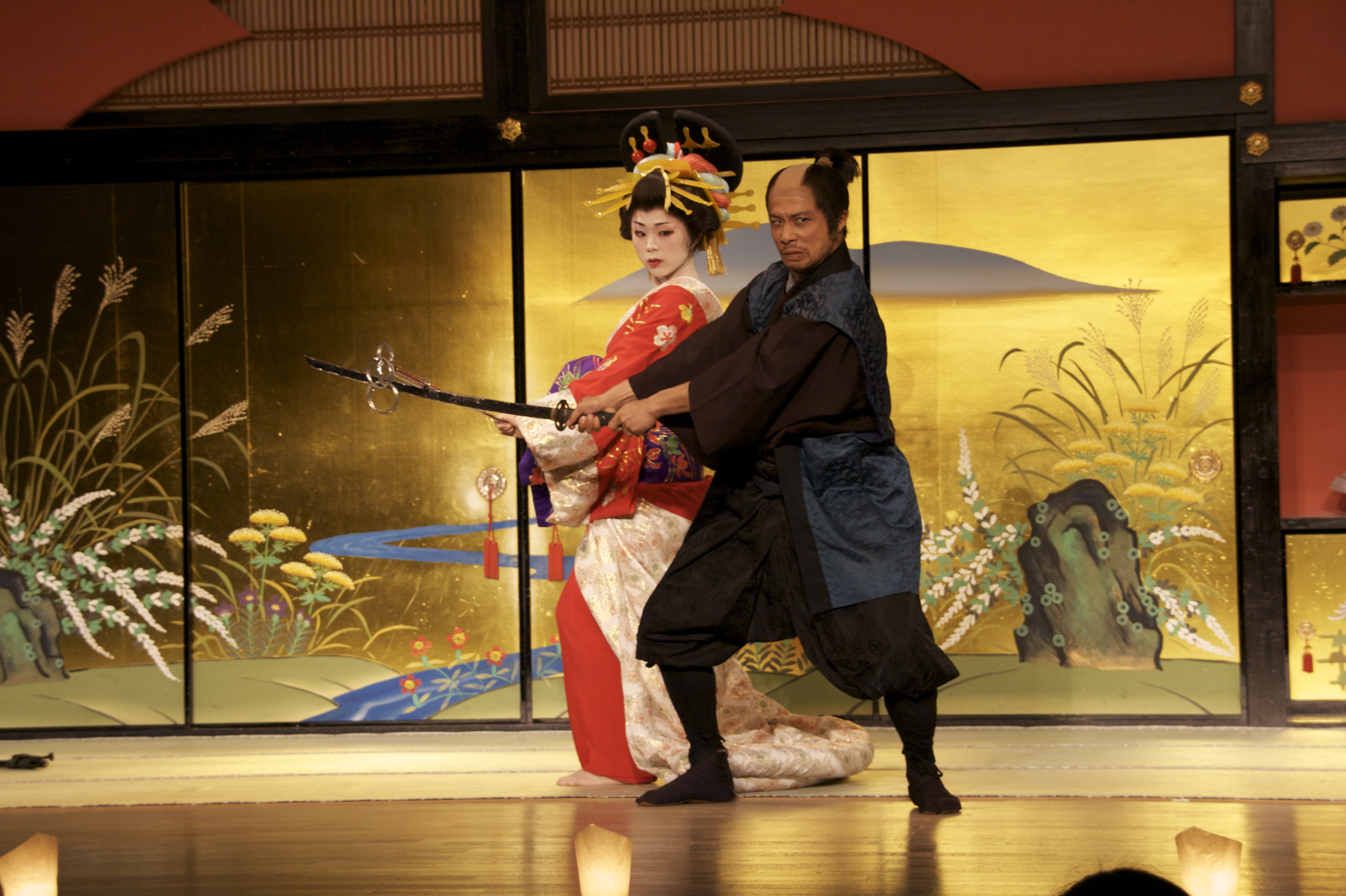
Across its seven indoor theaters and numerous outdoor performance spaces, Edo Wonderland stages a rotating program of shows rooted in period entertainment. Ninja action sequences feature acrobatic combat on rooftops and across courtyards. Oiran shows recreate the elaborate processions of high-ranking courtesans, with their towering hairdos and exaggerated geta sandals. Traditional plays draw from the jidaigeki genre of historical drama. Street performers, parades, seasonal festivals, and special events fill the gaps between scheduled shows, so the park operates less like an amusement park with rides and more like an immersive theatrical district. For visitors who want to participate rather than watch, workshops offer instruction in traditional Japanese archery and the art of throwing shuriken -- the star-shaped blades that have become inseparable from the popular image of the ninja, though their historical use was far more mundane than Hollywood suggests.
Behind the Curtain: A Working Studio
What many visitors do not realize is that Edo Wonderland contains professional film studios and a large open set regularly used for jidaigeki productions -- historical films and television dramas that are a staple of Japanese popular culture. The park's architecture is detailed enough to serve as a period-accurate backdrop for professional cinematography. The 2022 film Pure Japanese, starring Dean Fujioka, was partially shot on location at the park in September 2020, with the castle interior of Studio 2 serving as a key set. Japanese variety shows and international travel programs have also filmed extensively within the grounds. The park once anchored a small empire: three additional Edo Wonderland parks were built in Hokkaido, Kanazawa, and Mie Prefecture, though all were sold off in the 2000s. Nikko's original remains the flagship, its longevity owed in part to the Kinugawa Onsen tourism economy that surrounds it.
Time Travel in the Mountains
From the air, Edo Wonderland reads as a compact cluster of traditional-style rooftops nestled in the forested valley of the Kinugawa River, a conspicuous patch of dark wooden architecture in a landscape otherwise dominated by the modern hotels and ryokan of the hot spring resort district. The park sits in the broader Nikko region, where the Tokugawa legacy is not confined to theme parks. The lavishly decorated Toshogu Shrine, the cedar-lined avenues, and the mountain temples that earned UNESCO World Heritage status all lie within a short drive. Edo Wonderland draws its power from that context -- it is not recreating a vanished world in a vacuum but amplifying a cultural memory that permeates the entire valley. The Genroku era it celebrates was an age of confident cultural production, when Japan turned inward under Tokugawa isolation and built something extraordinary with the energy it might have spent on foreign wars. The park's trick is making that confidence feel contagious.
From the Air
Located at 36.79N, 139.70E in the Kinugawa Onsen area, Nikko, Tochigi Prefecture. The park is a compact cluster of traditional Edo-period architecture visible as dark wooden rooftops against the green forested valley of the Kinugawa River. Best viewed at 2,000-4,000 feet AGL. Nearest airport: RJTU (Utsunomiya Airport) approximately 25nm south-southeast. Tokyo Narita (RJAA) lies approximately 80nm southeast. The surrounding terrain is mountainous with river valleys; Mount Nantai (8,169 ft) dominates the skyline to the west. The area is prone to valley fog in the mornings and scattered cloud buildup against the mountains in afternoon hours.