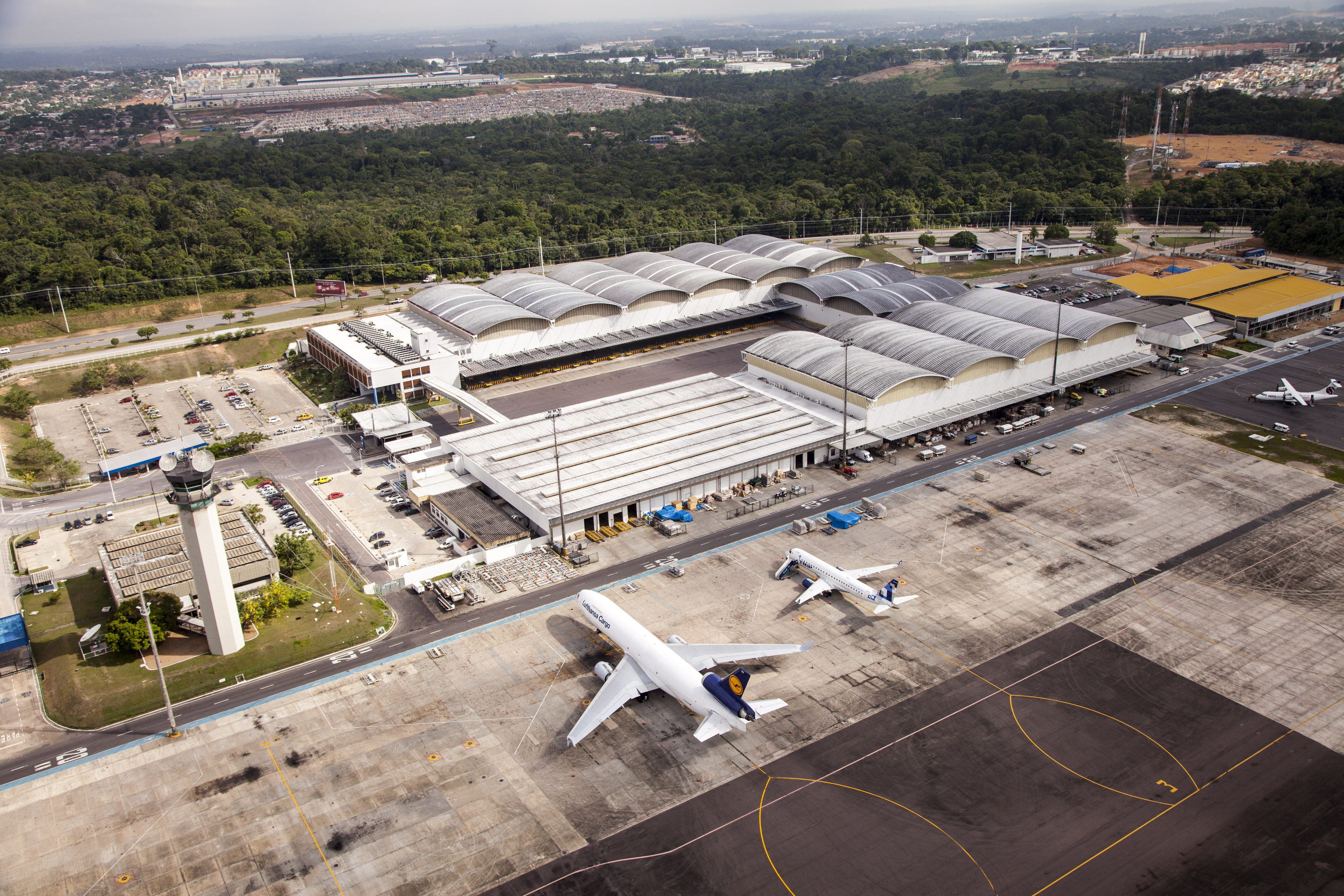
Eduardo Gomes International Airport
In 1972, Brazilian planners broke ground in the forest north of Manaus on what they officially called the Supersonic Airport of Manaus. The runway was designed long and strong enough to handle the Concorde, the Anglo-French supersonic passenger jet then edging toward commercial service. Before construction finished, the name changed. On December 11, 1973, the facility was rechristened the Eduardo Gomes International Airport after Air Marshal Eduardo Gomes, the Brazilian politician and military figure who was born in 1896 and would die in 1981 at 84. Commissioned on March 31, 1976, with a Boeing 727 domestic flight, the airport was the most modern in Brazil at the time, and the first to operate with jet bridges.
A Gateway That Had to Be Built
Manaus had a problem the rest of Brazil did not. Sitting 1,500 kilometers up the Amazon from the Atlantic, with no paved road connection to the industrial south, the city depended almost entirely on its river port and its airport to link it to the national economy. Ponta Pelada Airport had served as Manaus's main public field, but by the early 1970s it could no longer handle growing traffic. The Brazilian military government decided to build a replacement large enough for every aircraft then flying, and long enough for the aircraft it expected to be flying soon. That last ambition explains the Supersonic name. The runway geometry still reflects it. The Concorde never did make regular service to Manaus, but the airport the hope inspired turned out to be exactly what the city needed as it expanded into the Free Trade Zone era.
Marshal of the Revolution
Eduardo Gomes himself was one of the most visible soldiers of his generation. Born in 1896, he flew for the fledgling Brazilian Air Force and joined the tenente revolts of the 1920s against the Old Republic, including the 1922 uprising at Fort Copacabana that left him among the legendary Eighteen of the Fort. He became a founding figure of the independent Brazilian Air Force in 1941, rose to Air Marshal, and ran for president twice, in 1945 and 1950. He lost both times to Eurico Dutra and Getulio Vargas respectively but remained a political presence. When he died in 1981, the airport that had briefly been the Supersonic Airport permanently bore his name. The runway that was supposed to launch a Concorde instead became a memorial to a general who had helped invent Brazilian military aviation.
Cargo Capital of the Free Zone
Today the airport is the third busiest in Brazil for cargo, behind only Sao Paulo-Guarulhos and Campinas. The reason is the Manaus Free Trade Zone, established in 1957 and rebuilt under military decree in 1967. Factories in the Industrial Pole of Manaus assemble electronics, motorcycles and home appliances for the Brazilian market, taking advantage of tax exemptions meant to populate the Amazon. The finished goods fly out from Eduardo Gomes toward every major Brazilian city. Cargo terminals opened in 1976, 1980 and 2004 together cover 49,000 square meters and can process up to 12,000 tons of cargo per month. Passenger Terminal 1 handles all domestic and international flights, while Passenger Terminal 2, opened in 1985, takes general aviation. A 793.5 million real upgrade program launched by the federal airport operator Infraero in 2009 overhauled the apron, runway and passenger terminal in preparation for the 2014 FIFA World Cup, when Manaus hosted four matches.
A Record of Skies That Are Not Always Calm
The airport's history includes several aviation incidents that underscore the distances and isolation of Amazonian flying. On March 6, 1991, a TABA Embraer EMB 110 Bandeirante inbound to Manaus was hijacked near Sao Gabriel da Cachoeira by three people. On December 15, 1994, another TABA Bandeirante en route from Carauari and Tefe to Manaus was hijacked by two Colombian citizens; the passengers were released near Tabatinga and the aircraft was flown to Colombia, where the crew was released at the Brazilian embassy in Bogota. The deadliest local accident came on May 14, 2004, when Rico Linhas Aereas Flight 4815, an Embraer EMB 120ER Brasilia registered PT-WRO en route from Sao Paulo de Olivenca and Tefe to Manaus, crashed in the forest about 18 nautical miles from the airport. All 33 passengers and crew died. Bush pilots across the region still navigate conditions most aviators never face: afternoon thunderstorms over trackless jungle, towering cumulus, the constant knowledge that an engine failure leaves few landing options.
Under New Management
In April 2021, after decades of operation by the federal airport authority Infraero, the French infrastructure firm Vinci Airports won a 30-year concession to run Eduardo Gomes International. The handoff is part of a broader wave of Brazilian airport privatizations. The field sits 14 kilometers north of downtown Manaus, connected by the same road that eventually leads to the Balbina Dam, the Waimiri-Atroari territory and Boa Vista beyond. The Brazilian Integrated Air Traffic Control and Air Defense Center section 4, Cindacta IV, sits in the vicinity. From the air, the airport appears as a straight slice of concrete in an otherwise unbroken green canopy, a geometric reminder that even the Amazon has its airports, and that in Manaus the airport is not just infrastructure. It is the lifeline.
From the Air
ICAO SBEG, IATA MAO. Located at 3.04S, 60.05W, 14 kilometers north of Manaus city center. Runway 10/28 is 2,700 meters, originally designed for Concorde operations. Elevation roughly 80 feet MSL. Operated by Vinci Airports under a 30-year concession since 2021. Passenger Terminal 1 handles domestic and international flights. Three cargo terminals handle up to 12,000 tons per month. Weather considerations: equatorial convective activity is routine, especially in afternoons December through May; expect heavy precipitation, low ceilings and gusting winds around storm cells. Dry-season haze from regional burning can reduce visibility July through October. Approach typically aligns with the prevailing easterly trade winds.