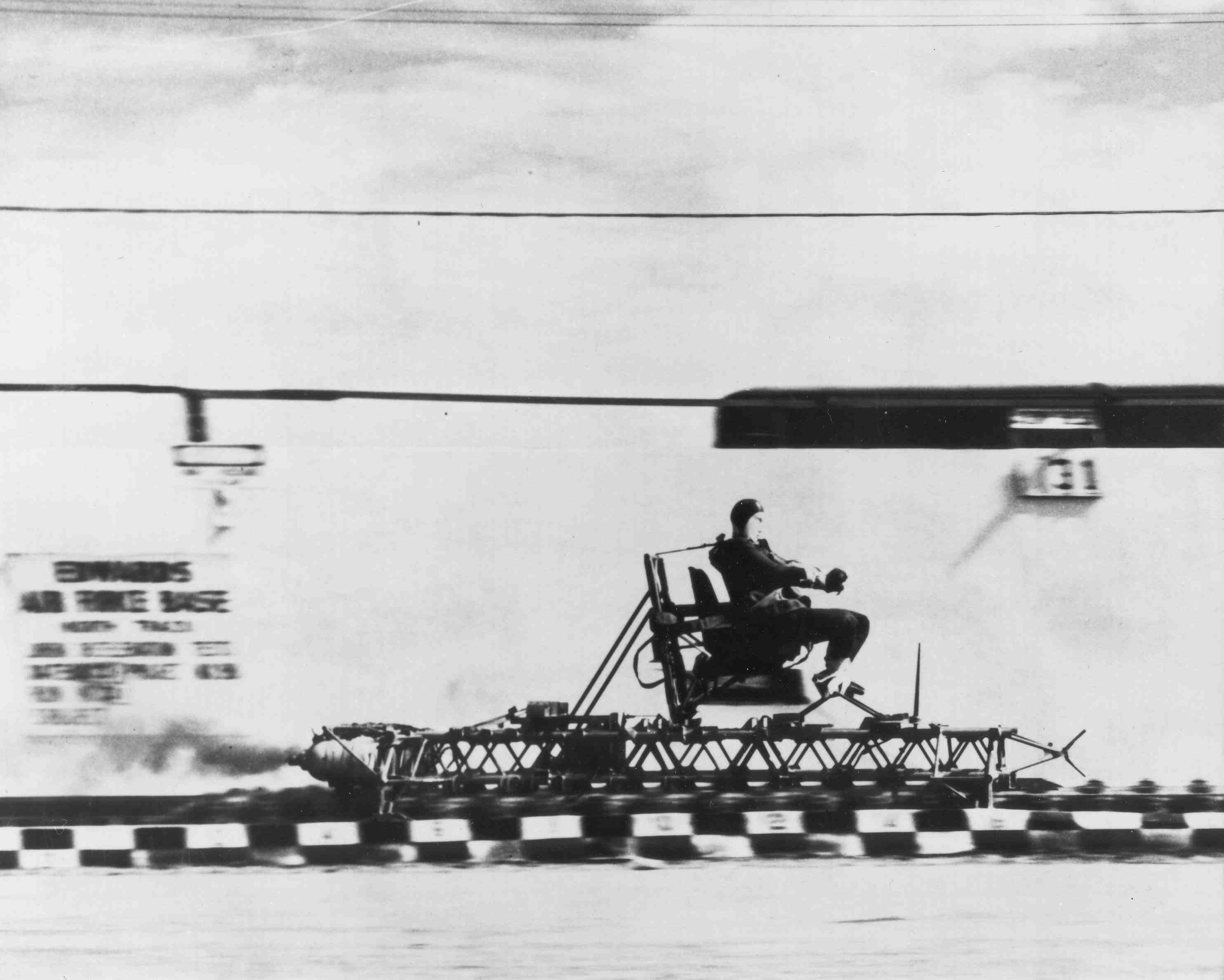
Edwards Air Force Base
On October 14, 1947, Chuck Yeager climbed into a bullet-shaped aircraft named Glamorous Glennis and dropped from the belly of a B-29 bomber over the Mojave Desert. Minutes later, he became the first human to fly faster than sound. The sonic boom that rolled across Rogers Dry Lake announced a new era in aviation, and the remote desert base that made it possible has never stopped pushing the boundaries of flight.
From Muroc to the Edge of Space
The story begins with a family named Corum who homesteaded near this sun-blasted lakebed in 1910. When a post office arrived, they named it Muroc, their name spelled backward. By 1932, Lieutenant Colonel Henry "Hap" Arnold recognized that the vast, flat expanse of Rogers Dry Lake offered something no conventional runway could: limitless room for experimental aircraft to land, even if something went wrong. The natural runway stretches over 44 square miles, so smooth in places that altitude deviates only one foot every three miles. Here, America's first jet fighter, the Bell P-59 Airacomet, made its secret test flights in 1942. The X-15 rocket plane later reached the edge of space, flying over 4,500 miles per hour. And when the Space Shuttle Columbia completed its maiden voyage in 1981, it touched down on these same lakebeds where hot-rodders had raced in the 1930s.
The Century Series and Cold War Icons
The 1950s transformed Edwards into the center of supersonic aviation. Here the famed Century Series fighters took shape: the F-100 Super Sabre, F-104 Starfighter, F-105 Thunderchief, and F-106 Delta Dart. Each pushed aircraft into previously impossible flight regimes, defining speed and altitude envelopes that military jets still operate within today. The Douglas D-558-II Skyrocket flew here in 1951 at over 1,200 miles per hour and reached altitudes above 79,000 feet. The Lockheed U-2 spy plane, capable of cruising at 70,000 feet, conducted its early flight tests over these same desert ranges. When the B-58 Hustler arrived as the world's first Mach 2 bomber, it added another entry to Edwards' growing list of aviation firsts. The base became the proving ground for every significant American military aircraft of the jet age.
Pancho's and the Test Pilot Mystique
Just outside the base, Florence "Pancho" Barnes ran her Happy Bottom Riding Club, a legendary dude ranch and watering hole where test pilots unwound after pushing experimental aircraft to their limits. Here Chuck Yeager and his contemporaries celebrated their survival and mourned colleagues who didn't make it back. The ranch burned down in 1953, but its spirit pervades the culture of Edwards. The Air Force Test Pilot School continues to train the service's elite aviators, teaching them to coax data from machines that exist nowhere else on Earth. Pilots assigned to Edwards carry on a tradition of calculated risk that began with those early jet pioneers. The base's motto, "Ad Inexplorata" (Toward the Unknown), captures this ethos perfectly.
The Modern Test Center
Today Edwards hosts the Air Force Test Center, where the 412th Test Wing operates some 90 aircraft representing over 30 different designs. The F-22 Raptor, F-35 Lightning II, B-2 Spirit, and RQ-4 Global Hawk all undergo testing here. NASA's Armstrong Flight Research Center occupies a corner of the base, continuing research that stretches back to 1946 when 13 engineers arrived from Virginia to support X-1 flights. The base's Benefield Anechoic Facility tests electromagnetic and radio frequency systems, while the Air Force Rocket Research Laboratory puts rocket engines through their paces on Leuhman Ridge. Even the Royal Air Force maintains a presence, testing F-35B Lightning II aircraft alongside their American counterparts.
A Landscape Written in History
The compass rose painted on Rogers Dry Lake is the world's largest, spanning nearly a mile in diameter. Constructed in 1956, its magnetic alignment has drifted with the Earth's shifting poles, a reminder that even calibration marks here measure time in decades. The lakebed itself is a National Historic Landmark, its surface polished smooth each year by desert winds whipping seasonal rains across the playa. Joshua trees and desert tortoises inhabit the surrounding terrain, protected species sharing space with aircraft that can outrun their own shadows. Rogers Dry Lake occasionally fills with water during winter rains, then dries to a mirror-flat surface perfect for experimental landings. The base now includes an 875-megawatt solar installation, a modern addition to a landscape that has witnessed every major chapter of American aerospace history.
From the Air
Located at 34.91N, 117.88W in the Mojave Desert. Visible landmarks include the distinctive Rogers Dry Lake with painted runway markings and the massive compass rose visible from altitude. Nearby airports include Mojave Air and Space Port (KMHV) and General William J. Fox Airfield (KWJF). Military airspace restrictions apply. Best viewed from 8,000-12,000 feet AGL on clear days when the lakebed patterns are visible.