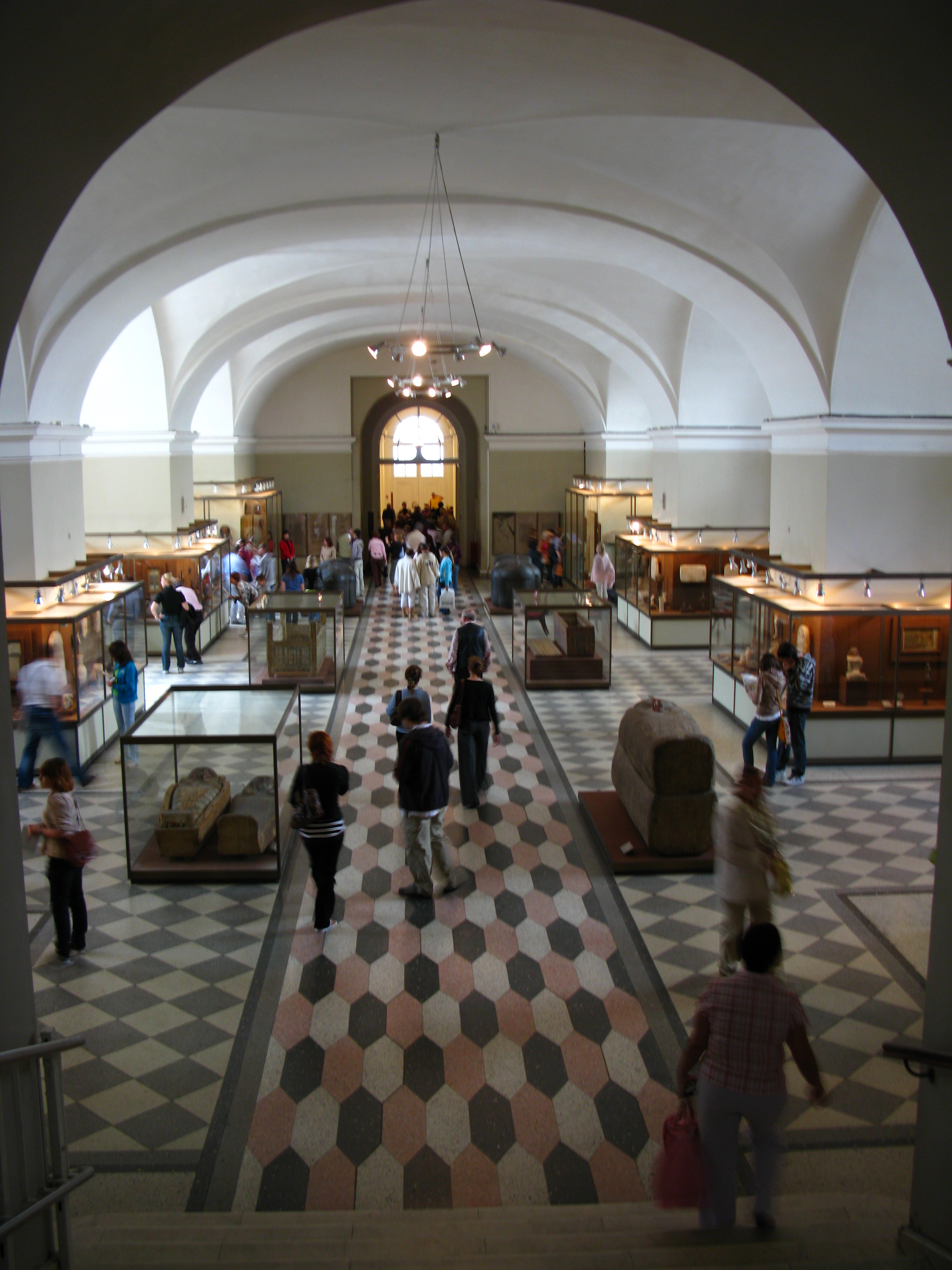
Egyptian Collection of the Hermitage Museum
Walk through the eastern ground floor of the Winter Palace and you cross under the soaring weight of St. George's Hall, where the Romanov throne once stood. Before 1940, the room directly beneath St. George's was the palace's main buffet, where servants assembled platters for state dinners three flights up. Today that room holds the Egyptian Collection of the Hermitage Museum: about 7,500 objects, the oldest from the Predynastic Period and the youngest from the twelfth century AD, displayed in a single long hall on the path to the museum's classical antiquities. The mummy of a tenth-century-BC priest named Petese lies in one case. A fragment of the cuneiform tablet recording the Egyptian-Hittite peace treaty of 1259 BC sits in another. How they got from the Nile to the Neva is its own four-thousand-year story.
A Countess and a Duke
The collection has a clean founding date: 1852, the year the Hermitage opened to the public. That year the museum bought a collection of Egyptian statuettes from Countess Alexandra Lavalle, who had kept them in her mansion on the English Embankment along the Neva. The Lavalle pieces were small, the kind of grave goods and amulets that wealthy European collectors had been buying from Egyptian middlemen since the eighteenth century. The same year the Hermitage received the Egyptian collection of Maximilian, Duke of Leuchtenberg. Maximilian was the son of Eugène de Beauharnais, Napoleon's stepson, and he had married Tsar Nicholas I's daughter Maria. His Egyptian holdings included two black basalt sarcophagi from the Late Period, which still sit in the middle of the hall, and the sculpture group of the Theban governor Amenemheb with his wife and mother, dating to the fourteenth century BC. In 1853 the statue of the lion-headed goddess Sekhmet, brought by Russian traveler Alexei Norov from the Theban Necropolis in the 1830s, was transferred from the Imperial Academy of Arts.
The Castiglione Transfer
The collection grew suddenly larger in 1862 when the Castiglione collection was transferred to the Hermitage from the Kunstkamera, the Petersburg cabinet of curiosities Peter the Great had founded in 1714. The Castiglione collection had been bought in 1826 by the Imperial Academy of Sciences from Carlo Ottavio Castiglione in Milan, more than nine hundred objects assembled in the early nineteenth-century European fashion of buying Egyptian antiquities from intermediaries in Cairo and Alexandria. Most of these objects had no archaeological context. They had been pulled from tombs by local diggers and sold up the chain to European collectors who valued them as art objects rather than as evidence of how ancient Egyptians actually lived. The Castiglione transfer made the Hermitage the largest Egyptian collection in Russia almost overnight, but there was a problem: there were no Egyptologists in Russia to study any of it.
Vladimir Golenishchev
The first Russian Egyptologist arrived in the 1870s. Vladimir Golenishchev was the son of a wealthy merchant family. He learned hieroglyphic Egyptian as a young man and started working at the Hermitage in his twenties. In 1881 he persuaded the museum to bring over what remained of the Egyptian collection still held by the Kunstkamera. He acquired Coptic written texts and fragments of Egyptian water clocks for the Hermitage in the 1880s. In 1891 he published the first complete inventory of the collection, in French, the standard scholarly language for Egyptology of the period. Golenishchev was also building a private collection of his own, partly through buying from Egyptian dealers and partly through the kind of European collecting that the early twentieth century would later reckon with as colonialism by another name. His private collection became financially impossible to maintain after his family's fortune declined, and in 1909 he sold it to the Pushkin Museum in Moscow, shortly before he emigrated. While the new Pushkin building was under construction, his collection was temporarily stored at the Hermitage. He moved to Cairo and lived out his life there as a professor.
What Catalogs Cannot Show
From 1918 to 1933 the collection was overseen by the Soviet Orientalist Vasily Struve, who developed the academic study of Egyptology at Leningrad State University. The collection survived the Russian Civil War, the Siege of Leningrad, and the Soviet period. The hall was redesigned by the architect Alexander Sivkov in 1940 and reopened after the war. Today, walking along the cases, you see the everyday objects that the European market never valued highly enough to extract: pottery, tools, the limestone stele of a chief potter named Pepi from the eighteenth century BC. You see the prestige objects too: the mummy of Petese, displayed full-length under glass; the Amenemheb family sculpture; the basalt sarcophagi. The Egyptian-Hittite peace treaty fragment is roughly the size of a paperback book and contains some of the earliest known diplomatic correspondence between two great powers. The full treaty, agreed between Pharaoh Ramesses II and the Hittite king Hattusili III, ended a long war of attrition fought largely over what is now Syria. A copy of it hangs in the United Nations headquarters in New York.
Sphinxes by the Neva
The Hermitage's collection is not the only Egyptian presence in Saint Petersburg. Across the Neva on the Universitetskaya Embankment, two granite sphinxes of Pharaoh Amenhotep III have flanked the Quay with Sphinxes since 1832. They were quarried at Aswan around 1370 BC, originally placed at the pharaoh's mortuary temple in Western Thebes, dug up in the early nineteenth century, and shipped to Saint Petersburg by the Russian government. They are roughly thirty-four centuries older than the embankment they sit on. The Museum of the History of Religion also holds an Egyptian collection. To stand on the Quay with Sphinxes at dawn, with one of those granite faces watching the Neva flow past, is to feel the strangeness of how empires accumulate other empires. The Hermitage holds about seventy-five hundred Egyptian items now. Each of them traveled a long way to be there. Most of them did not travel by their own choice.
From the Air
The Egyptian Collection is housed inside the Winter Palace at 59.941°N, 30.315°E, on the Neva River embankment in central Saint Petersburg. The palace's pale green facade with white columns and a long roofline is one of the most recognizable buildings in Russia, easily picked out from the air on the south bank of the Neva opposite the Peter and Paul Fortress. Pulkovo (ULLI) is about 18 km south. Best viewed from low altitude on the west-east axis along the Neva. Recommended viewing altitude 2,000 to 4,000 ft AGL. The Quay with Sphinxes lies directly across the river on the Vasilyevsky Island side.