Egyptian Pyramids
From the air, they resolve first as shadows: three triangular voids punched into the tawny plateau west of Cairo, their geometry so deliberate it looks artificial even before the brain registers what it is seeing. The Egyptian pyramids are the oldest of the Seven Wonders of the Ancient World, and the only ones still standing. At least 138 have been identified across Egypt, from royal tombs of the Old Kingdom to smaller mudbrick structures of the Middle Kingdom. They were built across more than a thousand years, and yet the most famous of them, the Great Pyramid of Khufu at Giza, was already ancient when the Greeks arrived to marvel at it.
From Stairway to Smooth Stone
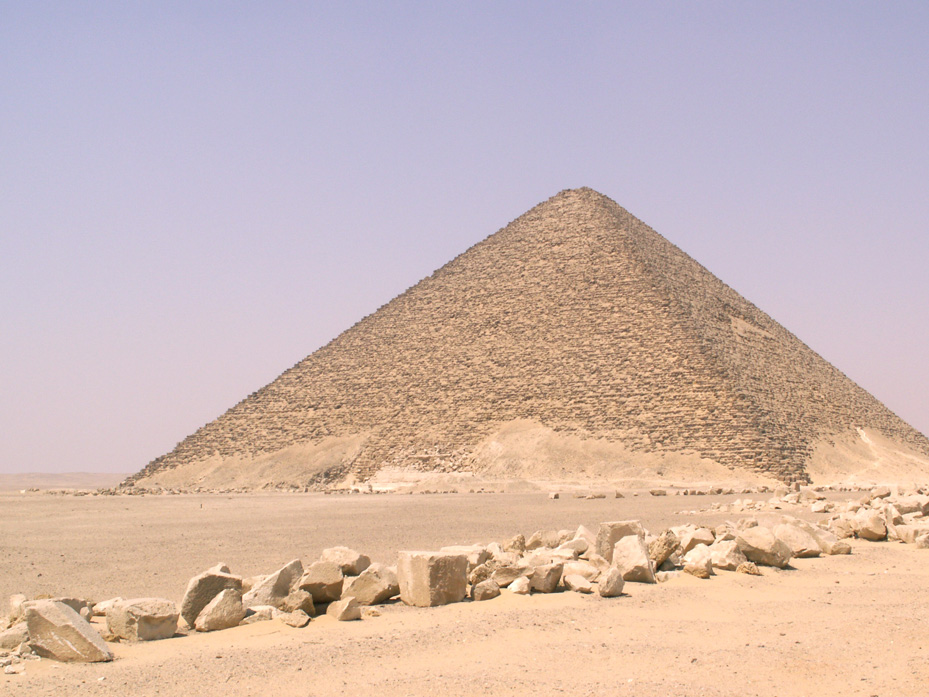
Pyramid building did not begin with perfection. The earliest known example, the Pyramid of Djoser at Saqqara, started as a rectangular mastaba, the flat-roofed tomb style common in Egypt's first dynasties. Expanded through several rounds of accretion, it became a stepped structure, six tiers rising to about 62 meters. Egyptologists believe the design served as a stairway for the pharaoh's soul to ascend to the heavens. Credit for the concept is often given to Djoser's vizier Imhotep, though the ancient Egyptians themselves never actually documented that attribution. The real leap came during the Fourth Dynasty, when builders attempted to transition from steps to true smooth-sided pyramids. Pharaoh Sneferu alone built three: the partially collapsed pyramid at Meidum, the Bent Pyramid at Dahshur whose angle of incline changes dramatically midway up, and finally the Red Pyramid, the world's first successfully completed smooth-sided pyramid. By the time Sneferu's son Khufu began building at Giza, the technology was mature.
The Giants of Giza
The Giza plateau holds three pyramids that have defined the popular imagination of ancient Egypt. The Great Pyramid of Khufu, originally standing about 146 meters tall, remained the tallest human-made structure on earth for nearly 3,800 years. Beside it stands the Pyramid of Khafre, which appears taller due to its elevated position on the plateau and steeper angle of construction, though it is actually smaller in both height and volume. The Pyramid of Menkaure, the smallest of the three, still reaches 65 meters. Of the trio, only Khafre's pyramid retains part of its original polished white limestone casing near the apex, a remnant that hints at how brilliantly these structures once shone. When Antipater of Sidon compiled his list of the Seven Wonders of the Ancient World during Hellenistic times, the Great Pyramid was already two thousand years old. It is still the only wonder standing.
Resurrection Machines
The pyramids were not simply tombs. Their very shape encoded Egyptian cosmology. The form was thought to represent the benben, the primordial mound from which the Egyptians believed creation emerged. It also evoked the descending rays of the sun, a connection reinforced by the highly reflective white limestone casing that made each pyramid blaze in the desert light. Their formal names made the solar connection explicit: the Bent Pyramid at Dahshur was called "The Southern Shining Pyramid," while Senusret II's pyramid at El Lahun was named "Senusret Shines." Inside the Great Pyramid, one of the narrow shafts extending from the burial chamber through the entire structure points toward the circumpolar stars, the region of sky around which all other stars appear to revolve. The Egyptians believed this dark patch of sky was the gateway to the heavens. The pyramid, in this reading, was a launch mechanism for the pharaoh's soul.
Limestone, Water, and Papyrus
How were they built? The question has inspired centuries of speculation, but archaeology keeps narrowing the answers. Most limestone blocks came from quarries near the construction sites, while finer white limestone traveled by barge from Tura and granite came from Aswan, hundreds of kilometers upriver. In 2013, a trove of papyri known as the Diary of Merer was discovered at an ancient harbor on the Red Sea coast. Written over 4,500 years ago by an inspector named Merer, the logbooks document the transport of Tura limestone along the Nile to the Great Pyramid. Sediment core analysis at Giza has revealed evidence of a Nile-connected harbor functioning on the plateau during Khufu's reign, confirming that waterways were the primary transport arteries. On land, wooden sleds dragged blocks across sand that workers wetted to reduce friction, a technique depicted in ancient tomb paintings and validated by modern physics experiments.
The Long Decline and Second Lives
By the end of the Sixth Dynasty, around 2181 BCE, the age of monumental pyramid construction in Egypt was effectively over. When large pyramids returned during the Middle Kingdom, builders substituted mudbrick for stone, and the results were less durable. But pyramid building did not die; it migrated south. After the Kingdom of Kush conquered much of Egypt and established the Twenty-fifth Dynasty around 750 BCE, Kushite rulers built pyramids of their own at El-Kurru and Nuri in present-day Sudan. During the later Meroitic period, between roughly 300 BCE and 300 CE, about 180 royal pyramid-tombs were constructed near the Kushite capital cities. Even destruction failed. In the twelfth century, the Ayyubid Sultan Al-Aziz Uthman attempted to demolish the Giza pyramids. He managed to scar the Pyramid of Menkaure before abandoning the project, defeated by the sheer scale of what the Old Kingdom builders had achieved.
From the Air
Located at 29.972N, 31.128E on the Giza plateau, southwest of central Cairo on the west bank of the Nile. The three main pyramids and the Great Sphinx are unmistakable from any altitude. Nearest airports: Cairo International (HECA) approximately 35 km northeast, and Sphinx International Airport (HESX) approximately 15 km northwest. Recommended viewing altitude: 3,000-5,000 ft AGL for the full pyramid field including Saqqara to the south. The contrast between the green Nile valley and the desert edge running through the site is striking from the air.