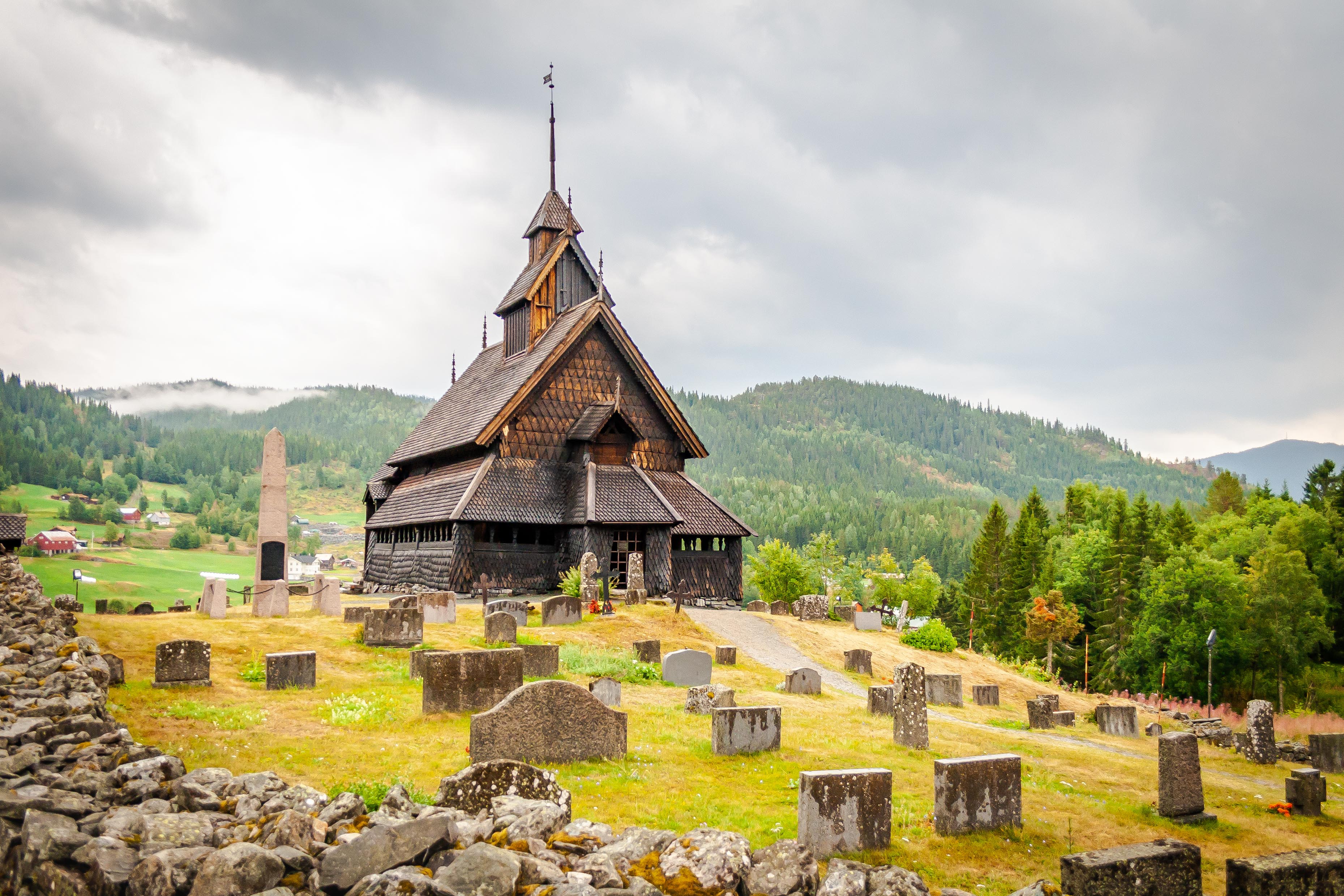
Eidsborg Stave Church
During a 1920s restoration of Eidsborg Stave Church, workers removing the floor discovered something unexpected: a fireplace, buried beneath the timber, in a location that made no practical sense for heating a Christian sanctuary. The prevailing theory is that it served burnt offerings for pagan cults -- evidence that this site in the Telemark mountains held religious significance long before anyone raised a cross here. Charred wood beneath the existing foundations confirms that an earlier building once stood on the spot. The stave church that replaced it, built between 1250 and 1280, has endured for nearly 800 years and remains one of the best-preserved examples of medieval Norwegian wooden architecture.
The Traveler's Saint
Eidsborg Stave Church is dedicated to St. Nicholas of Bari, the patron saint of travelers -- a fitting dedication for a church in the mountains of Telemark, where the roads between valleys were long and the weather unpredictable. A painted sculpture of St. Nicholas from the mid-12th century once stood inside the church, predating the current building itself. According to local legend, every midsummer night the sculpture was carried to a nearby pond and immersed in the water, a ritual that blends Christian devotion with older, deeper traditions. The original sculpture now resides in the Kulturhistorisk Museum in Oslo, but a copy stands in the church, greeting the travelers who still arrive -- though now they come as tourists rather than pilgrims.
A Builder's Rough Edges
Architectural historians have noted something distinctive about Eidsborg's construction: it appears to have been built by less experienced hands than many of Norway's other stave churches. The tell-tale signs are in the details. In most stave churches, the bottom sills are lapped over one another at the corners, creating a strong interlocking joint. At Eidsborg, they simply sit side by side, held in place by the corner posts -- a less stable arrangement. Ax marks from the counting and measuring process remain clearly visible on the sills, both inside and outside the church. In more polished examples of stave construction, these marks were always smoothed away to leave clean walls. At Eidsborg, they were left rough. These imperfections, far from diminishing the church, make it more human. Someone built this with the skills they had, and it has stood for eight centuries regardless.
Seven Centuries of Renovation
The history of Eidsborg is a history of change. The original church was tiny -- less than 40 square meters of floor space, which was probably typical of village stave churches in medieval Norway. The choir was barely 6 square meters. In the 1600s, the interior walls received their first murals. In the 1700s, a tower went up over the nave. By 1826, the old choir had been demolished and the church extended eastward. Another expansion followed in 1845, with a new timber-framed choir and interior paneling that covered the original medieval walls. Then the twentieth century reversed course: the 1920s restoration stripped away the paneling and false ceiling, revealing the 17th-century murals and Renaissance ornaments that had been hidden for decades. In the 2000s, structural repairs addressed cracked rafter girders that had been slowly buckling under the weight of the roof.
Gothic Arches and Medieval Bells
Three pieces of evidence pin Eidsborg's construction to the period between 1250 and 1280. The first is a double-arch profile preserved in the bottom sill below the church entrance -- a Gothic decorative element rare among Norwegian churches and dated stylistically to the mid-13th century. Similar double arches appear in the small windows of the roof tower. The second and third are two medieval church bells that still hang inside the tower. The older bell has been dated stylistically to 1250-1280; the younger is several decades later. Together with the architectural details, they place the church firmly in the second half of the 13th century. Today the church stands beside the Vest-Telemark Museum in the village of Eidsborg, still active as a parish church while serving as one of Telemark's most visited cultural landmarks.
From the Air
Located at 59.46N, 8.02E in the village of Eidsborg, Tokke Municipality, Telemark county. The church sits in a mountain valley in the upper Telemark region. Nearest airports include Notodden Airport (ENNO), approximately 80 km northeast, and Kristiansand Airport Kjevik (ENCN), approximately 130 km south. Recommended viewing altitude 3,000-6,000 feet. The church and adjacent Vest-Telemark Museum are identifiable as a cluster of historic buildings in the small village.