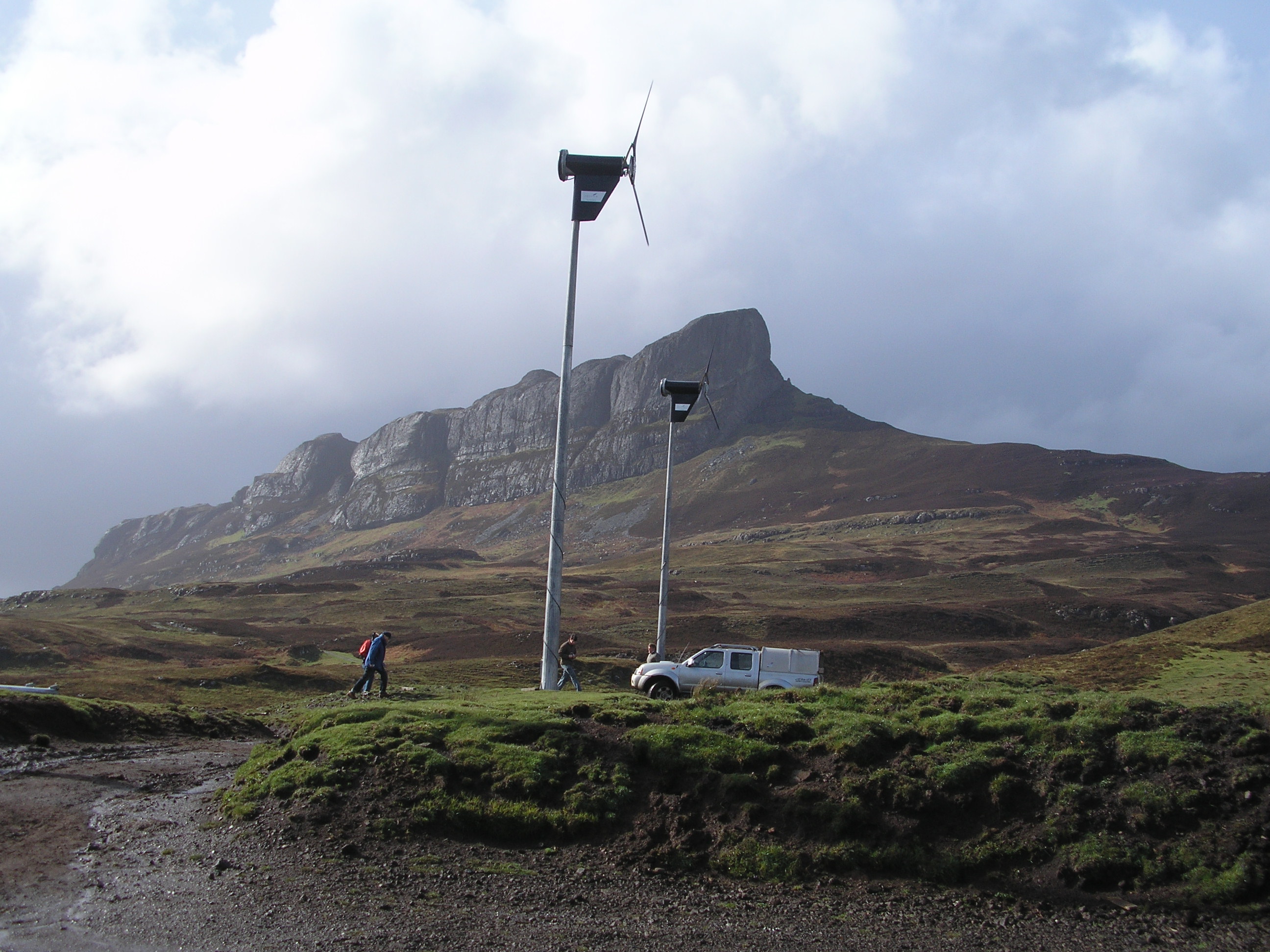
Eigg
The entire population of Eigg once fit inside a cave. That was the problem. In the late 16th century, during a savage feud between the MacDonalds and the MacLeods, the islanders hid in a sea cave called Uamh Fhraing -- the Cave of Frances -- hoping the raiding party from Skye would search the island, find it empty, and leave. The MacLeods did search. They found nothing. But as their galleys prepared to depart, a scout spotted a single islander moving on the hillside, and the tracks in fresh snow led straight to the cave's mouth. The MacLeods lit a fire at the entrance. Every person inside -- perhaps 395 men, women, and children -- suffocated. The cave still exists. So does the island, though its story since then has been one of clearance, neglect, eccentric lairds, and ultimately a community buyout that changed Scottish land law.
Fire and Faith
Eigg sits in the Small Isles archipelago of the Inner Hebrides, a volcanic ridge five miles long dominated by An Sgurr, a pitchstone cliff that rises 393 metres above sea level and is visible from the mainland on clear days. The island's human history stretches back to at least the 6th century, when the Irish monk Donnan established a monastery at Kildonnan. His mission ended badly: in 617 AD, Donnan and 52 of his monks were murdered, reportedly by a local chieftain or perhaps by Norse raiders. The ruins at Kildonnan remain, overlooking the spot where Christianity on Eigg began and was nearly extinguished in the same generation. The Cave of Frances massacre, centuries later, was not the island's only encounter with sectarian violence -- a larger coastal cave, accessible only at low tide, became known as Cathedral Cave because Catholic islanders held secret masses there after the Reformation, when practising their faith was illegal.
Between the Clans and the Crown
Eigg belonged to Clan Ranald, a branch of the MacDonalds, for centuries. The feud with the MacLeods that produced the cave massacre was part of a cycle of retaliatory violence across the Hebrides. According to tradition, the MacLeods had earlier been wronged by MacDonalds on Eigg, and the suffocation in the cave was their answer. The MacDonalds responded with the burning of Trumpan Church on Skye, where MacLeod worshippers were locked inside and the building set alight. During the Jacobite rising of 1689, Eigg suffered again: a boat from the island encountered the Royal Navy ship Dartmouth anchored at Armadale on Skye. A brawl broke out, a soldier was killed, and the Dartmouth's captain sailed to Eigg and pillaged the island. The soldiers took a young island woman aboard and returned her the next day with her hair shorn -- a public humiliation that the islanders could not answer.
Cleared and Sold
The Clearances came to Eigg as they came to so many Hebridean islands. In the 19th century, the population was forced off the land to make way for sheep. The island passed through a series of owners, some absentee, some eccentric. By the 1990s, Eigg had been bought and sold by a succession of landlords who made promises about development and broke them. The last private owner, a German artist known as Maruma, proved particularly controversial. Islanders described years of neglect and broken commitments. In 1997, something extraordinary happened: the Isle of Eigg Heritage Trust, a partnership between the islanders, Highland Council, and the Scottish Wildlife Trust, raised 1.5 million pounds -- much of it from public donations -- and bought the island outright. It was one of the first community buyouts in Scottish history and became a model for the Land Reform Act that followed.
Dinosaurs and Dynamos
Community ownership transformed Eigg. The island built its own electricity grid powered by wind, solar, and hydroelectric generation, becoming one of the first places in the world to run entirely on renewable energy. Each household is limited to five kilowatts at any one time -- enough for modern life, but a discipline that keeps consumption in check. The population, which had dwindled to around 65, has grown past 100. Then in 2020, researchers published the discovery of a fossilised limb bone found in the island's coastal rock during 2017 fieldwork. Scientists identified it as belonging to a Middle Jurassic stegosaurian dinosaur -- the first confirmed dinosaur fossil found in Scotland outside the Isle of Skye. An Sgurr, the great pitchstone ridge that dominates Eigg's skyline, is itself a geological monument: formed 58 million years ago from a massive volcanic eruption, its cliff face is the largest exposure of columnar pitchstone anywhere in the British Isles. From massacred monks to community power grids, from clan warfare to dinosaur bones, Eigg compresses an improbable amount of history into five miles of Hebridean rock.
From the Air
Eigg lies at approximately 56.9N, 6.167W in the Small Isles archipelago of the Inner Hebrides. An Sgurr (393 m) is the dominant visual feature, a dramatic pitchstone ridge visible from considerable distance. The island is roughly 5 miles long, oriented NE-SW. Nearest airfield is no designated airfield on the island; the nearest is Oban Airport (EGEO) approximately 50 nm south. The neighbouring islands of Rum, Muck, and Canna are all visible from altitude. The ferry port of Mallaig on the mainland lies approximately 12 nm to the east.