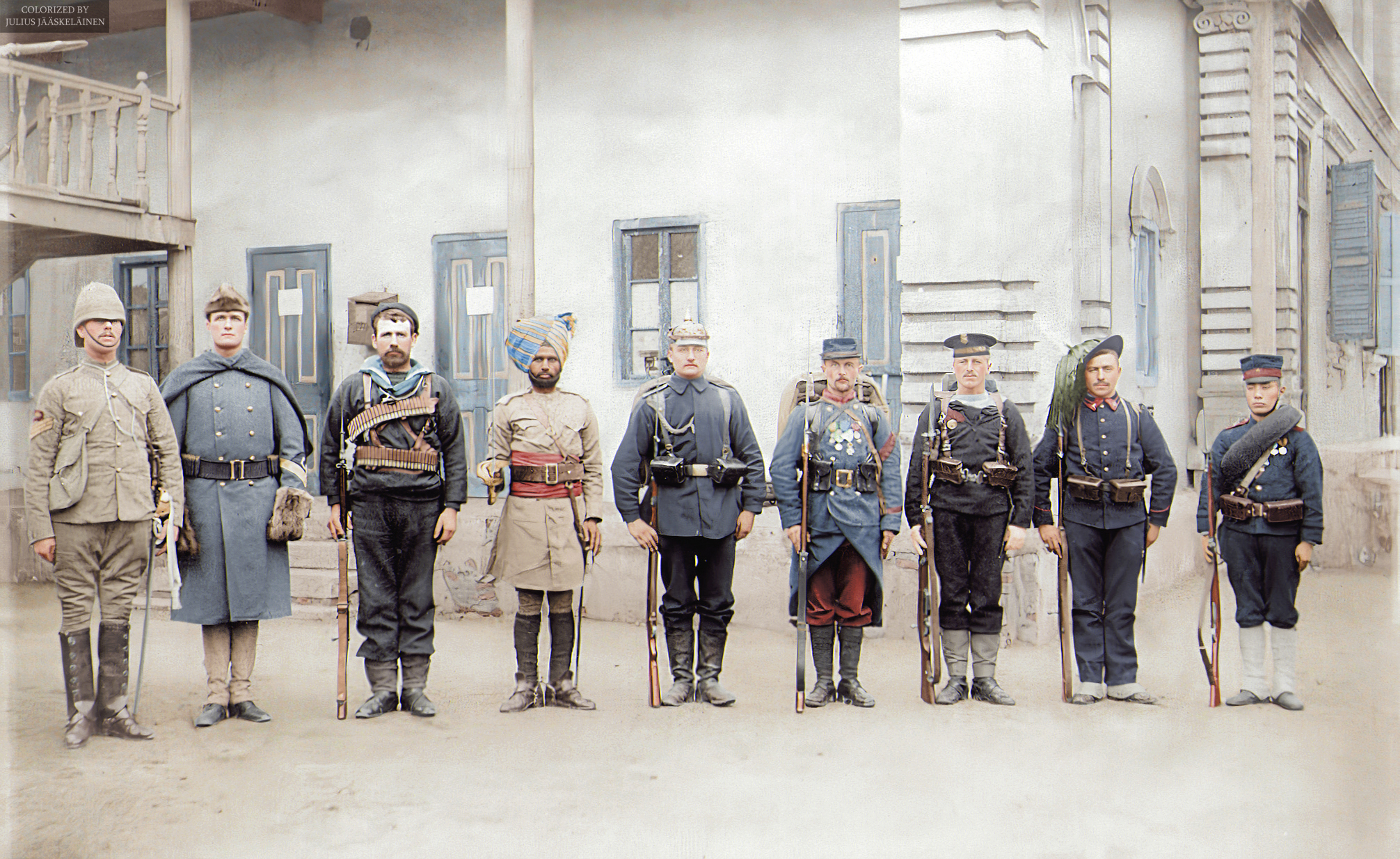
Troops of the Eight-Nation Alliance, 1900, by by Captain C.F. O’Keefe; Colorized by Julius Jääskeläinen. Note: The Boxer Rebellion (拳亂), Boxer Uprising, or Yihetuan Movement (義和團運動) was an anti-imperialist, anti-foreign, and anti-Christian uprising in China between 1899 and 1901, toward the end of the Qing dynasty. It was initiated by the Militia United in Righteousness (Yìhéquán), known in English as the Boxers because many of their members had practiced Chinese martial arts, also referred to in the west as Chinese Boxing. Villagers in North China had been building resentment against Christian missionaries who ignored tax obligations and abused their extraterritorial rights to protect their congregants against lawsuits. The immediate background of the uprising included severe drought and disruption by the growth of foreign spheres of influence after the Sino-Japanese War of 1895. After several months of growing violence and murder in Shandong and the North China Plain against foreign and Christian presence in June 1900, Boxer fighters, convinced they were invulnerable to foreign weapons, converged on Beijing with the slogan Support the Qing government and exterminate the foreigners. Foreigners and Chinese Christians sought refuge in the Legation Quarter. In response to reports of an invasion by Eight Nation Alliance of American, Austro-Hungarian, British, French, German, Italian, Japanese, and Russian troops to lift the siege, the initially hesitant Empress Dowager Cixi supported the Boxers and on June 21 issued an Imperial Decree declaring war on the foreign powers. Diplomats, foreign civilians, and soldiers as well as Chinese Christians in the Legation Quarter were besieged for 55 days by the Imperial Army of China and the Boxers. Chinese officialdom was split between those supporting the Boxers and those favoring conciliation, led by Prince Qing. The supreme commander of the Chinese forces, the Manchu General Ronglu (Junglu), later claimed he acted to protect the foreigners. Officials in the Mutual Protection of Southeast China ignored the imperial order to fight against foreigners. The Eight-Nation Alliance, after being initially turned back, brought 20,000 armed troops to China, defeated the Imperial Army, and arrived at Peking on August 14, relieving the siege of the Legations. Uncontrolled plunder of the capital and the surrounding countryside ensued, along with summary execution of those suspected of being Boxers. The Boxer Protocol of 7 September 1901 provided for the execution of government officials who had supported the Boxers, provisions for foreign troops to be stationed in Beijing, and 450 million taels of silver—approximately $10 billion at 2018 silver prices and more than the government's annual tax revenue—to be paid as indemnity over the course of the next 39 years to the eight nations involved.

Eight-Nation Alliance

historymilitaryconflictcolonialism
4 min read

They called it the International Gun. Its barrel was British, its carriage Italian, its shells Russian, and its crew American. Cobbled together from scraps during the 55-day siege of Beijing's Legation Quarter in the summer of 1900, it embodied the improvised alliance of eight nations -- Germany, Japan, Russia, Britain, France, the United States, Italy, and Austria-Hungary -- that had no treaty binding them together and no shared agenda beyond survival. The Eight-Nation Alliance assembled some 45,000 troops to suppress the Boxer Rebellion, relieve the besieged foreigners in Beijing, and punish the Qing dynasty. What began as a rescue mission became a punitive colonial expedition that pillaged one of the world's great capitals for over a year.

Siege and Survival

The crisis began when the Boxers, a populist peasant movement determined to expel foreign influence from China, attacked missionaries, foreign nationals, and Chinese Christians across the north in 1899 and 1900. The Qing government, under the Manchu general Ronglu, threw its support behind the Boxers and besieged the Legation Quarter in Beijing. For 55 days, from June 20 to August 14, 1900, some 473 foreign civilians, 409 soldiers from eight countries, and approximately 3,000 Chinese Christians held out inside the compound. Simultaneously, the North Cathedral -- the Beitang -- endured its own siege, defended by 43 French and Italian soldiers, 33 Catholic priests and nuns, and about 3,200 Chinese Catholics who suffered from starvation and underground mines detonated beneath them.

The March to Beijing

On August 14, 1900, the allied forces marched from Tianjin to relieve the siege. Japan provided the largest contingent, with over 20,000 troops, followed by Russia with 12,400. The Japanese troops fought aggressively -- at Tianjin, they suffered more than half the allied casualties while making up less than a quarter of the force. Britain contributed 10,000 soldiers, many drawn from Indian regiments of Baluchis, Sikhs, Gurkhas, and Punjabis. Germany dispatched an expeditionary corps of about 15,000 under General Alfred von Waldersee, though most arrived too late for the major engagements. The United States drew on forces already deployed in the Philippines after the Spanish-American War. Even future president Herbert Hoover was present during the siege, helping build barricades while his wife Lou nursed the wounded and carried a Mauser pistol.

The Sack of a Capital

What followed the liberation was devastating. Allied troops looted the Forbidden City, the Summer Palace, government buildings, and temples with systematic thoroughness. More than 3,000 gold-plated bronze Buddhas were taken from Songzhu Temple alone. Soldiers scraped gold plating from the copper tanks outside the Forbidden City's palaces -- scratch marks still visible today. The Yongle Dadian, an encyclopedic masterwork compiled by approximately 2,169 scholars during the Ming dynasty between 1403 and 1408 and comprising 22,937 chapters, had already been partially damaged in the Second Opium War. In 1900, the alliance destroyed what remained. Parts of the encyclopedia were reportedly used to build fortifications. Troops executed unknown numbers of suspected Boxers in the countryside. A U.S. Marine later wrote that he witnessed German and Russian soldiers committing atrocities against civilians.

The Protocol and Its Shadow

Empress Dowager Cixi and the imperial court fled to Xi'an, sending Li Hongzhang to negotiate. The fighting ended in 1901 with the Boxer Protocol, which imposed crushing indemnities, granted foreign powers the right to station troops on Chinese soil, and deepened the humiliation that would fuel revolutionary sentiment for decades. Russia used the crisis to seize effective control of Manchuria. Italy obtained a concession area in Tianjin. The alliance's members returned to being rivals, as they had been before the Boxers forced them into temporary cooperation. China remembered the invasion as a defining wound -- a moment when eight of the world's most powerful nations descended on a weakened empire and stripped it of treasures, sovereignty, and dignity.

From the Air

Located at 38.51°N, 115.55°E, centered on northern Hebei near the historic Zhili Province. The allied march route from Tianjin to Beijing is visible as the corridor between these two cities, approximately 120 km apart. Beijing Capital International Airport (ZBAA) lies to the northeast. Tianjin Binhai International Airport (ZBTJ) to the southeast. The flat North China Plain dominates the landscape. Best viewed at 5,000-10,000 feet to appreciate the geography of the campaign.