Eihei-ji
The wake-up bell rings at 3:30 in the morning. In the darkness of a mountain valley fifteen kilometers east of Fukui city, more than two hundred monks roll from their tatami mats and begin the rituals that have barely changed since 1244. This is Eihei-ji, the Temple of Eternal Peace, one of the two head temples of Soto Zen Buddhism, Japan's largest single Buddhist denomination. Its name carries a quiet promise in every syllable: ei means eternal, hei means peaceful, ji means temple. But the peace here is not passive. It is earned, day after day, through zazen meditation, sutra chanting, and a discipline so total that each monk sleeps, eats, and meditates on a single tatami mat measuring one meter by two.
A Forest Cathedral
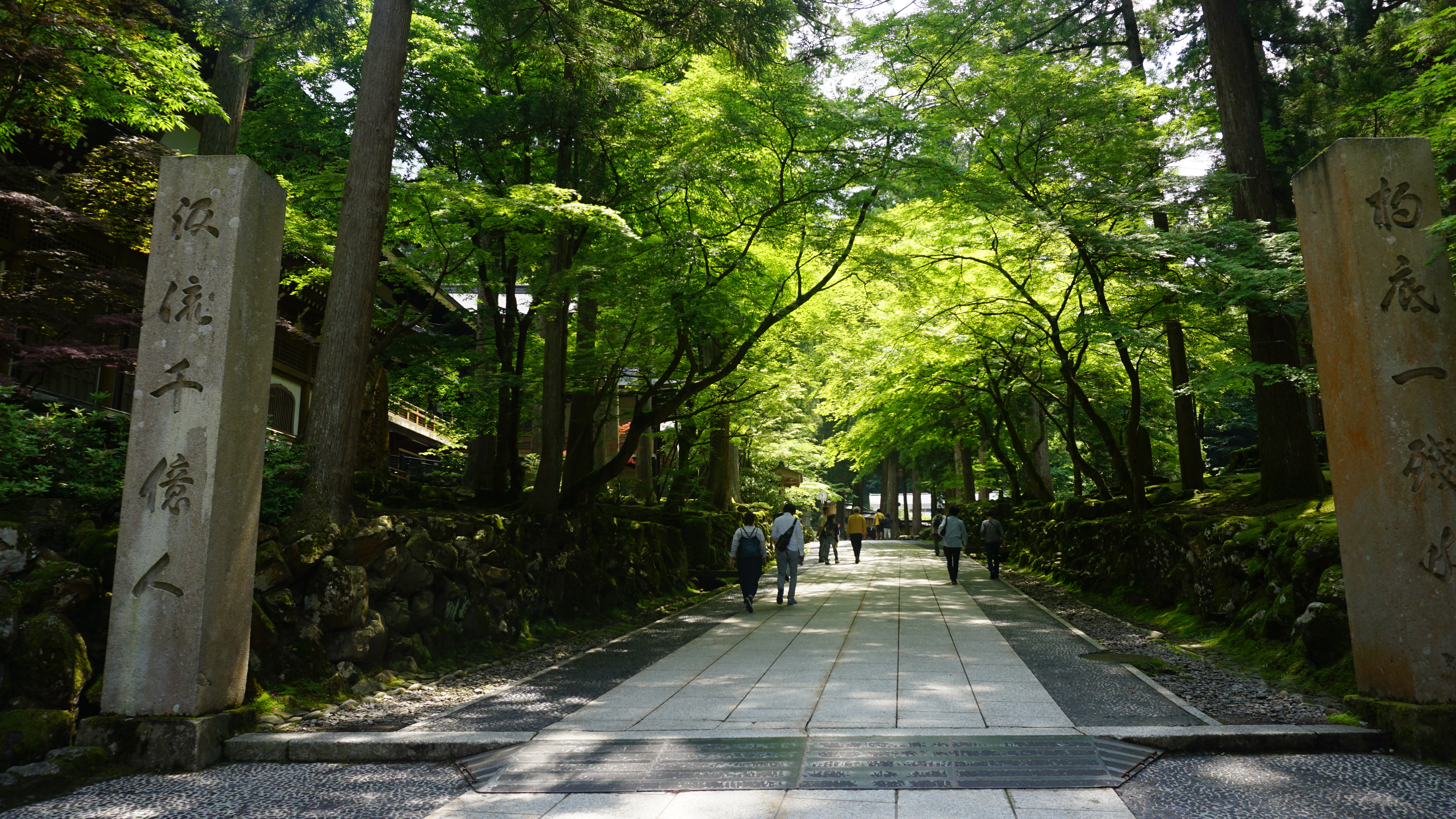
The temple complex sprawls across 330,000 square meters of mountainside, wrapped in a forest of Japanese cedars so old that some are said to have been saplings when Dogen himself walked these paths nearly eight centuries ago. Over seventy buildings nestle into the slope, connected by covered walkways that serve a practical purpose: Fukui Prefecture receives heavy snowfall from December through March, and these corridors keep the monks moving between meditation halls, kitchens, and dormitories without breaking stride. The air smells of damp wood and incense. Streams murmur beneath moss-covered stone. At the Sanmon gate, statues of the Four Heavenly Kings stand guard. Inside the Buddha Hall, three statues represent Buddhas of past, present, and future. The Hatto, or Dharma Hall, holds a figure of Kannon, the bodhisattva of compassion, flanked by four white guardian lions. Every hall, every statue, every worn stone step carries the weight of continuous use.
Dogen's Deliberate Exile
In the 13th century, a young monk named Dogen Zenji traveled to China and returned with the teachings of Soto Zen, a school of Buddhism emphasizing shikantaza, or 'just sitting,' as the path to awakening. He could have established his temple near the political centers of Kamakura-period Japan. Instead, in 1244, he accepted an offer of land from Yoshishige Hatano, a devoted lay follower, and built his monastery deep in the rural mountains of Echizen Province, deliberately far from urban distraction. He named it Sanshoho Daibutsuji before later renaming it Eihei-ji. Dogen spent the remainder of his life here, leaving only once at the request of the Shogun's regent. After his death in 1253, his ashes were entombed in the Joyoden, the Founder's Hall, where they remain today. The choice of isolation was not retreat but strategy: Dogen believed true practice required removing every excuse not to sit.
Centuries of Rivalry
Dogen's death triggered a bitter succession dispute known as the sandai soron. For over two centuries, Eihei-ji was held not by the lineage that dominates Soto Zen today but by the followers of Jakuen, Dogen's Chinese disciple. It was not until 1468 that the Keizan line, which already controlled the rival head temple Soji-ji on the Noto Peninsula, took ownership of Eihei-ji as well. The two temples then spent centuries jockeying for primacy. Eihei-ji pressed its claim as the place where Dogen himself had lived and taught. Soji-ji countered with its own institutional strength. As scholar William Bodiford of UCLA observed, Eihei-ji 'aggrandized Dogen to bolster its own authority vis-a-vis its institutional rivals within the Soto denomination.' The tension between these two great monasteries shaped the evolution of Soto Zen across Japan, ultimately producing a denomination that today oversees roughly 14,000 temples.
The Monastic Day
Training at Eihei-ji is not a retreat or a course. It is a years-long immersion in discipline. Monks rise before dawn, winter and summer, to begin zazen meditation. The day proceeds through sutra chanting, work duties, meals eaten in formal silence, and more meditation. Each trainee occupies a single tatami on a raised platform called a tan in a communal hall. That mat is their bed, their dining table, and their meditation cushion. The food is simple vegetarian fare, prepared and consumed as a form of practice itself. Visitors can experience a version of this life through overnight stays, rising early to join morning services and attempting the posture of seated meditation in halls where the cold seeps through wooden floors. It is, by all accounts, an experience that strips away the comfortable padding of modern life and replaces it with something harder to name.
An Unbroken Thread
Eihei-ji has endured fires, political upheaval, sectarian schism, and the wholesale transformation of Japanese society. Through the Meiji restoration, two world wars, and the rise of modern Japan, monks have continued to wake before dawn in this mountain valley. The temple has also engaged with contemporary issues: after the 2011 Tohoku earthquake and tsunami, monks at Eihei-ji spoke out against nuclear power, urging Japan to reconsider its energy policies. The monastery remains a training ground for priests who will go on to lead Soto Zen temples across the country. It is also a place of pilgrimage for anyone drawn to the idea that peace is not a destination but a practice, repeated each morning in the dark, on a single tatami mat, in a forest older than memory.
From the Air
Eihei-ji sits at 36.053N, 136.356E in a narrow mountain valley approximately 15 km east of Fukui city center. From the air, look for the dense cedar forest on the mountain slopes southeast of the Kuzuryu River valley. The temple complex is not easily visible from high altitude due to heavy tree cover, but the valley and surrounding terrain are distinctive. Nearest airports: Fukui Airport (RJNF) approximately 20 km northwest, and Komatsu Airport (RJNK) approximately 50 km to the northeast. The area receives significant snowfall December through March.