Eindhoven University of Technology
There is a running joke in Eindhoven: the university trains the engineers, and Philips trains the professors. It used to be a fair description. When the Dutch government founded the Technische Hogeschool Eindhoven on 23 June 1956, the immediate problem it was solving was Philips's hiring problem - the electronics giant headquartered in the city needed more local graduates in electronics, physics, and chemistry than the country was producing. Senior Philips engineers were brought in to staff the faculty. Seventy years later, Philips has largely left town, the university is called TU/e, and its 14,000 students learn from a faculty that has produced a Turing Award winner, a Nobel laureate in chemistry, the inventor of the Philishave, and the inventor of Dyneema fibre. The arrangement still feeds the regional economy. The economy is just no longer one company.
Founded for Philips
TU/e was the second university of its kind in the Netherlands, after Delft. Its early curriculum followed the German model: four- or five-year programmes that earned graduates the title ir. (ingenieur), distinct from the lower-tier ing. degree awarded by technical hogescholen. That changed in 2002 with the Bologna Accords, when Dutch higher education shifted to a three-year bachelor plus two-year master structure. Today nine departments cover the technical map: Biomedical Engineering, Built Environment, Electrical Engineering, Industrial Design, Chemical Engineering and Chemistry, Industrial Engineering and Innovation Sciences, Applied Physics, Mechanical Engineering, and Mathematics and Computer Science. Every department teaches entirely in English except Biomedical Engineering, which runs a Dutch-English hybrid - so all bachelor applicants must show competence in both languages.
Dijkstra, Dyneema, and a Nobel Laureate
The faculty roster across TU/e's history reads like a who's-who of postwar Dutch science and engineering. Edsger W. Dijkstra, the mathematician and computer scientist whose name shows up in graph theory and operating systems and software engineering courses everywhere, won the Turing Award in 1972 while at Eindhoven. Archer Martin, the Royal Society fellow who won the 1952 Nobel Prize in chemistry for partition chromatography, was a professor here from 1964 to 1974. Alexandre Horowitz, a mechanical engineer on the staff, invented the Philishave - the rotary electric shaver that became one of Philips's signature consumer products. Piet Lemstra invented Dyneema, the ultra-strong polyethylene fibre now used in ropes, ballistic armour, and surgical sutures. The university has won multiple Spinozapremies - the Dutch equivalent of a national science prize - across chemistry, polymer research, and beyond.
When Philips Left
The 1980s and 1990s were difficult. As Philips restructured and gradually moved its headquarters and major operations out of Eindhoven, the implicit deal that had founded the university - graduates flow to Philips, executives flow to the faculty - broke. The city and the university responded with the Brainport initiative, deliberately courting high-tech industry to fill the gap. It worked unusually well. TU/e is now embedded in a regional ecosystem that includes ASML, the lithography company that makes the machines used to manufacture nearly every advanced computer chip in the world; NXP Semiconductors, FEI Company, and the broader High Tech Campus Eindhoven. The university anchors the Eindhoven-Leuven-Aachen triangle, a cross-border zone of three technical universities and three cities that ranks among the EU's heaviest investors in knowledge economy work.
Race Cars, Robots, and a Sagrada Familia of Ice
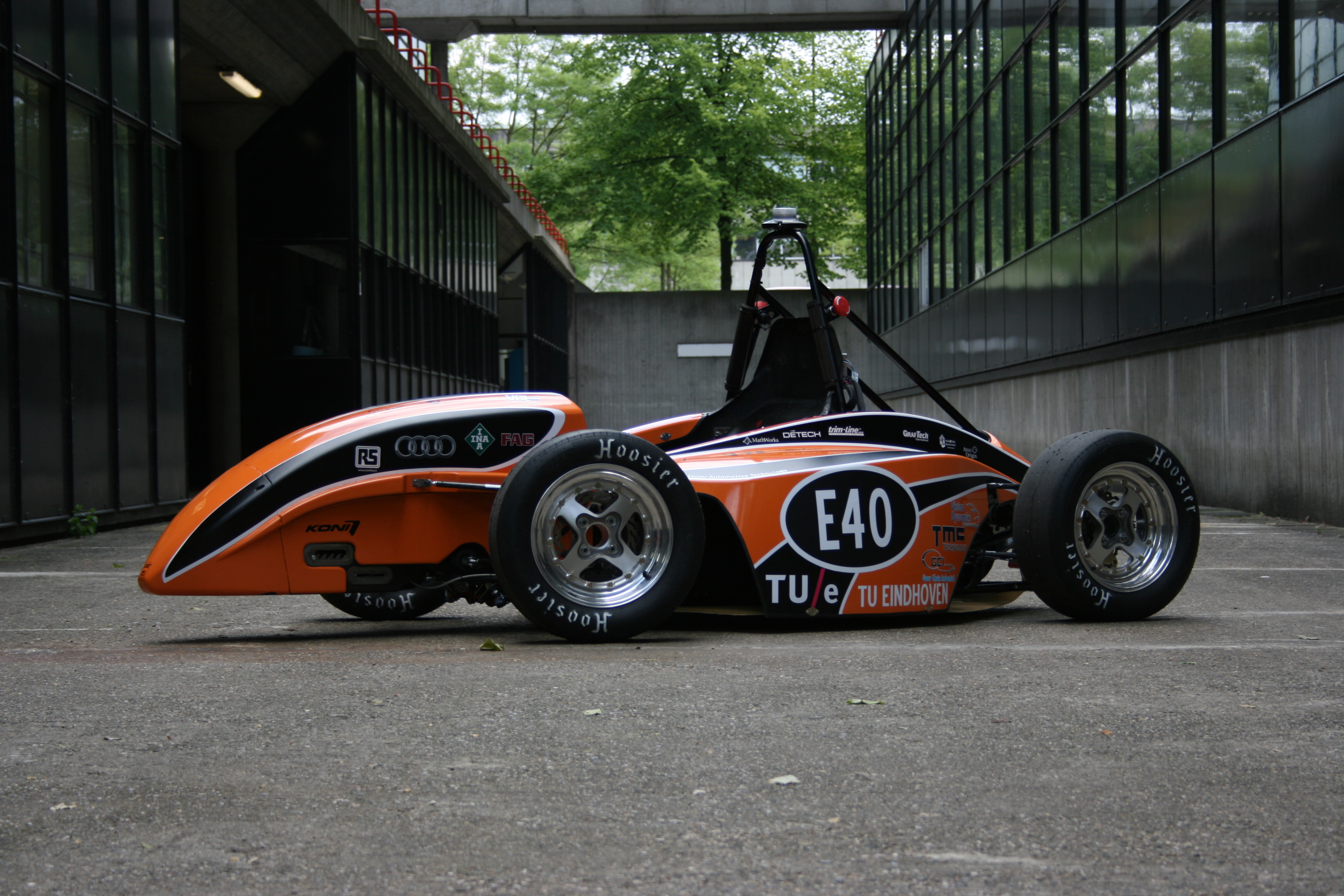
TU/e's student teams have a habit of taking projects beyond classroom scale. The auto-racing team, University Racing Eindhoven, switched from a petrol engine to a fully electric car in 2010 and won the Formula Student in its first year - then finished third at Silverstone and second at Hockenheim. Solar Team Eindhoven has been entering its Stella series of solar-powered family cars into the World Solar Challenge since 2013, winning the Cruiser class in 2013 and 2015. The robot football team competes in the Mid-Size league of RoboCup and has finished as a repeat world finalist, taking the title in 2012. In 2015 Master students from the Built Environment faculty travelled to Juuka, Finland, and built a full replica of Antoni Gaudi's still-unfinished Sagrada Familia basilica out of ice composite - not a small one, either. The university also runs PDEng programmes - two-year postgraduate doctorates of engineering established in 1986 with TU Delft and Twente.
A Public University Run Like One
TU/e is governed under the Dutch Law on Higher Education and Scientific Research. An Executive Board - president, rector magnificus, and vice president - runs the day-to-day. A Supervisory Board of five external members, appointed by the Minister of Education, watches the Executive Board. A University Council of eighteen, half elected from staff and half from students, must agree to any change in management structure and guards against discrimination. The rector magnificus is the only board member whose role is legally required, and in practice is always a former dean. The current rector is Silvia Lenaerts. The 1997-vintage TU/e Holding B.V. handles the university's commercial spin-offs - companies like SMART Photonics, EFFECT Photonics, MicroAlign, and NC Biomatrix. Public university, public mission, but the spin-out path to industry is engineered into the institution itself.
From the Air
Coordinates 51.4481 N, 5.4897 E, on the north side of central Eindhoven. Best viewing altitude 1500-2500 ft AGL. The TU/e campus is a clear cluster of modern academic buildings, including the distinctive Auditorium and the Vertigo and Atlas blocks; the campus borders the Dommel river on the east and the city centre to the south. Nearest airports: Eindhoven Airport (EHEH) 7 km west, on a typical approach path - mind the controlled airspace. The High Tech Campus Eindhoven and ASML's Veldhoven site are visible to the southwest.