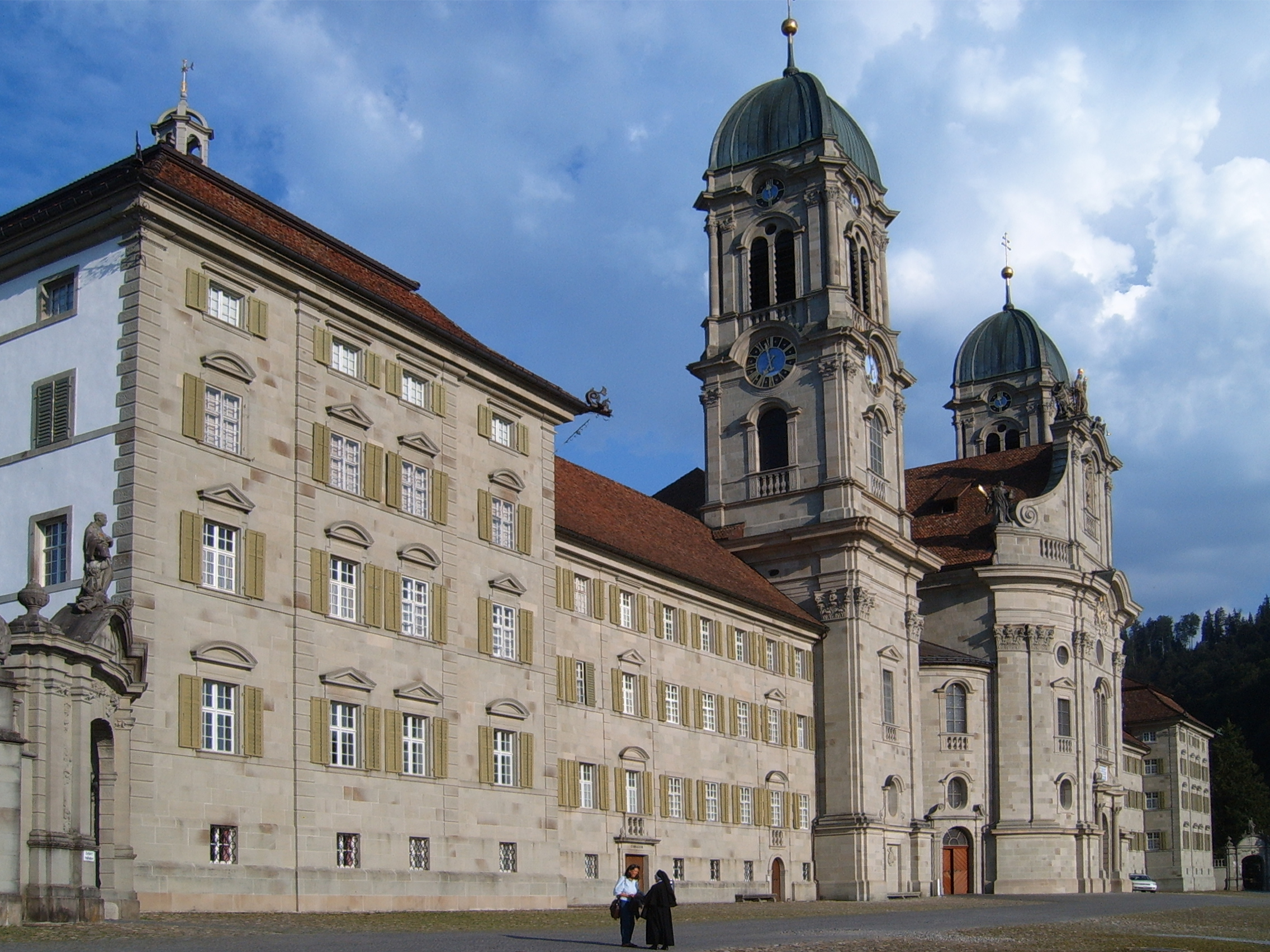
Einsiedeln Abbey
Eight hundred thousand people visit each year, and most of them come for the same reason pilgrims have come since the Middle Ages: a small dark statue in a small dark chapel, inside one of the grandest Baroque churches in Switzerland. The Black Madonna of Einsiedeln sits in the Chapel of Grace, dressed in elaborate vestments that are changed regularly, her carved face darkened by centuries of candle smoke and devotion. She is not the oldest reason to come here -- that would be the legend that Christ himself consecrated this chapel in 948 -- but she is the reason people keep coming back.
The Hermit and the Robbers
The story begins with a murder. Meinrad of Einsiedeln, born in 797 in Sulchen, was educated at the abbey school on Reichenau Island before becoming a Benedictine monk and priest. After gaining unwanted public attention for reportedly performing miracles, he retreated in 828 to the dense forests of what is now the canton of Schwyz, seeking solitude. He found it for 33 years. In January 861, two robbers killed him at his hermitage. Over the next eight decades, other hermits occupied the site, drawn by Meinrad's reputation for holiness. In 934, Eberhard, formerly Provost of Strassburg, formalized what the hermits had sustained informally: he built a monastery and church on the hermitage site and became its first abbot. Einsiedeln Abbey had begun.
Consecrated by Christ, Claimed by Pilgrims
According to legend, when the new church was to be consecrated in 948, Christ himself performed the rite, honoring his mother Mary. The story of this miraculous consecration launched one of the great medieval pilgrimages. Originally, visitors came for the chapel that Christ had blessed -- the Marian devotion developed gradually, intensifying during the High Middle Ages as veneration of the Virgin Mary surged across Europe. By the Baroque period, Einsiedeln was firmly a Marian pilgrimage site. The abbey church was rebuilt between 1704 and 1719 under Abbot Maurus, and the Baroque ornamentation was completed in 1734, creating the extravagant interior visitors see today. Medieval pilgrims heading to Rome or Santiago de Compostela often stopped here en route. Modern pilgrims come from across Switzerland, Germany, Austria, and increasingly from Eastern Europe.
Invasion, Exile, and the Monks of Indiana
The abbey's independence was shattered in 1798 when French revolutionary soldiers occupied the monastery, stripping Einsiedeln of its status as an independent principality. The monks were expelled but returned in 1801, and the abbey was formally reinstated by the Act of Mediation in 1803. The Chapel of Grace, damaged during the occupation, was rebuilt between 1815 and 1817 in neoclassical style. But the trauma of dissolution left a lasting mark. In the 1840s, fearing that political turmoil might once again destroy them, the abbey's leaders sent a group of monks to southern Indiana in the United States to establish a refuge. That foundation survives today as Saint Meinrad Archabbey, and it spawned four additional American monasteries in Arkansas, Louisiana, Illinois, and California -- five New World communities tracing their lineage to a Swiss forest hermitage.
A Living Monastery
Einsiedeln is not a museum. Forty Benedictine monks live and work here, a number that has held steady thanks to a continuous stream of new vocations -- unusual for European monasteries. The community operates a private high school with over 400 students, a winery, a sawmill, a restaurant, and various small businesses. The library holds approximately 230,000 printed books, 1,230 manuscripts, and more than 1,000 volumes of incunabula. It was founded in 934, the same year as the abbey itself, and the monastery maintained its own writing school by the mid-10th century. A scriptorium opened in 2022 invites visitors to try writing with ink and quill. The abbey is also a territorial abbey, meaning it answers to no diocese or bishop -- the abbot governs with the same authority as a diocesan bishop. Pope John Paul II visited in 1984 and consecrated the new high altar, a mark of the institution's enduring significance within the Catholic world.
From the Air
Located at 47.13N, 8.75E in the canton of Schwyz, Switzerland, in the foothills of the Alps southeast of Zurich. The large Baroque abbey complex is visible from the air as a prominent cluster of buildings with twin towers on the main facade, set against the forested hills of central Switzerland. Nearest major airport is Zurich (LSZH), approximately 40 km to the northwest. The town of Einsiedeln sits in a broad valley at roughly 880 meters elevation. The Sihlsee reservoir to the south provides an additional visual reference. Best viewed at 3,000-5,000 feet.