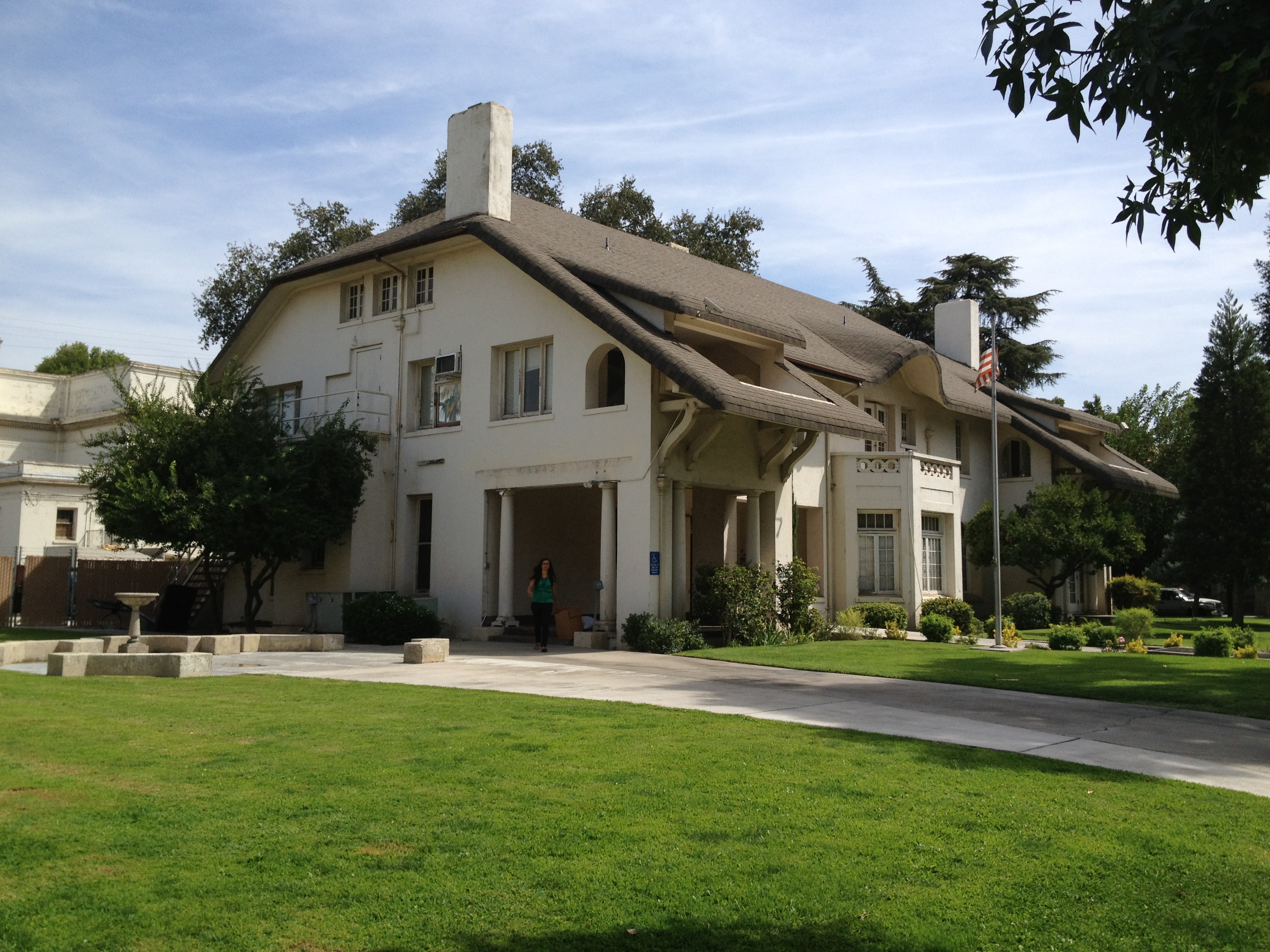
The Einstein House
Most houses have basements for storage. The Einstein House has one for survival. When architect Edward T. Foulkes designed this English Arts and Crafts residence in 1912, he gave it an underground summer living room and game room -- a genteel admission that Fresno's triple-digit heat made the ground floor uninhabitable for months each year. The house was built for Louis Einstein, a prominent Fresno merchant and banker, and from the street it presents the picture of Edwardian respectability: plaster over brick, a sweeping bay window anchoring the facade, Doric columns framing a side veranda. But the building's real story lies not in its architecture. It lies in what happened after the Einsteins were gone.
A Merchant's Showpiece
Louis Einstein commissioned Foulkes to design a home befitting his stature in early twentieth-century Fresno. Foulkes, a San Francisco architect whose portfolio included banks and civic buildings, delivered a house that borrowed freely from the English Arts and Crafts movement while adapting to the realities of the San Joaquin Valley. The exterior wraps plaster over brick in a cottage-like composition, though the scale is anything but modest. An elaborate bay window dominates the front elevation, supporting a second-floor balcony with an upward sweep of roofline that draws the eye skyward. To the left, a veranda with Doric columns opens onto a second-floor porch. Inside, a brick fireplace continues the classical vocabulary, its entablature carried on more Doric columns. Einstein enjoyed the house for only two years. He died in 1914, and his widow Eda remained until her own death, the sole occupant of a home designed to impress a city that was still deciding what it wanted to become.
From Parlor to Purpose
In 1950, the YWCA of Fresno purchased the Einstein House as an activity center to complement the adjacent YWCA Building. The transition from private residence to community space was a common fate for grand homes in mid-century American cities, but what happened next was less predictable. By 1979, the YWCA had opened the Marjaree Mason Center in both buildings, refocusing its mission on serving victims of domestic violence. The elegant rooms that once hosted Fresno's banking elite became counseling offices, crisis intake areas, and safe spaces for women and children fleeing abuse. In 1998, the organization disaffiliated from the national YWCA to operate independently, deepening its commitment to the specialized work that had come to define it.
A Name Earned, Not Inherited
The house has carried three names across its lifetime. It was built as the Einstein House, became the YWCA Activity Unit, and was eventually renamed the Joyce Gibson-Bennett Building in honor of a Fresno trial attorney whose legal advocacy and personal support had sustained the Marjaree Mason Center through decades of growth. The renaming marked a deliberate shift: the building's identity would no longer derive from the wealth that built it but from the work that filled it. For nearly half a century, the center operated from this Arts and Crafts home, its domestic architecture lending an unlikely warmth to the serious business of crisis intervention. The intimate rooms, the fireplaces, the garden -- all remnants of a banker's comfort -- became part of a vocabulary of safety for thousands of Fresno families.
Moving On, Staying Put
In 2025, the Marjaree Mason Center relocated to the Isnardi Foundation Building, a modern facility designed from the ground up for the organization's needs. The move was a triumph -- more space, better infrastructure, purpose-built counseling and shelter areas. But it left the Einstein House standing on its corner, quiet again for the first time in seventy-five years. The building remains on the National Register of Historic Places, its nomination filed in 1977 when its significance was still primarily architectural. What the nomination could not have anticipated was how thoroughly the house's meaning would be transformed -- not by renovation or restoration, but by the people who passed through its doors seeking help. The plaster walls and Doric columns endure. Whether the building finds another purpose as purposeful as the last remains to be seen.
From the Air
The Einstein House sits at 36.7425N, 119.7928W in central Fresno, a few blocks south of the downtown core. From the air, look for the residential blocks south of Fresno's central grid near the intersection of major north-south streets. The nearest airport is Fresno Yosemite International (KFAT), approximately 5 nautical miles northeast. Fresno Chandler Executive Airport (KFCH) lies about 3 nautical miles south. The San Joaquin Valley floor provides excellent visibility in most conditions, though summer haze can reduce range.
Sources
- Einstein House (Fresno, California)
- National Register of Historic Places Inventory-Nomination Form: Einstein House
- Marjaree Mason Center Place of Refuge for the Defenseless
- Grand opening for Marjaree Mason Center's new facility
- Einstein House (Fresno, California) - Wikipedia