Eisenstuck Affair
It started with a marriage. In 1871, Franziska Bahlke married Nicaraguan dentist Francisco Leal against her parents' wishes. By 1876, she had left him, claiming he was abusive, and moved back in with her stepfather, German businessman Paul Eisenstuck. Leal wanted her back. When persuasion failed, he turned to violence -- and because Paul's brother Christian happened to be the German consul to Nicaragua, a domestic dispute between a dentist and his in-laws became an international crisis involving six warships, the Monroe Doctrine, and the humiliation of a sovereign nation.
Shots Fired in Leon
On October 23, 1876, Isidoro Infante, the son of a family acquaintance, fired three shots near the Eisenstuck home -- one aimed at Paul's wife Ida, which missed, and two into the air. Ida suspected Leal was behind the attack. The family sought legal action, but after five weeks no investigation had begun. Then, on November 29, a second attack came. Around 20 police officers led by Leal himself stormed the household, assaulting Bahlke, her daughter, her parents, Consul Christian Eisenstuck, and two others. They kidnapped Bahlke and her daughter. Paul and Christian were arrested but released once the officers realized Christian held diplomatic status. The brothers met Nicaraguan President Pedro Chamorro that same day and demanded action. Chamorro promised to instruct the chief of police of Leon to investigate. Nothing happened.
A Family Matter or an Affair of State?
Nicaraguan Foreign Minister Anselmo Rivas dismissed the shootings as a "family matter" rather than a diplomatic incident. German Foreign Minister Bernhard Ernst von Bulow disagreed. On April 1, 1877, he issued demands: severe punishment for the perpetrators, prosecution of the officials who had delayed justice, a $30,000 indemnity paid to Christian Eisenstuck, and a salute to the German flag by Nicaraguan soldiers. Nicaragua's Supreme Court ruled that Paul had threatened Leal with a revolver and that Ida had struck him with an iron bolt, holding the Eisenstucks -- not Leal -- liable. Germany appealed to Britain and the United States for diplomatic support. Both sided with Germany. American Minister George Williamson called the Nicaraguan court's ruling a "prearranged burlesque upon justice." When Chamorro declined to meet the foreign diplomats on June 29, 1877 -- it was his birthday, coinciding with the feast of Saint Peter -- Williamson took it as a deliberate insult and the United States severed relations with Nicaragua entirely.
Six Warships for a Dentist's Quarrel
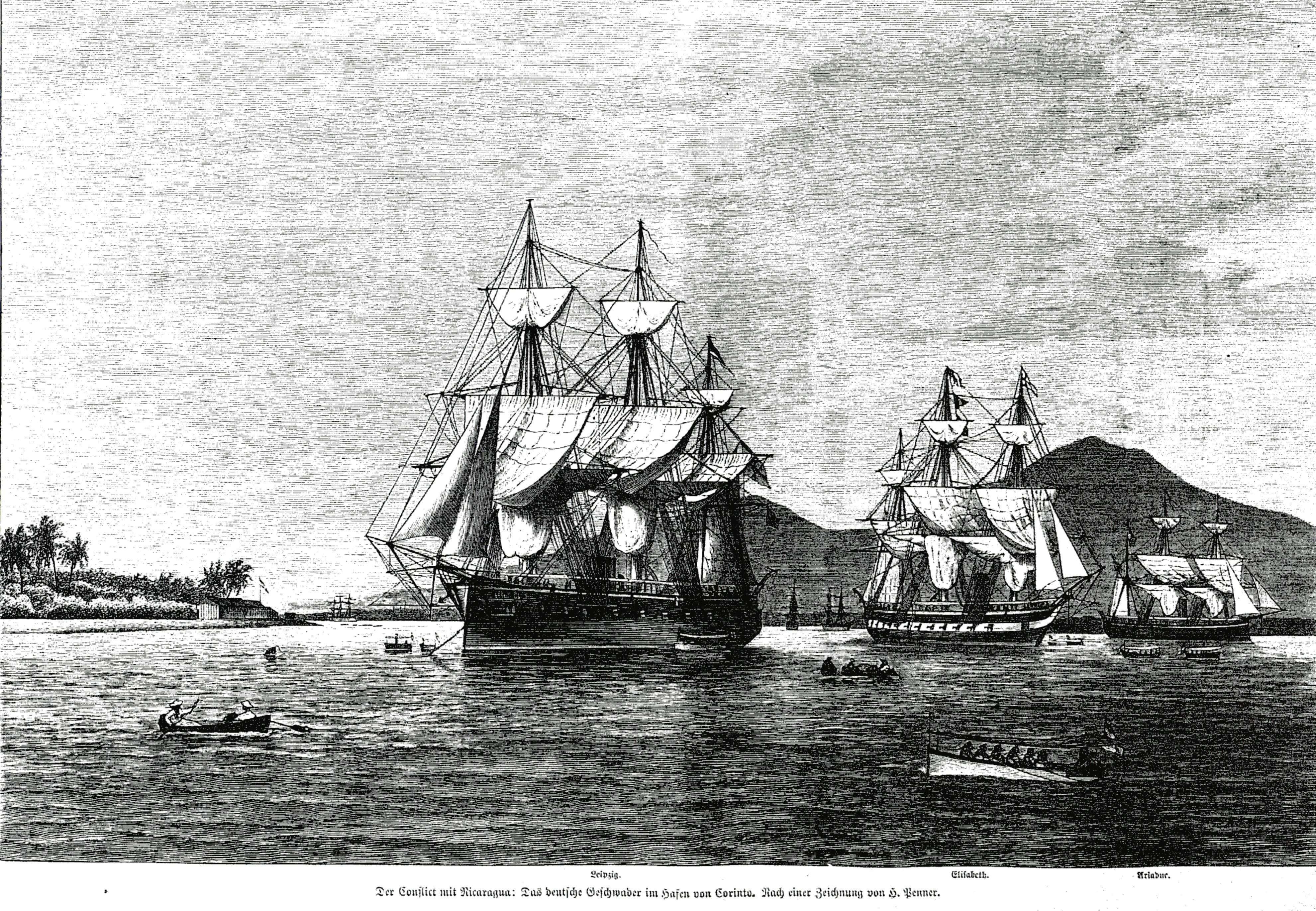
In September 1877, the German Foreign Office asked the Imperial Admiralty to consider a military demonstration. The navy launched "Operation Nicaragua," assembling a Central American Squadron of warships including the screw corvettes SMS Leipzig and SMS Ariadne from Germany and the screw frigate SMS Elisabeth from Japan. By March 1878, the squadron had arrived off the Nicaraguan coast with roughly 1,100 sailors. The corvette SMS Medusa landed 150 men at Grey Town on the Caribbean side. On the Pacific coast at Corinto, sailors inspected buildings for potential occupation and checked lagoons for naval mines. Lieutenant Captain Stubenrauch delivered a 24-hour ultimatum: meet Germany's demands or face severed relations, an additional $8,000 fine, and consequences left ominously undefined. Nicaragua sought allies. Colombia, El Salvador, Guatemala, and Venezuela pledged support, but none sent help. Guatemala's president privately advised Chamorro to simply pay.
A Day of Eternal Shame
On March 31, 1878, Chamorro's government capitulated. Officials brought $30,000 to the Central American Squadron, and Nicaraguan soldiers saluted the Reichskriegsflagge in Corinto. The mayor of Leon was fined $500 and banned from public office for five years. Francisco Leal -- the man whose violence had triggered the entire crisis -- faced no consequences whatsoever. Bahlke, despite having been kidnapped, remained with him. Nicaraguan journalist Enrique Guzman called the payment "a day of eternal shame for Nicaragua." The German government used the indemnity to pay teachers and junior officials over the following months. Historian Lawrence Sondhaus later described the affair as a "classic example of gunboat politics." Germany took a different lesson: that naval force could protect imperial commercial interests in Latin America. The Eisenstuck affair became Germany's largest military operation in the region until the Venezuelan crisis of 1902-1903.
From the Air
Located at 12.48N, 87.17W near Corinto on Nicaragua's Pacific coast, where the German squadron anchored during the confrontation. Corinto is a port city on a peninsula visible from altitude, with the Maribios volcanic chain to the east. The city of Leon is approximately 20 km inland to the southeast. Nearest airport: Augusto C. Sandino International (MNMG) in Managua, approximately 75 nm southeast.