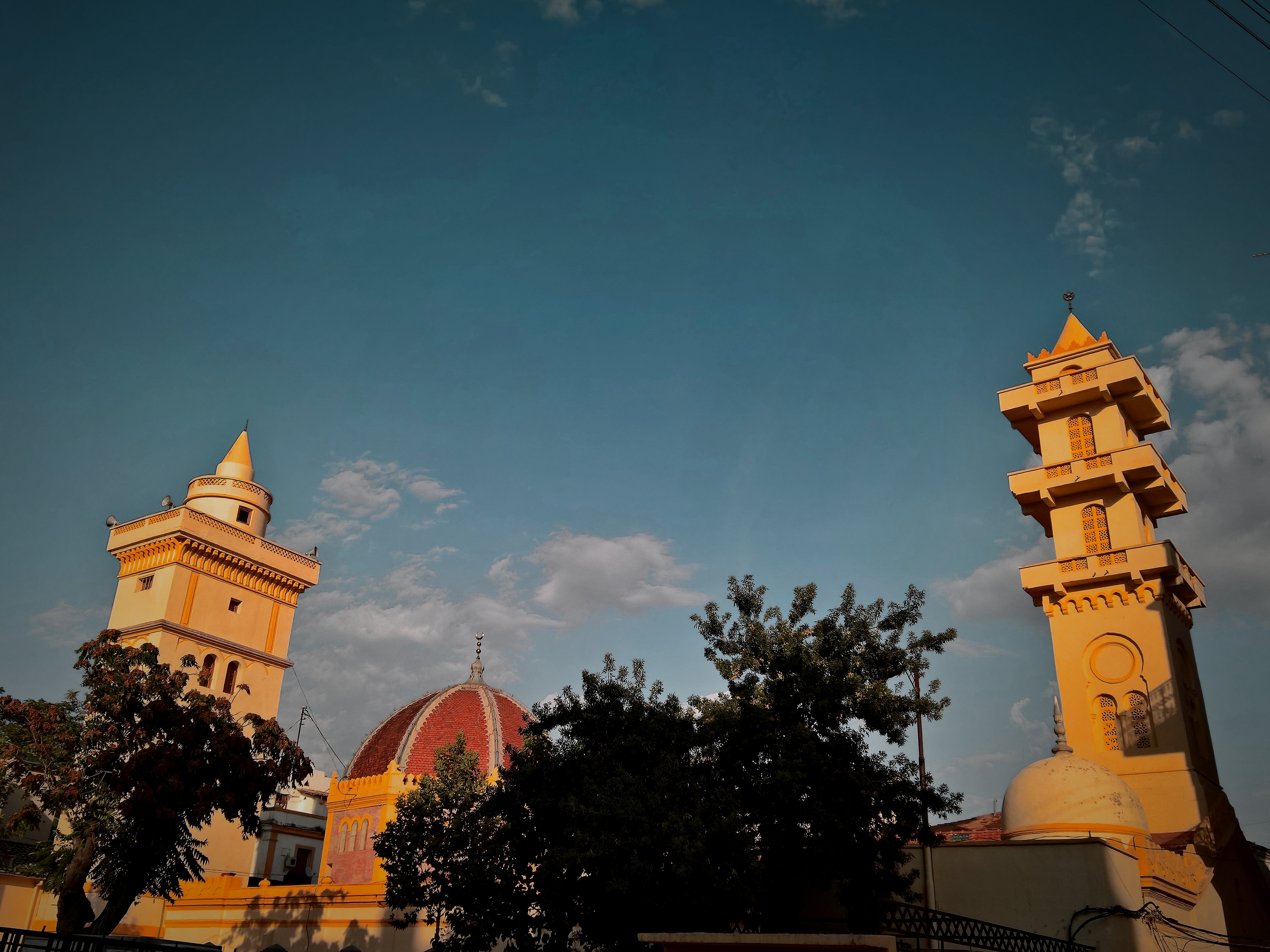
El Bey Mosque
For 124 years, the call to prayer did not sound from the minaret of the Souk El Ghezel Mosque. From 1838 to 1962, the building served as the Cathedral of Our Lady of the Seven Sorrows of Constantine, its mihrab displaced by an altar, its domes presiding over Catholic masses instead of Friday prayers. When Algeria won independence in 1962, the building was restored to its original purpose. Today the El Bey Mosque stands as one of Constantine's most layered monuments, a structure whose walls have absorbed the devotions of two faiths and the ambitions of two empires.
The Spinning Market Mosque
The mosque takes its original name from the Souk Al-Ghazal, the spinning market where wool was sold and prepared for weaving on the western side of the building. It was built during the reign of Hussein Bey Boukamiya, who ruled Constantine from 1713 to 1736, and it stands between Kerman Street and Didouche Mourad Street, bordered by the Ahmed Bey Palace to the west. The founding story carries its own intrigue: French researchers later proved that the mosque was actually built with the money of a man named Abbas, whose grandson, Sheikh Mustafa bin Jalul, confirmed the account. According to this version, the Bey erased Abbas's name from the commemorative inscription and replaced it with his own, ensuring that posterity would credit the ruler rather than the benefactor.
Domes and Marble Columns
The mosque's architecture blends Ottoman design with North African sensibility. Its rectangular plan merges on its northern and western sides with the Ahmed Bey Palace. Two main entrances on the southern facade are reached by stone steps. Inside, 30 marble columns on circular bases support the prayer hall, where the mihrab is adorned with a half-dome of plaster decorated in floral and geometric motifs, its cavity covered in brightly colored ceramic squares. Black and white marble columns flank the mihrab. The wooden pulpit, 3.45 meters long and 0.96 meters high, has eleven steps and is decorated with ornamental fillings. From the outside, circular domes rise on either side of the minaret on the mosque's western face, while shallower secondary domes cover the rest of the roof.
Cathedral Years
In 1838, one year after French forces captured Constantine in a bloody siege, the occupying authorities converted the mosque into a Roman Catholic cathedral. It became the Cathedral of Our Lady of the Seven Sorrows and served as the seat of the Bishop of Constantine. The conversion was part of a broader pattern across French Algeria, where religious buildings were repurposed to serve the colonial population and to assert French cultural dominance. Photographs from 1889 and 1895 show the building in its cathedral configuration, the domes and minarets still intact but the interior reorganized for Christian worship. For the Muslim population of Constantine, the conversion was a daily reminder of the colonial order imposed after the siege.
Restoration and Return
Independence in 1962 brought the building full circle. The cathedral was reconverted to a mosque, and the building resumed the function it had served for its first 108 years. The stucco window frames, the arched openings, the knotted windows overlooking the street, all survived the transitions with their decorative programs largely intact. The El Bey Mosque today sits at the heart of Constantine's historic fabric, adjacent to the Ahmed Bey Palace and the streets of the old city. Its story of conversion and reconversion is not unique in Algeria, but the specifics of its architecture, its proximity to power, and its 124-year interlude as a cathedral make it one of the most vivid examples of how colonial rule reshaped even the most sacred spaces.
From the Air
Located at 36.37N, 6.61E in the historic center of Constantine, Algeria. The mosque's circular domes and minaret are visible within the dense old city fabric on the rocky plateau. Adjacent to the Ahmed Bey Palace. Best viewed at 2,000-3,000 feet AGL. Nearest airport: Mohamed Boudiaf International Airport (DABC) approximately 10 km south. City elevation approximately 640 meters.