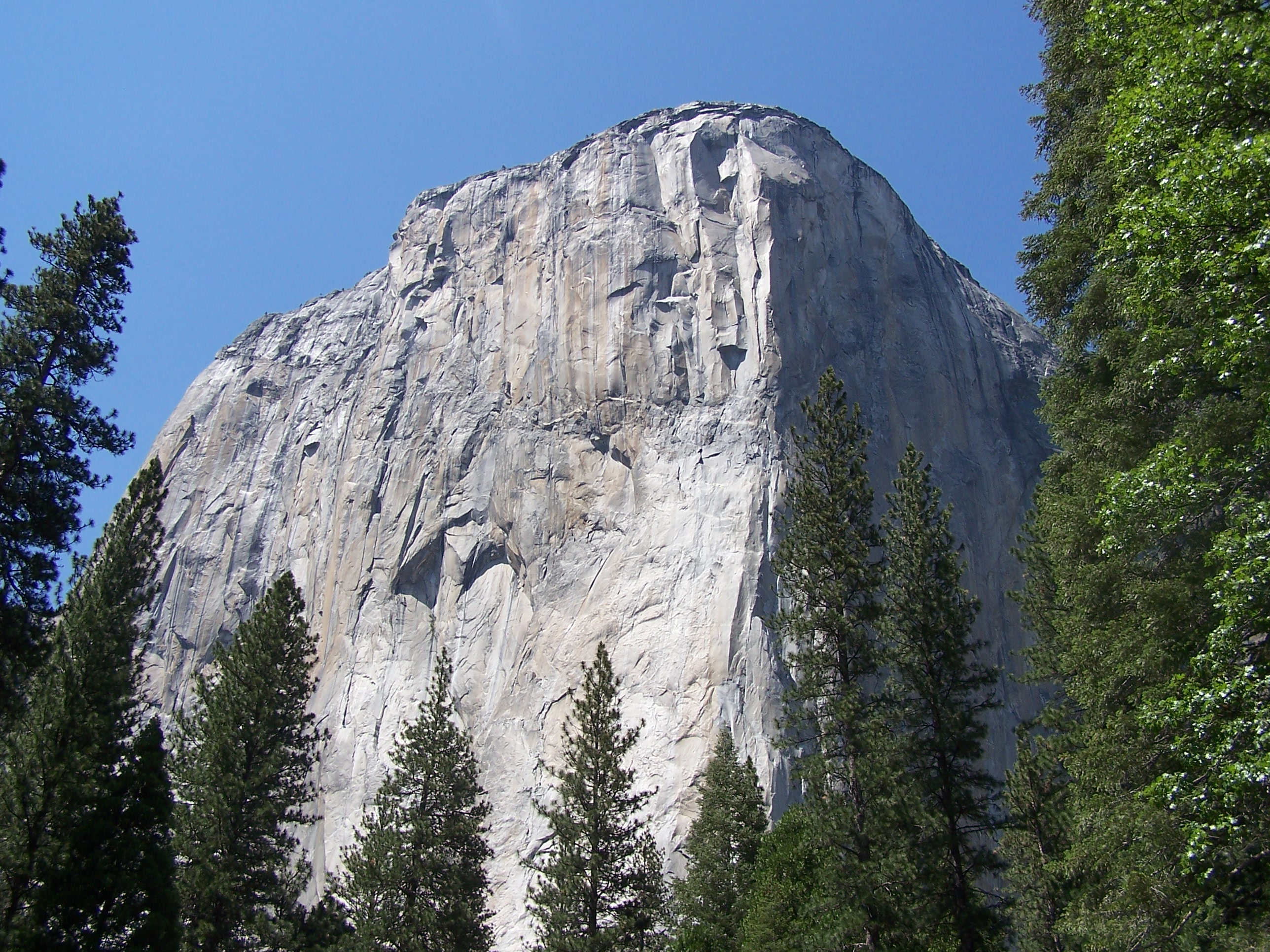
El Capitan
The Miwok called it Tutokanula, and the story behind that name is stranger than anything the climbers have done on it since. Two bear cubs fall asleep on a flat rock by the river. While they nap, the rock grows - past the trees, past the clouds, into the sky. Every animal in the valley tries to rescue the cubs. The fox fails. The mountain lion fails. Finally, a lowly inchworm begins the climb, inch by inch, and makes it to the top. The rock is named in its honor. The Spanish-speaking soldiers of the Mariposa Battalion, arriving in 1851, heard the Ahwahneechee name and translated it loosely as "the captain" - El Capitan. But the original story, as Julia F. Parker, the Yosemite Museum's cultural ambassador for over six decades, explains, was never about authority. It was about persistence.
A Hundred Million Years of Patience
El Capitan is composed almost entirely of pale, coarse-grained granite approximately 100 million years old. That granite forms most of the rock features along the western end of Yosemite Valley, though a separate intrusion called Taft Granite crowns the uppermost portions of the cliff face, and dark veins of diorite streak through both layers, most visibly on the section climbers call the North America Wall. The Sherwin Glaciation, lasting from roughly 1.3 million to 1 million years ago, carved the valley around El Capitan, but because the granite here is relatively free of joints, the ice could not erode it as deeply as the more fractured rock nearby. The result is a monolith that seems to have resisted everything the planet threw at it. It is still resisting. The Texas Flake, a massive block of granite halfway up the cliff, is slowly detaching from the main face - geological time measured in millimeters per century.
Forty-Seven Days on the Nose
Warren Harding, Wayne Merry, and George Whitmore completed the first ascent of El Capitan's most famous route in 1958, spending 47 days over an 18-month siege. They fixed manila ropes along the entire route, ascending and descending from the ground between climbing sessions. The ropes sometimes broke from exposure to cold. The team relied heavily on pitons, expansion bolts, and sheer stubbornness. Two years later, Royal Robbins led a team that climbed the Nose in seven continuous days without siege tactics - a philosophical statement as much as an athletic one. By 1975, John Long, Jim Bridwell, and Billy Westbay had pushed the Nose into a single day. The routes multiplied through the 1960s and 1970s: the Salathe Wall, the North America Wall, the Dihedral Wall, each opened by teams whose names read like a who's who of American climbing. Today there are over 70 established routes on El Capitan. New ones are still being added, usually threading between or linking existing lines.
The Women Who Rewrote the Record Books
Beverly Johnson climbed the Nose with Dan Asay in June 1973. Three months later, she and Sibylle Hechtel became the first all-women team to ascend El Capitan, via the Triple Direct route. In 1978, Johnson soloed the Dihedral Wall - the first woman to climb El Capitan alone. Lynn Hill's 1993 free ascent of the Nose, graded 5.14a/b, was a landmark that transcended gender categories entirely; she climbed what many of the sport's strongest men had failed to free. Hazel Findlay made three free ascents of El Capitan between 2011 and 2017. Emily Harrington, in November 2020, became the first woman to free climb El Capitan in a single day via Golden Gate. And then there is Dierdre Wolownick, Alex Honnold's mother, who first climbed El Capitan at 66 and broke her own age record at 70. The youngest to scale the Nose was 10-year-old Selah Schneiter, in 2019.
Three Hours and Fifty-Six Minutes
On June 3, 2017, Alex Honnold woke before dawn and began climbing El Capitan's Freerider route without a rope, harness, or any protective equipment. He started at 5:32 a.m. and reached the summit at 9:28 a.m. - 3 hours and 56 minutes for 2,900 vertical feet. The climb was filmed for the 2018 documentary Free Solo. The audacity of the act obscures the preparation behind it: Honnold had rehearsed every move on the route for years, memorizing sequences the way a pianist memorizes a concerto. A year later, Honnold and Tommy Caldwell set the speed record on the Nose at 1 hour, 58 minutes, and 7 seconds. Caldwell himself, with Kevin Jorgeson, had already completed one of climbing's most celebrated achievements - the first free ascent of the Dawn Wall in January 2015, a 19-day effort on El Capitan's southeast face that created the world's hardest multi-pitch climbing route.
Jumpers, Quarters, and the Overlook Hotel
El Capitan's cultural reach extends well beyond climbing. In 1966, Michael Pelkey and Brian Schubert made the first BASE jump from the summit; both broke bones on landing. The National Park Service briefly issued jumping permits in 1980, but shut the program down after just ten weeks. In 1999, 60-year-old Jan Davis died during a protest jump, using borrowed equipment so that her own gear would not be confiscated by the rangers waiting below - a tragedy born from a dispute over park regulations. The cliff appears on the 2010 Yosemite quarter, and Apple named a version of macOS after it. Captain Kirk free-solos El Capitan in the opening of Star Trek V, though William Shatner's technique would not fool anyone who has actually been on the wall. The El Capitan supercomputer at Lawrence Livermore National Laboratory, currently the fastest in the world, borrows the name too. For a rock face that the Miwok named after an inchworm, El Capitan has made an outsized impression.
From the Air
Located at 37.734°N, 119.637°W on the north side of Yosemite Valley near its western end. The 3,000-foot granite face is unmistakable from the air - a pale, sheer wall rising above the Merced River. Best viewed at 5,000-7,000 ft AGL from the south side of the valley. Nearest airports: Fresno Yosemite International (FAT), approximately 65 miles south; Mariposa-Yosemite Airport (MPI), roughly 30 miles west. Half Dome is visible to the east, Bridalveil Fall to the southeast. Caution: strong thermals and mountain wave turbulence common along the valley walls.