El Chal
The tallest structure at El Chal rises from the west side of its West Plaza, a pyramid whose rooms were deliberately sealed with packed white earth during the Terminal Classic period. Why the Maya entombed those painted chambers remains unclear, but the act itself speaks to something unusual about this place: El Chal was not abandoned in haste. Occupied from roughly 300 BC through 1300 AD -- a span of sixteen centuries -- this site in Guatemala's Peten Basin survived the great Maya collapse that emptied neighboring cities. While El Eden, El Tigrillo, and Copoja faded into the jungle, El Chal kept building.
A City Beneath a Village
El Chal sits in the upper San Juan River valley, 40 kilometers south of Flores in Guatemala's Peten department, at an altitude of 270 meters above sea level. The archaeological site occupies the southern edge of the modern village that shares its name, and the collision between old and new is literal. Some ancient mounds were destroyed when modern streets were laid out; others were stripped of dressed stone that found its way into village houses and walls. Group 15's Structure 2 was severed when a road was cut through its north side. The site sprawls across four sectors -- Central El Chal with 25 structure groups, Arrepentimiento with 40, Panorama with 53, and Municipal with 18 -- but it has received very little restoration. The jungle and the village have claimed most of it.
The Glyph That Proved Importance
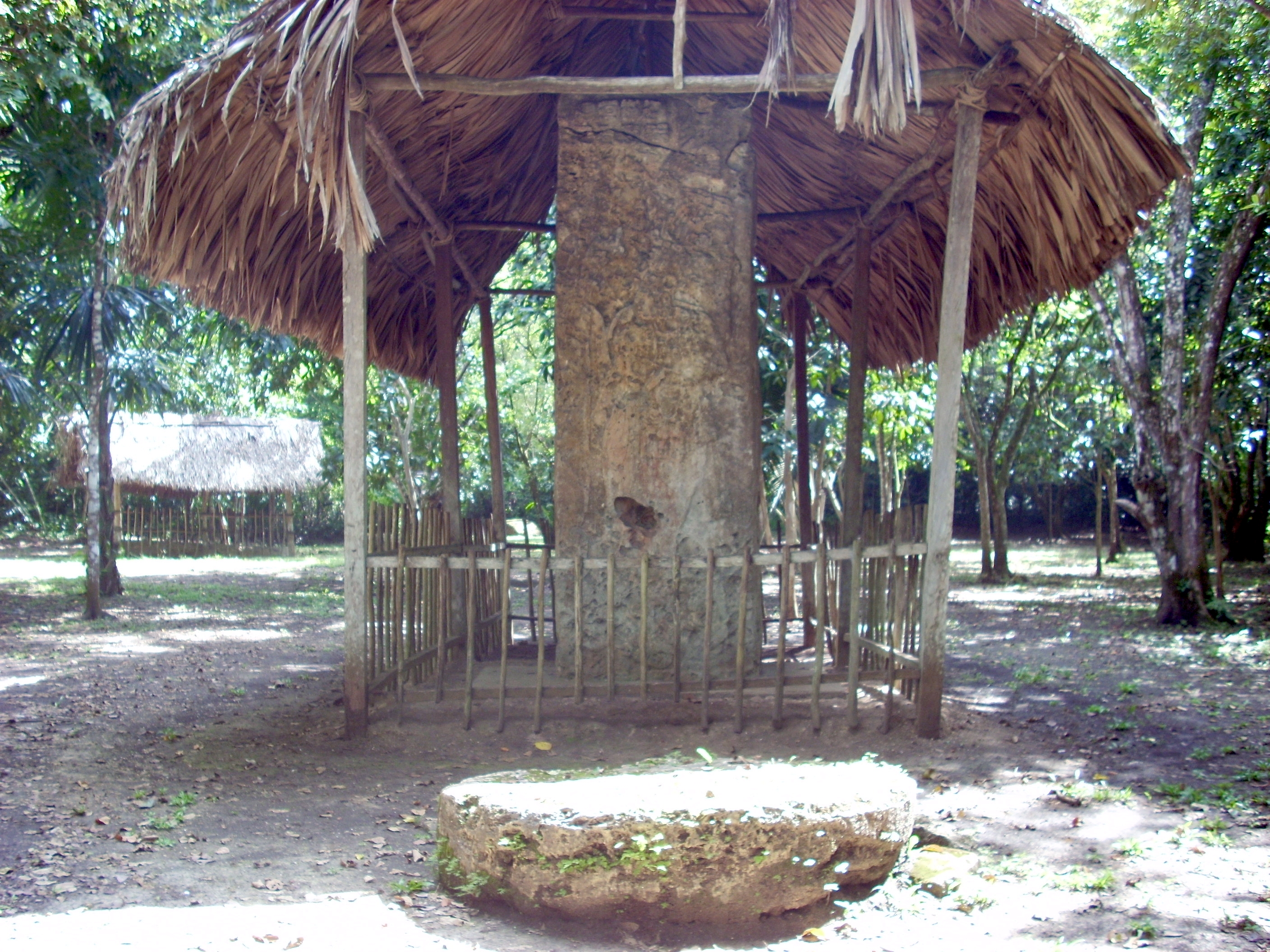
During the Late Classic period, El Chal earned something that only significant Maya centers possessed: its own Emblem Glyph, a hieroglyphic signature that identified it as an independent polity. Sculpted monuments from this era record the city's rulers and their deeds. Stela 4, dating to the eighth century, shows a ruler in full regalia. Stela 11, found in the East Plaza, depicts three seated prisoners -- the central figure facing left, the other two turned inward toward him -- a scene of political dominance carved in stone. Hieroglyphic texts run beneath the prisoners and along the altar's sides, though erosion has consumed much of the detail. Six stelae and three altars were found in the East Plaza alone, erected across two construction phases spanning the Late Classic and Terminal Classic periods.
The Acropolis on Three Terraces
The site's ceremonial core consists of an acropolis leveled into three broad terraces, each averaging 2,800 square meters, along with the East, West, Northeast, and Northwest Plazas. The acropolis supported an interconnected complex of patios, pyramids, and residential structures. Patio A's largest building, Structure 5, enclosed a courtyard of 768 square meters and connected to adjacent structures from its earliest construction phase. Patio C served an administrative function, with one room containing a bench -- likely a throne -- measuring 2.4 meters wide. The North Structure on this terrace was covered in stucco and painted red. A ballcourt on the north side of the West Plaza featured sculpted stone blocks bearing geometric designs and deity masks on its aprons. Excavations also uncovered Burial 68, dating to the Middle Preclassic period -- a poignant find containing a seated infant buried alongside a newborn.
Outlasting the Collapse
What makes El Chal remarkable among Maya sites is its persistence. Most cities in the southeastern Peten were abandoned during the ninth-century collapse, but El Chal entered a new phase of construction during the Terminal Classic. Massive structures were expanded, new monuments erected alongside older ones, and the site's influence grew as its neighbors declined. Panorama sector became a center for chert tool production, with 62 percent of its recovered ceramics dating to the Late Classic. The E-Group astronomical complex, first built in the Late Preclassic, was expanded with two new structures in the Late Classic. Even a few Postclassic potsherds turned up in the Central Sector, suggesting some presence as late as 1300 AD. Protected today by Guatemala's Instituto de Antropologia e Historia, El Chal remains largely unrestored -- its pyramids cloaked in heavy forest, its plazas half-reclaimed by the village above.
From the Air
Located at 16.63N, 89.65W in the Peten Basin of northern Guatemala, 40 km south of Flores. From the air, the site is largely hidden beneath dense tropical forest and the modern village of El Chal. The San Juan River valley runs through the area, with flat savanna terrain surrounding the site. Nearest airport is Mundo Maya International (MGMM) near Flores, approximately 40 km to the north. The landscape is characterized by low-lying jungle and scattered villages connected by road CA-13.