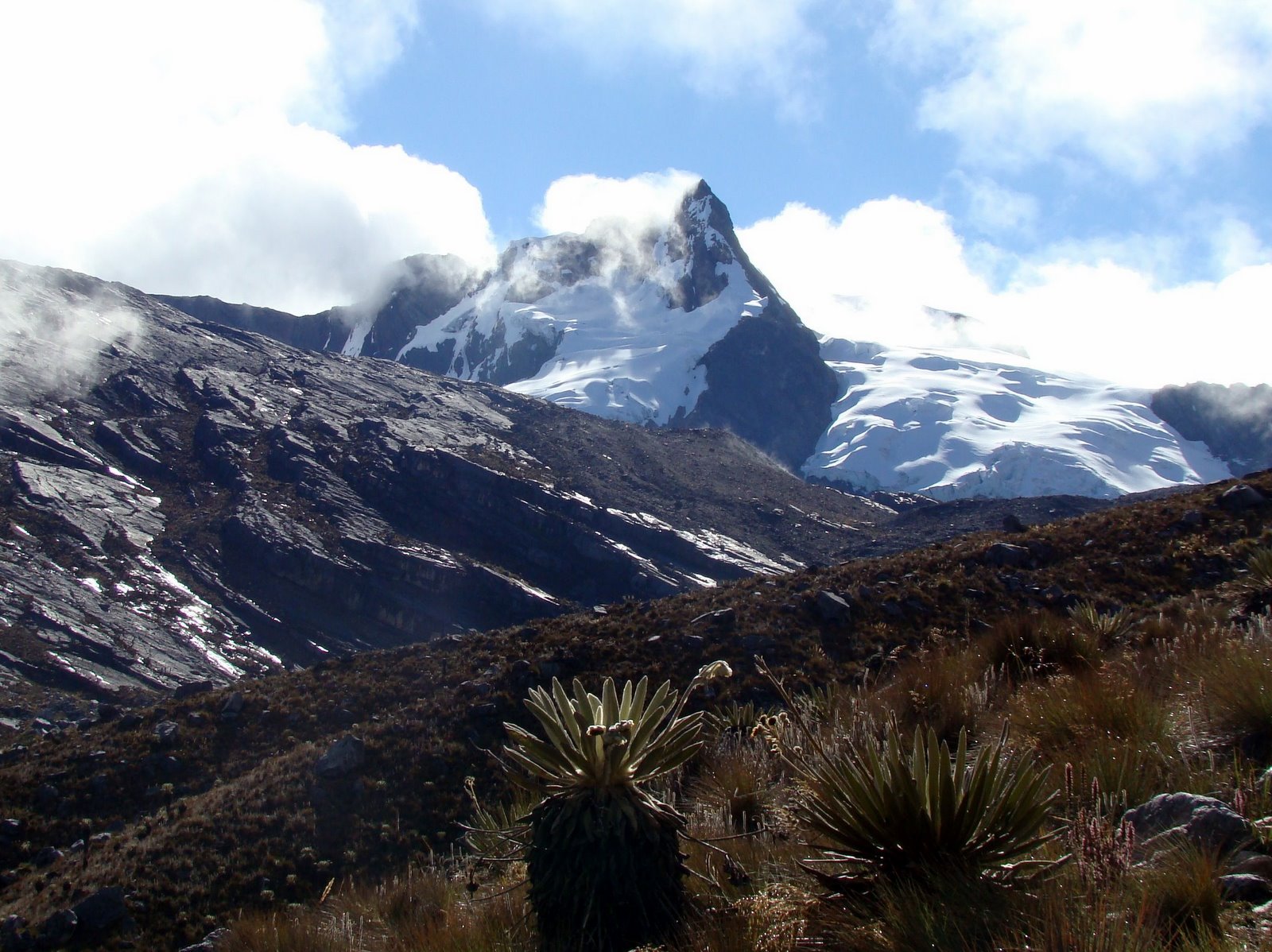
El Cocuy National Park
The U'wa people, who have lived in the lowlands surrounding the Sierra Nevada del Cocuy for centuries, hold a simple belief about the ice above them: you should not touch snow or walk on it. The glaciers are sacred, not meant for human feet. By 2030, according to Colombia's Hydrological, Meteorological, and Environmental Studies Institute, the question may be moot. El Cocuy's ice fields, the largest glacial mass in South America north of the equator, are vanishing so rapidly that within a few years there may be nothing left to touch. What remains right now, in this narrow window of geological time, is one of the most extraordinary mountain landscapes on the continent.
Ice at the Equator
El Cocuy National Park sits in the Eastern Cordillera of the Colombian Andes, just six degrees north of the equator, where glaciers have no business existing and yet have persisted for millennia. Established in 1977, the park covers 306,000 hectares and contains eighteen snow-covered peaks, the highest being Ritacuba Blanco at 5,330 meters, the tallest point in the entire Eastern Cordillera. The topography spans 4,500 meters from its lowest point to its summit, creating a vertical transect through nearly every climate zone the tropics can produce. At the base, subtropical forests give way to cloud forest, then to the treeless paramo grasslands, and finally to the glacial zone where ice meets rock in a landscape sculpted by forces most people associate with Patagonia or the Alps, not with equatorial Colombia.
A Landscape Shaped by Ice
The post-glacial geology of El Cocuy reads like a textbook on what ice can do to stone. Cirques carved by ancient glaciers scoop into the mountainsides like giant amphitheaters. Moraines, the rubble piles left by retreating ice, dam glacial lakes with names like La Pintada and La Cuadrada, their waters an opaque turquoise from suspended rock flour. The peaks themselves carry evocative names that hint at the terrain's character: Pulpito del Diablo, the Devil's Pulpit, at 5,100 meters; Pan de Azucar, the Sugarloaf, at 5,120 meters; Concavo and Concavito, the twin hollows, above 5,000 meters. Climbers and rock climbers of all skill levels make the journey to El Cocuy, though the park restricts access to protect both the fragile ecosystem and the interests of the U'wa, whose reservation overlaps the park's boundaries. Only about 500 people per year complete the full six-day circuit around the Sierra Nevada del Cocuy.
Sacred Ground, Contested Ground
The relationship between the park and the U'wa people, also known as the Tunebos, is one of Colombia's more complex conservation stories. The U'wa reservation overlaps the national park, and parts of the park are dedicated to their traditional farming, grazing, hunting, and fishing activities. For the U'wa, the mountains are not recreational terrain but sacred geography, and their objections to tourism in the glacial zone have led to periodic closures and strict access regulations. Several trails reopened in late 2017 after extended closures, but the indigenous reserve, the full circuit trail, and all direct access to glaciers remain off-limits. Visitors must hire certified guides, and groups are limited to four people per guide. These restrictions reflect a broader negotiation between conservation, indigenous rights, and the economic pressures of adventure tourism in a country eager to showcase its natural wonders.
The Clock on the Ice
Colombia once had six glaciated mountain ranges. Today it has four, and the ice on each is retreating. At El Cocuy, what was once a continuous icefield has fragmented into scattered snowcaps, each one smaller than the last satellite measurement showed. The Colombian government's prediction that all the country's glaciers will disappear by 2030 has given El Cocuy an urgency that transcends ordinary tourism. People come now not just for the beauty but for the finality, to see something that will not exist for their children. The paramo grasslands below the glaciers, already expanding upward as the ice retreats, are themselves among the most biodiverse ecosystems in the Andes, home to frailejones, the distinctive rosette plants that can take a century to reach full height. Whether El Cocuy's future is one of bare rock summits or newly green alpine meadows, it will be a different landscape from the one that exists today. The U'wa, perhaps, understood this fragility all along.
From the Air
Located at 6.50N, 72.12W in the Eastern Cordillera of the Andes. The Sierra Nevada del Cocuy is visible from considerable distance as a chain of snow-covered peaks rising above the surrounding paramo. Ritacuba Blanco reaches 5,330 meters (17,487 feet). No major airports nearby; the closest is Sogamoso (SKSO) approximately 120 km to the southwest, and El Yopal (SKYP) to the east on the llanos. Approach from the east offers dramatic views of the glaciated peaks above the lowland plains. Mountain weather is highly variable; morning visibility is typically best. Significant terrain and altitude considerations for low-level flight.