El Escorial
Philip II wanted a building that could be everything at once. Built between 1563 and 1584 in the foothills of the Sierra de Guadarrama, about 45 kilometers northwest of Madrid, El Escorial functions as a monastery, basilica, royal palace, royal pantheon, library, museum, university, school, and hospital. That a single complex could serve all these purposes tells you something about the ambitions of the man who ordered it and the empire he ran from a small, austere study within its walls. Philip governed the largest empire the world had yet seen -- Spain, Portugal, the Netherlands, half of Italy, the Philippines, vast stretches of the Americas -- and he did much of it from a wooden desk overlooking the altar of El Escorial's basilica, where he could watch Mass being celebrated without leaving his chair.
A Gridiron in Granite
The building's layout is said to honor Saint Lawrence, on whose feast day, August 10, 1557, Philip's armies won the Battle of Saint-Quentin against France. Lawrence was martyred on a gridiron, and El Escorial's rectangular plan with its grid-like arrangement of courtyards and corridors has long been read as an architectural echo of the saint's instrument of death. Whether Philip intended the resemblance is debated, but the symbolism suits a king who saw his empire as a divine mission. The architect Juan Bautista de Toledo began the design, drawing on Italian Renaissance principles, but died in 1567 with the project far from complete. His successor, Juan de Herrera, finished the building and gave it the severe, unornamented style that became known as Herreriano -- an aesthetic of stripped-down grandeur that rejected the decorative excess of the time in favor of geometric clarity and massive granite walls.
The Pantheon of Kings
Beneath the basilica, the Royal Pantheon holds the remains of nearly every Spanish monarch since Charles V -- Philip II's father, the Holy Roman Emperor who retired to a monastery and abdicated his thrones. The circular chamber, finished under Philip IV in the 17th century, is lined with identical marble and bronze sarcophagi arranged in tiers, king facing queen across the room. The uniformity is deliberate: in death, all monarchs are equal. A separate vault, the Pantheon of Princes, contains the remains of royal children and consorts who were not reigning monarchs, its 19th-century marble tombs carved by the Italian sculptor Giuseppe Ponzano. The effect of descending into these vaults is visceral -- the air is cool, the silence absolute, and the weight of centuries of dynasty presses from above. Philip II, who spent his final agonizing weeks dying of illness in a small room adjacent to the basilica, is interred here alongside the wife he married for empire, not love.
Forty Thousand Books and a Ceiling of Stars
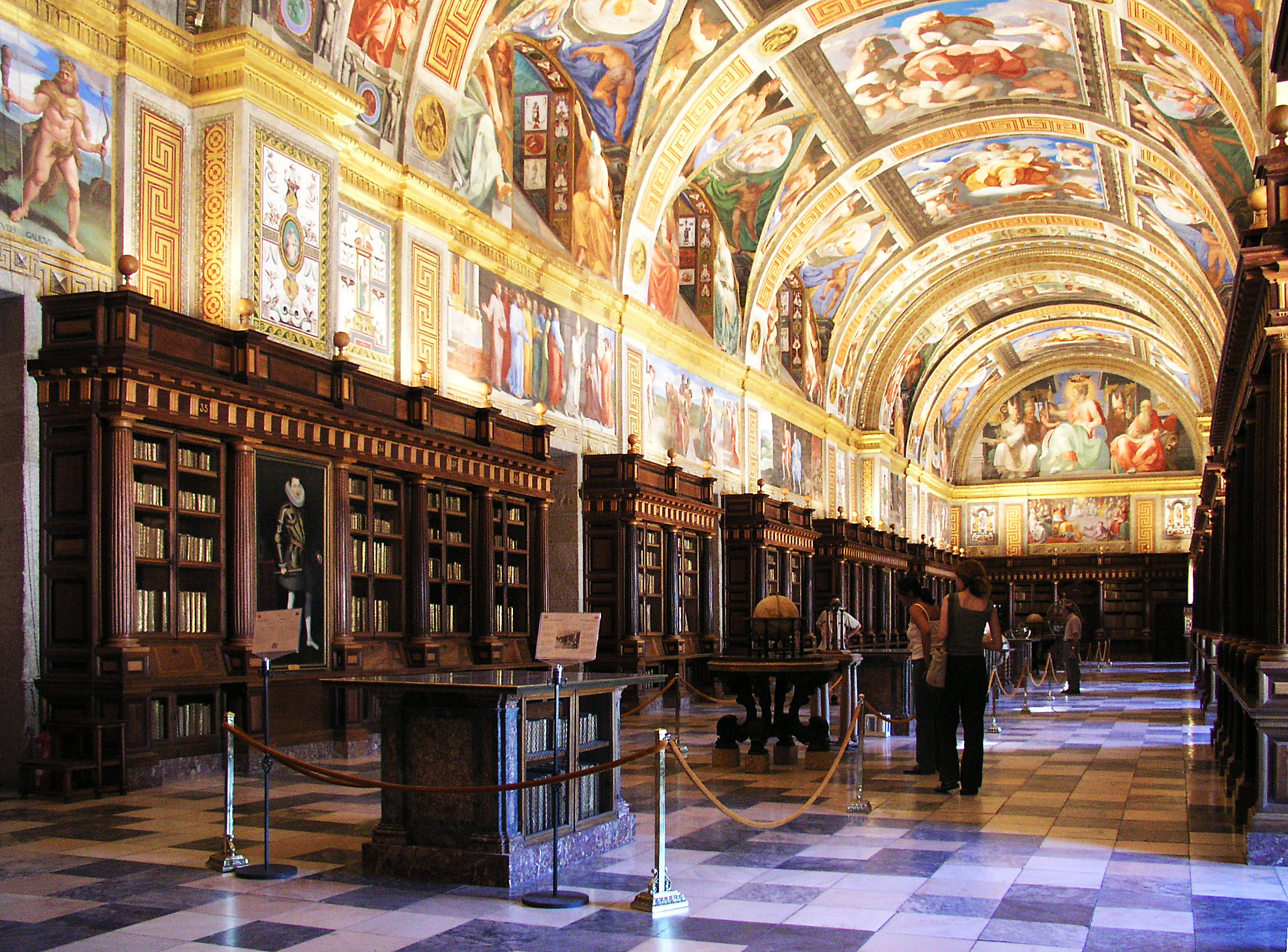
El Escorial's library was one of the finest in Renaissance Europe. Philip II was an avid collector of manuscripts, and his library accumulated over 40,000 volumes, including rare Arabic, Hebrew, and Latin texts. The main hall, designed by Juan de Herrera, is a vaulted gallery whose ceiling was painted by Pellegrino Tibaldi with allegorical frescoes representing the liberal arts -- grammar, rhetoric, dialectic, arithmetic, music, geometry, and astronomy. The books are shelved with their spines facing inward, a practice that puzzled later generations but may have been intended to protect the gilded edges that face outward. Among the holdings are illuminated manuscripts from the 10th century, a collection of drawings by Hieronymus Bosch (whose triptychs Philip collected obsessively), and scientific texts that reflect the era's uneasy balance between faith and inquiry.
Austerity as Power
Visitors expecting Versailles-style opulence are often startled by El Escorial's restraint. Philip II's private apartments are small, almost monastic -- whitewashed walls, tiled floors, a simple bed from which the ailing king could see the altar through a window. This austerity was a choice, not a limitation. The same man who governed half the world from these rooms decorated them with paintings by Titian, Velazquez, and El Greco, and filled the basilica with reliquaries said to contain over 7,000 sacred relics. The contrast between personal simplicity and institutional magnificence defined Philip's self-image: he was not a man who enjoyed luxury but a servant of God who happened to command the resources of a global empire. UNESCO designated El Escorial a World Heritage Site in 1984, recognizing it as the most complete and best-preserved example of a Renaissance royal complex anywhere in the world. From the air, its gray granite mass stands out against the green slopes of the Guadarrama foothills like a stone chess piece placed on a hillside.
From the Air
Located at 40.589N, 4.148W in the town of San Lorenzo de El Escorial, about 45 km northwest of central Madrid in the foothills of the Sierra de Guadarrama. The massive rectangular granite complex is unmistakable from the air -- one of the largest Renaissance-era buildings in the world, with its distinctive grid-like plan, domed basilica, and surrounding gardens. Recommended viewing altitude 3,000-6,000 ft AGL. Nearest airports: Madrid-Barajas (LEMD) approximately 55 km east, or the smaller Cuatro Vientos (LECU) approximately 35 km southeast. The Sierra de Guadarrama provides dramatic mountain backdrop to the north and west.