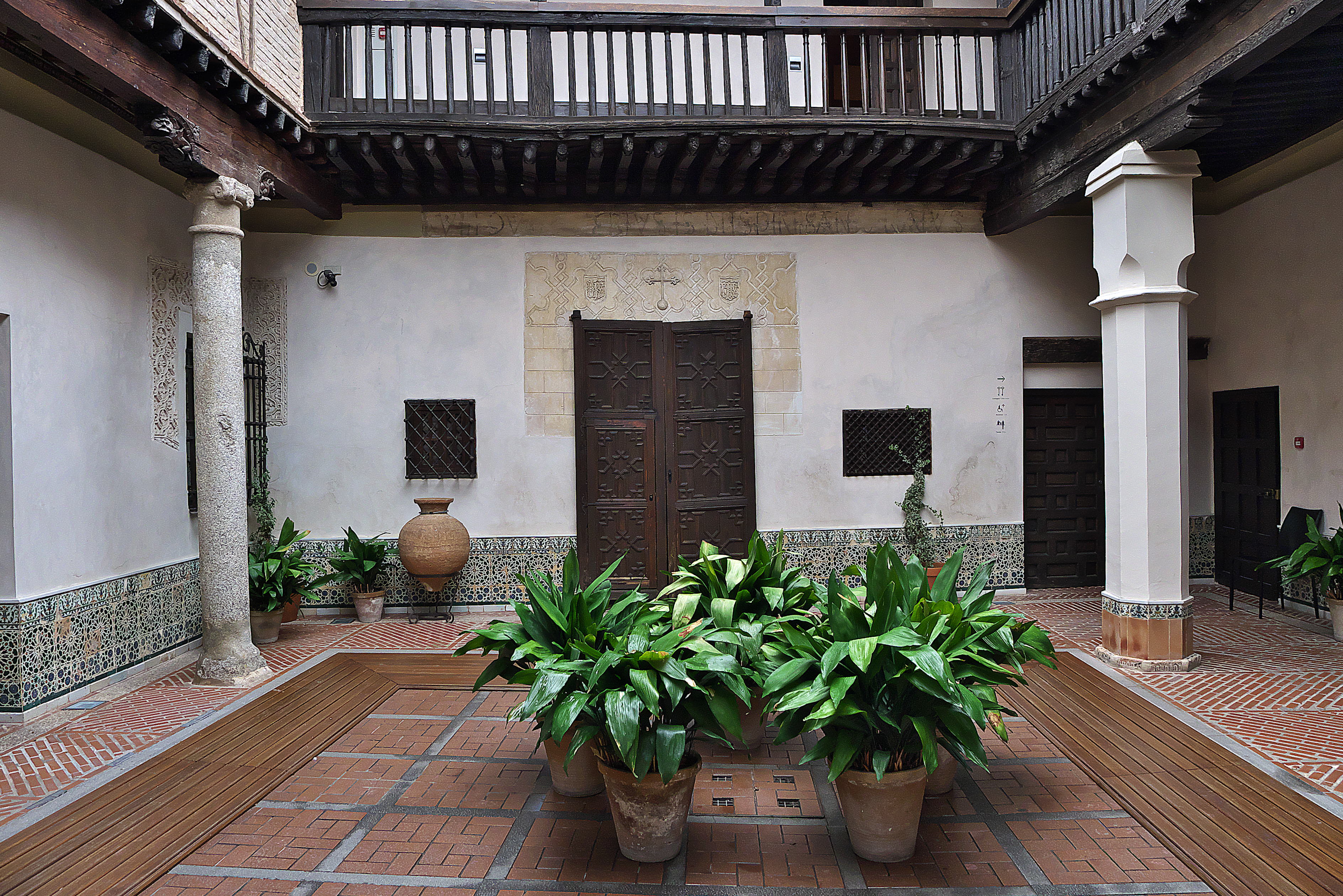
El Greco Museum, Toledo
Domenikos Theotokopoulos was born in Fodele, Crete, in 1541. He trained in Venice, tried and failed to find steady patronage in Rome, and arrived in Toledo in 1577 at the age of 36. He never left. For the remaining 37 years of his life, the painter the Spanish called El Greco - the Greek - worked in this city, producing the elongated, flame-like figures and supernatural color that would be ignored for centuries and then celebrated as proto-modern genius. The house where he actually lived is gone. But in 1911, a museum opened in Toledo's Jewish Quarter to evoke the world he inhabited, and to display the works - especially the late ones - that define his legacy.
A House That Never Was
The El Greco Museum does not occupy El Greco's actual home. That building was destroyed long ago. Instead, the museum consists of two structures: a 16th-century house with a courtyard, renovated to recreate the kind of domestic space El Greco would have known, and an early 20th-century building that serves as the gallery proper. A garden connects them. The effect is atmospheric rather than authentic - period furniture, Talavera pottery from the Province of Toledo, and the proportions of a 16th-century dwelling give visitors a sense of the painter's daily surroundings without pretending to reconstruct them exactly. The museum is classified as one of Spain's National Museums and operates under the Ministry of Culture. It sits in the heart of the old Jewish Quarter, the neighborhood where Toledo's Sephardic community flourished before the expulsions of 1492.
Thirteen Faces Looking Out
The museum's centerpiece is the Apostolado, a complete series of thirteen paintings portraying Christ and his twelve disciples. El Greco and his workshop produced the series between 1610 and 1614 - the last years of the painter's life - for the Hospital de Santiago in Toledo. It was conceived as a unified project: Christ gazes directly out of the canvas while six disciples look left and six look right, creating a visual rhythm that draws the viewer down the gallery wall. Each painting is oil on canvas, measuring 97 by 77 centimeters. The disgraced Judas Iscariot is absent, replaced by Saint Paul. The figures display El Greco's signature late style - attenuated bodies, expressive hands, luminous passages of color emerging from dark backgrounds. These are not portraits of individuals but visions of spiritual intensity, each apostle caught in a private moment of devotion or doubt.
The Greek in Toledo
Why Toledo? El Greco came to Spain hoping for royal commissions from Philip II at the Escorial. When those failed to materialize - the king found his style too unconventional - the painter settled in Toledo, then Spain's religious capital and a center of Counter-Reformation intellectual life. The city offered a steady stream of ecclesiastical commissions from churches, convents, and wealthy patrons. El Greco's household became a fixture of Toledo's cultural scene; he lived extravagantly, reportedly hiring musicians to play during meals. His workshop employed assistants who helped execute large commissions, though the master's distinctive touch remained unmistakable. Toledo shaped his art as much as he shaped the city's visual identity. The labyrinthine streets, the dramatic light of the Castilian meseta, the fervent religiosity of the Counter-Reformation - all found expression in canvases that seem lit from within by something other than the sun.
Beyond the Apostles
The collection extends well beyond the Apostolado. The museum holds additional works by El Greco, particularly from his late period when his style reached its most radical extremes. Paintings by other 17th-century Spanish artists provide context, showing how El Greco's contemporaries worked in more conventional modes. Period furniture and Talavera ceramics fill the recreated house, grounding the artistic collection in the material culture of the era. For visitors who have seen El Greco's Burial of the Count of Orgaz at the nearby Church of Santo Tome and his View of Toledo in reproduction, the museum offers something different: intimacy. These are not monumental altar paintings meant to overwhelm, but works scaled for close looking, produced in the final years of a man who had traveled from Crete to Venice to Rome to this hilltop city above the Tagus and decided, at last, that he was home.
From the Air
Located at 39.86N, 4.03W in Toledo's Jewish Quarter, in the southern portion of the historic city center. The museum is not individually visible from the air, but Toledo itself is one of Spain's most dramatic aerial sights - a medieval city on a granite promontory nearly encircled by the Tagus River gorge. Nearest major airport is Madrid-Barajas (LEMD), about 70 km northeast. The Jewish Quarter occupies the southwestern slope of the old city, descending toward the river. Best general viewing of Toledo at 2,000-5,000 feet.