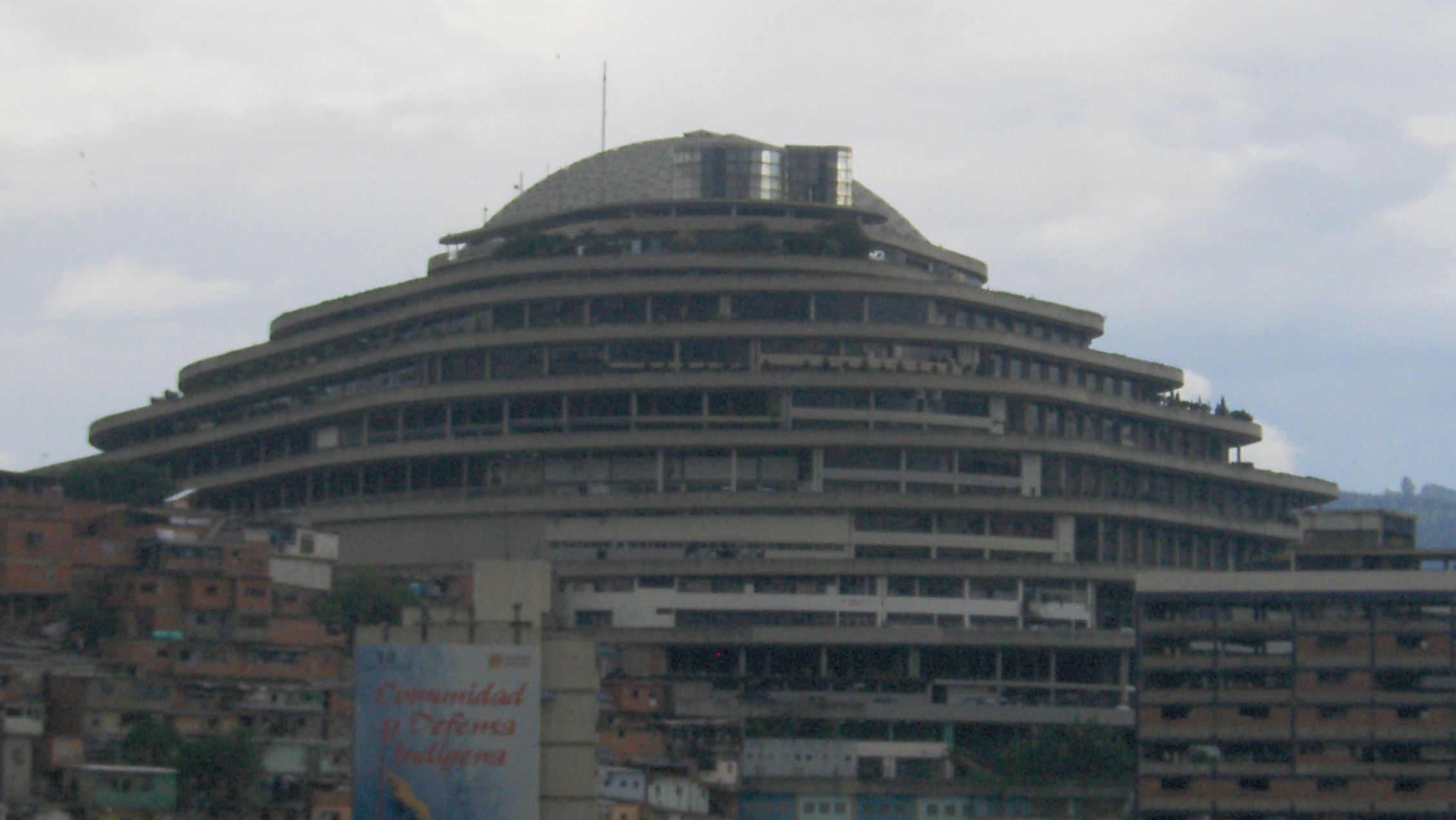
El Helicoide
The architects designed a building you could drive through. A four-kilometer ramp would spiral around a three-sided pyramid, letting shoppers park their cars inside a complex containing 300 boutiques, eight cinemas, a five-star hotel, and a heliport. It would have been the most ambitious shopping center in Latin America when it was conceived in 1956. Instead, El Helicoide became something its creators could never have imagined: a detention and torture facility operated by Venezuela's intelligence services, where political prisoners were held in cells nicknamed "Infiernito" -- Little Hell.
The Dream on a Hill
El Helicoide was commissioned during the dictatorship of Marcos Perez Jimenez, a period of massive infrastructure spending fueled by petroleum revenue. The architects Pedro Neuberger, Dirk Bornhorst, and Jorge Romero Gutierrez designed the structure on a hill called Roca Tarpeya, between the parishes of San Pedro and San Agustin in central Caracas. The building's total area reached nearly 102,000 square meters, with over 77,000 square meters of built space. The estimated cost was ten million dollars in 1958 -- roughly ninety million adjusted for inflation. But Perez Jimenez fell from power in January 1958, and the project stalled. Over the following decades, the concrete shell sat unfinished while its intended equipment -- including custom high-speed Austrian elevators -- was stolen. What remained was a modernist monument to a future that never arrived.
From Mall to Prison
The transformation happened gradually. Various government agencies occupied portions of the building over the decades, and eventually the Bolivarian National Intelligence Service, known as SEBIN, made it their headquarters and primary detention facility. The original cell, "Preventive I," measured just three by five meters and was used to hold new arrivals. As political detentions increased, three more preventive cells were created. By 2015, the cells were sorted by the nature of the accused: one for common prisoners, others for students, social media users, and "guarimberos" -- people arrested during anti-government protests. The largest detention area was called the "Guarimbero" cell, an annex of a cell known as "Guantanamo." Both were overcrowded, with no access to running water or toilets. Inmates slept on the floor.
People Inside the Pyramid
The human cost of El Helicoide's transformation is recorded in the testimony of those who survived it. In May 2018, political prisoners inside the building were subjected to tear gas and buckshot when a disturbance broke out. Among the inmates was Joshua Holt, an American citizen whose detention prompted concern from the U.S. Embassy. Human rights organizations documented patterns of abuse: prolonged isolation, denial of legal representation, and conditions that international observers classified as torture. The building that was supposed to let shoppers browse boutiques in air-conditioned comfort instead held people whose alleged crimes included posting criticism on Twitter. The gap between El Helicoide's original purpose and its actual function became, for many Venezuelans and outside observers alike, a metaphor for the country's trajectory.
The Doors Open
In January 2026, following a U.S. military operation that resulted in the capture of President Nicolas Maduro and his wife Cilia Flores, interim president Delcy Rodriguez assumed power. In the days that followed, President Donald Trump publicly announced the closure of what he called a "torture chamber in the heart of Caracas." The interim government released a significant number of political prisoners -- both Venezuelan and foreign nationals -- in what officials described as a unilateral gesture of peace. Family members gathered outside the building, waiting for further releases. On January 30, 2026, Rodriguez confirmed the facility's closure and announced plans to transform it into a sports and cultural center. At the same time, the government proposed a general amnesty law covering cases dating back to the arrival of Chavismo in 1999. The scope would extend beyond political prisoners to include exiled political leaders facing criminal charges. Whether the building will finally fulfill some version of its original promise as a public gathering place, or whether it will again be repurposed by circumstances, remains an open question.
From the Air
Located at 10.489N, 66.910W in central Caracas on the hill of Roca Tarpeya. The distinctive three-sided pyramid shape with its spiraling ramp is recognizable from the air, set on elevated ground between the San Pedro and San Agustin neighborhoods. Nearest major airport is Simon Bolivar International Airport (SVMI/CCS), approximately 25 km north across the Avila mountains. Best viewed at 4,000-7,000 feet AGL when approaching from the south. The building sits near the junction of several major avenues and is surrounded by dense urban development.