El Miron Cave
She was between 35 and 40 when she died, roughly 18,700 years ago. Someone carried her body to the back of El Miron Cave, placed it in a narrow space behind a large limestone block, and coated her bones with ochre, a red iron-based pigment that stained them the color of rust. Archaeologists who discovered her in 2010 named her the Red Lady of El Miron. She is one of the oldest known ritual burials in western Europe, and the care taken with her remains suggests that death, for the people who lived in this cave during the Magdalenian period, was not simply an ending.
A Cave in the Valley of the Ason
El Miron Cave opens onto the upper Ason River valley toward the eastern end of Cantabria, not far from the border with the Basque Country. It is a large cave by the standards of the region, spacious enough to have sheltered human communities for thousands of years. The town of Ramales de la Victoria sits nearby in a landscape of steep limestone valleys carved by water and time. The cave was first identified in 1903 by amateur archaeologists Hermilio Alcalde del Rio and Lorenzo Sierra, the same pair who documented so many of Cantabria's Paleolithic sites during that extraordinary period of discovery at the turn of the twentieth century. Despite its early identification, El Miron waited nearly a century for systematic study. The first proper excavation did not begin until 1996.
The Red Lady
The team that finally excavated El Miron was led by Lawrence Straus of the University of New Mexico and Manuel Gonzalez Morales of the University of Cantabria. Over years of careful work, they uncovered a rich sequence of prehistoric remains. Then, in 2010, they found her. The Red Lady's skeleton lay in a narrow space running through a large limestone block toward the rear of the cave. Her bones were stained with ochre, the same red iron pigment that Paleolithic peoples across Europe used in art, ritual, and burial. The ochre coating was deliberate, applied after death as part of what appears to have been a funerary rite. She lived during the Magdalenian period, a time when the people of northern Spain produced some of the finest stone tools, bone carvings, and cave art in human history.
Art and Survival in the Upper Paleolithic
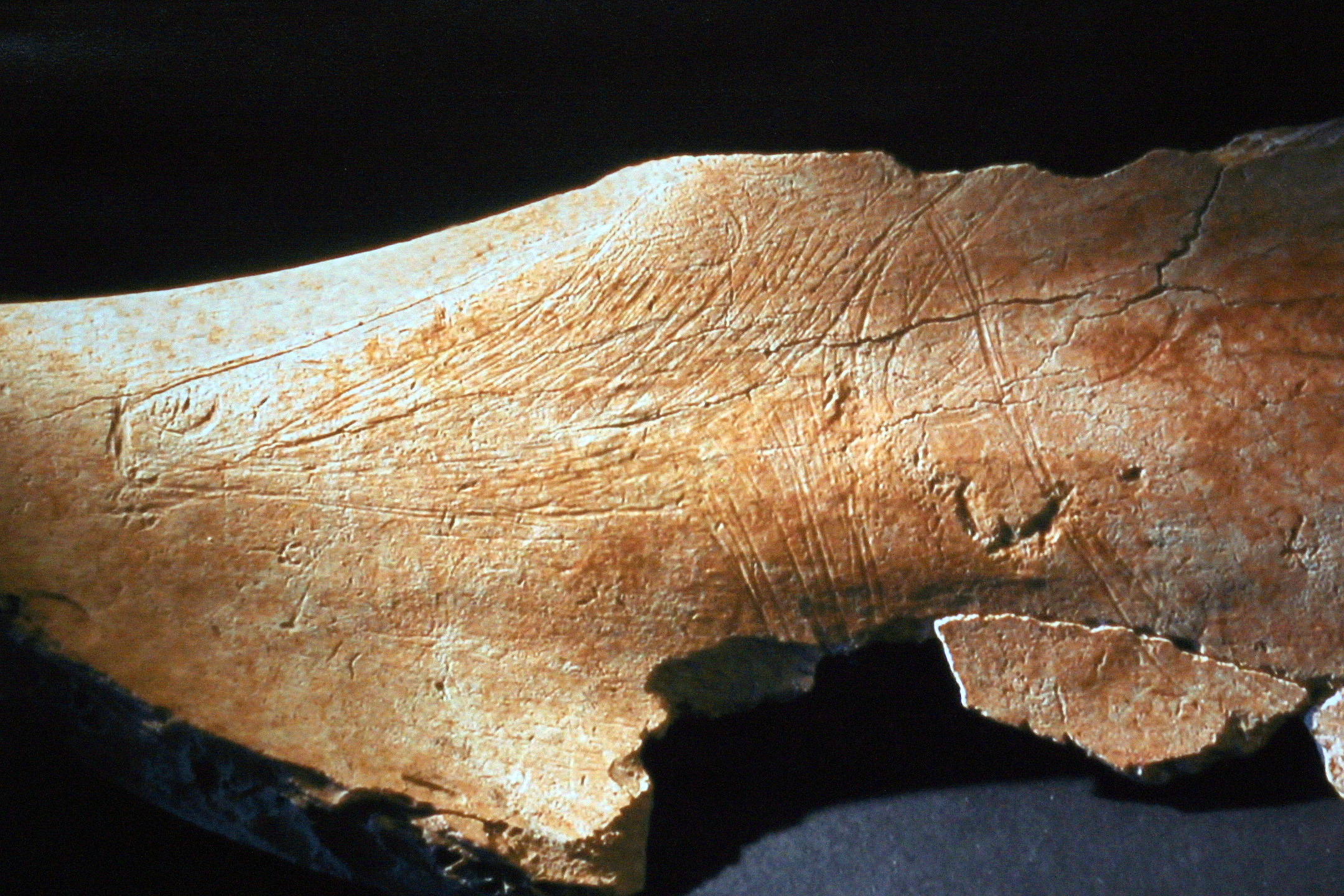
Beyond the burial, El Miron contains a rich collection of Upper Paleolithic art. The cave walls bear engravings and paintings that place it within the broader tradition of Franco-Cantabrian cave art. A striation-engraved red deer scapula found at the site exemplifies the Magdalenian artistic sensibility: precise, observational, capable of rendering animal forms with economy and grace. The people who used El Miron were not solely artists, of course. They were hunters and gatherers living at the edge of habitable Europe during one of the coldest periods in the planet's recent history. The Ason valley offered them resources: game in the mountain forests, fish in the rivers, and the cave itself, a reliable shelter with a commanding view of the approaches. Art and survival were not separate activities for these people. They were parts of the same life.
A Century Between Discovery and Understanding
The gap between El Miron's discovery in 1903 and its first excavation in 1996 reflects the sheer density of archaeological riches in Cantabria. Alcalde del Rio and Sierra identified dozens of caves across the region, more than any generation of researchers could fully investigate. El Miron sat quietly in the record books while attention focused on more immediately spectacular sites like Altamira and El Castillo. When Straus and Gonzalez Morales finally turned their attention to the cave, they found that patience had its rewards. The Red Lady's burial was not something that could have been found by casual exploration; it required methodical excavation of the kind that only became standard practice late in the twentieth century. Her discovery reminded the archaeological world that the caves of Cantabria still hold secrets, and that some of the most profound ones lie not on the walls but in the ground beneath them.
From the Air
Located at 43.25N, 3.45W in the upper Ason River valley near Ramales de la Victoria in eastern Cantabria, northern Spain. The cave is in a steep limestone valley near the border with the Basque Country. Nearest airports are Santander (LEXJ), approximately 50 km west, and Bilbao (LEBB), approximately 60 km east. Fly at 3,000-4,000 feet AGL to appreciate the dramatic valley topography. The town of Ramales de la Victoria is visible in the valley below.