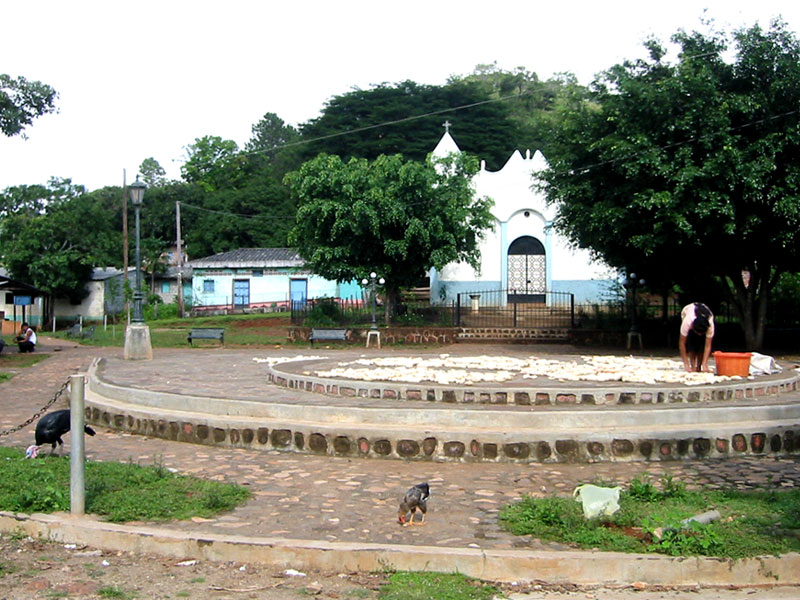
El Mozote
Rufina Amaya heard everything. Hidden in a crabapple tree behind the house where the soldiers had locked the women, she listened as her husband, her four children, and her neighbors were killed. She was the only known adult survivor of what happened at El Mozote on December 11, 1981 -- a massacre so thorough that the Atlacatl Battalion, an elite unit of the Salvadoran Army trained by the United States, killed nearly a thousand people in this village and surrounding hamlets over the course of two days. For more than a decade afterward, the Salvadoran government and its allies denied that the massacre had taken place. Rufina Amaya spent those years telling anyone who would listen what she had witnessed. Most of the world did not believe her until the forensic teams arrived.
The Village Before
El Mozote sits in the Morazan Department of northeastern El Salvador, a mountainous region that became a stronghold of the Farabundo Marti National Liberation Front (FMLN) during the Salvadoran Civil War. The village itself was small and poor but notably conservative -- its residents were largely evangelical Protestants who had avoided involvement with the guerrillas. Some villagers had been told by soldiers that they would be safe if they stayed home. Many who had fled to the hills returned to El Mozote precisely because they believed their neutrality would protect them. The village had perhaps a thousand inhabitants spread across El Mozote and the surrounding hamlets of La Joya, Rancheria, Los Toriles, Jocote Amarillo, and Cerro Pando. They were farmers. They had children. They had every reason to believe that staying put was the safest choice.
December 1981
On December 10, soldiers of the Atlacatl Battalion arrived in El Mozote. They ordered everyone into their homes and warned that anyone who stepped outside would be shot. The following morning, the soldiers forced the villagers out and separated them: men and older boys in one group, women with young children in another. The men were taken to the church. The women and children were locked in houses. In the church, the soldiers blindfolded the men and killed them by gunfire and decapitation. Then they went to the houses where the children had been gathered. The soldiers killed every child. They killed the women. When it was over, they left graffiti on the walls, set fire to the buildings and the bodies, and slaughtered the animals. The operation continued in surrounding hamlets for another day. The total number of people killed is estimated at close to a thousand. Among the dead were children as young as infants.
Denial and Testimony
In January 1982, reporters Raymond Bonner of the New York Times and Alma Guillermoprieto of the Washington Post reached El Mozote and published accounts of what they found. The Reagan administration, which was supporting the Salvadoran government with military aid and training, disputed the reports. Officials questioned the journalists' credibility. The story faded from public attention in the United States, though Rufina Amaya continued to give her account to human rights organizations. It was not until after the war ended in 1992 that a United Nations Truth Commission investigated. Forensic anthropologists exhumed a site at a building called El Convento and recovered the skeletal remains of at least 143 people. Of those remains, 136 belonged to children, with an average age of approximately six years. The physical evidence confirmed what Amaya had been saying for over a decade.
What Remains
El Mozote has been rebuilt. A memorial garden stands where some of the killings took place, and the names of the dead are inscribed on a wall. A sculpture of a family -- a mother, father, and child holding hands -- marks the site. Rufina Amaya, who spent the rest of her life bearing witness, died in 2007. The New York Times published her obituary. In 2012, the Salvadoran government formally acknowledged the massacre and asked forgiveness. Legal proceedings have moved slowly; a Salvadoran judge reopened the case in 2016, and in 2020 a former military commander was arrested in connection with the killings. El Mozote remains a place where people come to remember, not out of obligation but because the dead here were so thoroughly denied in life that remembering them is itself an act of justice. The village in the mountains is quiet now. It was quiet then, too, before the soldiers came.
From the Air
El Mozote is located at 13.90N, 88.12W in the mountainous Morazan Department of northeastern El Salvador. The terrain is rugged and hilly with limited flat ground. The village sits in a highland valley. Best viewed at 3,000-5,000 feet AGL. Nearest significant airport is Ilopango International Airport (MSSS) near San Salvador, approximately 150 km to the west. The mountains of northern Morazan and the Honduran border are visible to the north.