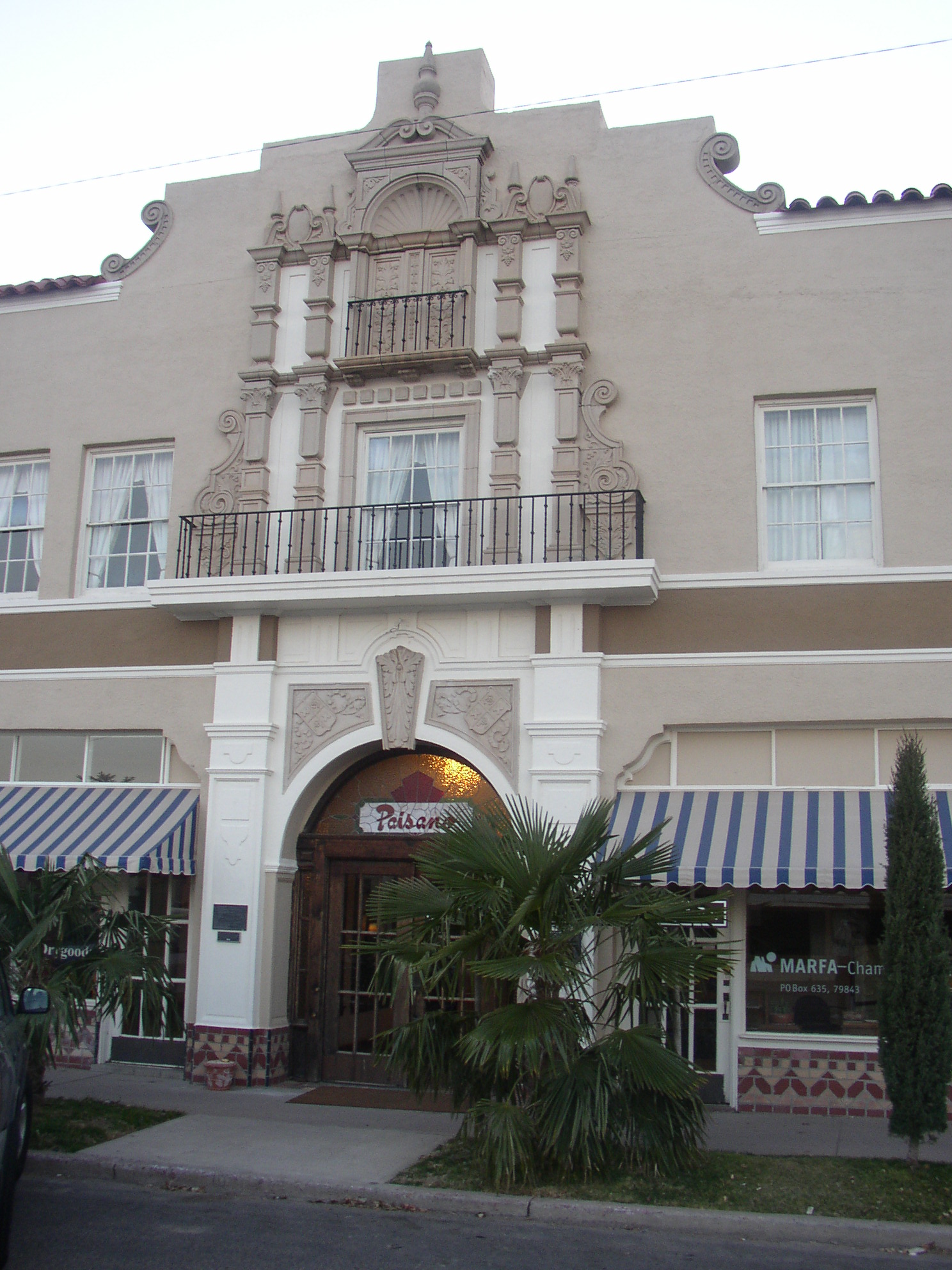
El Paisano Hotel
In the summer of 1955, more than 300 Hollywood cast and crew members descended on the remote West Texas town of Marfa to film Giant, the epic saga of Texas oil and cattle wealth. Their headquarters was the El Paisano Hotel, a Spanish Revival landmark built in 1930 that had served cattlemen and health tourists seeking the benefits of the dry desert air. For six weeks, James Dean, Elizabeth Taylor, Rock Hudson, and director George Stevens lived in this U-shaped courtyard hotel with its fifty-foot fountain, transforming a regional gem into a piece of American cinema history.
A Hotel for Cattlemen
Charles N. Bassett of El Paso commissioned the El Paisano Hotel in 1930, hiring the renowned regional architect Henry C. Trost of Trost & Trost to design the building. Trost created a Spanish Revival masterpiece with a distinctive U-shaped floor plan wrapped around a fifty-by-fifty-foot courtyard centered on a large fountain. The hotel's name means 'the countryman' in Spanish. During the 1930s and 1940s, the El Paisano's primary guests were area cattle ranchers who came to Marfa to buy and sell their herds, conducting business in the hotel's lobby and dining room. Tourists arrived too, drawn to West Texas for the dry desert air that was believed to benefit respiratory conditions. The hotel became the social center of Marfa, a gathering place for the ranching community in this isolated corner of Presidio County.
When Hollywood Came to Town
In 1955, director George Stevens chose Presidio County as the location for Warner Bros.' ambitious film adaptation of Edna Ferber's novel Giant. The production brought over 300 cast and crew members to Marfa, and the El Paisano Hotel became their base of operations. James Dean, then 24 years old and already famous for Rebel Without a Cause, stayed at the hotel during filming. So did Elizabeth Taylor, Rock Hudson, Sal Mineo, Chill Wills, and Jane Withers. For six weeks that summer, Hollywood stars walked the same halls as cattle ranchers. The hotel's piano, still in use today in the lobby, was played during those famous weeks of filming. Dean would die in a car accident just weeks after production wrapped, making Giant one of his final performances. The film was nominated for ten Academy Awards and won Best Director for Stevens.
Boom, Bust, and Resurrection
In 1970, Gary and Carolyn Rogers purchased the El Paisano and moved their family into the hotel itself, their children enjoying pottery and piano lessons from two retired ladies who lived permanently in the building. The hotel thrived with a busy restaurant and bar until the Rogers sold to El Paisano Properties Corp. in the late 1970s. The new owners attempted to convert the hotel's 65 rooms into 9 timeshare condominiums, selling 800 timeshare units. The scheme failed. The owners abandoned the business, and Presidio County foreclosed on the property for back taxes. The once-grand hotel sat empty and deteriorating. Then, in March 2001, Joe and Lanna Duncan purchased the property at auction for just $185,000. After three years of careful renovations, the El Paisano reopened with 33 rooms and suites, restored to serve a new generation of visitors drawn to Marfa's art scene and the hotel's Hollywood legacy.
A Living Landmark
The El Paisano Hotel was added to the National Register of Historic Places on August 1, 1978, recognized as one of the finest examples of Spanish Revival architecture in Texas. The building also carries the designation of Recorded Texas Historic Landmark. Today the hotel operates as both a historic site and working inn, its courtyard fountain still splashing beneath the West Texas sun. Guests can stay in rooms named for the Giant cast members, and the hotel displays memorabilia from the 1955 filming. The El Paisano stands as a testament to the enduring appeal of both classic Hollywood and the architectural heritage of the American Southwest, its Trost-designed walls having witnessed cattle deals, movie stars, bankruptcy, and rebirth over nearly a century.
From the Air
The El Paisano Hotel is located in downtown Marfa, Texas, at approximately 30.31°N, 104.02°W, at an elevation of about 4,830 feet MSL. The town sits on a high desert plateau in Presidio County, roughly 190 miles southeast of El Paso. Nearest airport: Marfa Municipal Airport (KMRF), approximately 2 nm northeast. The hotel is the largest building in the compact downtown area, recognizable by its Spanish Revival architecture with a distinctive U-shaped courtyard. Marfa's grid of streets is visible from altitude, with the hotel near the intersection of the main commercial corridor.