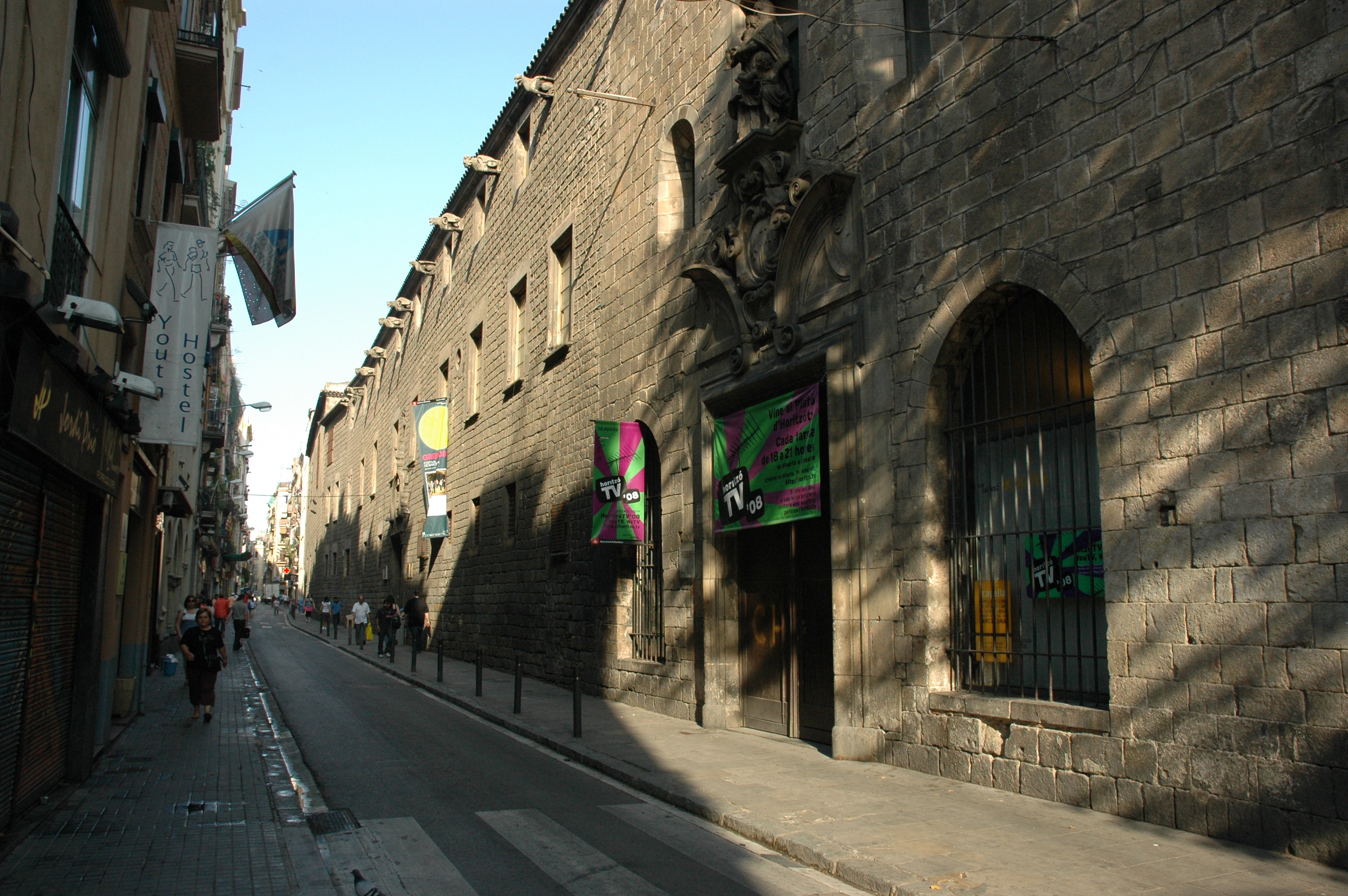
El Raval
They used to call it the Barrio Chino -- Chinatown -- though no Chinese community ever lived there. The name, borrowed from a journalist's comparison to San Francisco's red-light district in the 1920s, stuck to the part of El Raval closest to the port, a neighborhood of cabarets, brothels, and dark alleys where Jean Genet set his 1949 memoir The Thief's Journal. Today El Raval's 50,000 residents come from everywhere: Filipino, Pakistani, South American, Romanian, alongside lifelong Catalans whose families never left. Nearly half the population was born outside Spain. It is Barcelona's most international neighborhood, its most troubled, and, increasingly, its most creatively alive.
The Oldest Layers
El Raval sits in Barcelona's Ciutat Vella, bounded by La Rambla to the east, the Ronda de Sant Antoni and Ronda de Sant Pau to the west, and Avinguda del Paral-lel to the south. The neighborhood grew outside Barcelona's original medieval walls, accumulating convents, hospitals, and institutions that the city center had no room for. The Monastery of Sant Pau del Camp, a Romanesque gem hidden among apartment blocks, dates to the 10th century. In the southern part of the neighborhood, an old wall and gate called the Portal de Santa Madrona survives as part of the Maritime Museum, a fragment of the medieval city embedded in the modern one. These stone remnants anchor El Raval in a past that predates its reputation for danger, a reminder that before the cabarets came the monks.
Where Art Meets the Street
El Raval's cultural landscape defies its rough reputation. Antoni Gaudi's Palau Guell stands on Carrer Nou de la Rambla, an early masterwork of twisted ironwork and parabolic arches built for the industrialist Eusebi Guell. A few blocks north, the MACBA -- Barcelona's Museum of Contemporary Art -- occupies a gleaming white Richard Meier building on the Placa dels Angels, where skateboarders share the plaza with museum visitors. Near the MACBA, a reproduction of Keith Haring's 1989 mural Todos Juntos Podemos Parar el SIDA covers a wall, its bold figures a reminder of a different epidemic. On the Rambla del Raval, a wide pedestrian boulevard carved through the neighborhood's dense fabric, Fernando Botero's massive bronze cat lounges with the imperturbable calm of a creature that has seen everything and judges nothing. La Boqueria, the city's most famous food market, sits at El Raval's eastern edge on La Rambla.
The Neighborhood's Shadows
El Raval does not hide its difficulties. Forty percent of residents live at risk of social exclusion. Drug crime, particularly heroin, has proven stubbornly resistant to police intervention. Robberies are frequent enough that the neighborhood carries a reputation as Barcelona's most dangerous. Enriqueta Marti, the early 20th-century serial killer known as the Vampyre of Barcelona, operated here, kidnapping children from the streets. The neighborhood's history of exploitation, from the brothels of the Barrio Chino era to contemporary struggles with poverty and addiction, is woven into its identity alongside the art museums and medieval monasteries. El Raval has never been a place that could be reduced to a single narrative. Writers have understood this: Manuel Vazquez Montalban set his detective novels here, Carlos Ruiz Zafon's The Shadow of the Wind unfolds through its streets, and Roberto Bolano's The Savage Detectives passes through its bars.
Reinvention Without Erasure
The transformation of El Raval over the past three decades has been deliberate but incomplete, and the incompleteness may be its salvation. The MACBA and the Centre de Cultura Contemporania de Barcelona were placed here intentionally, cultural institutions dropped into a struggling neighborhood to catalyze change without the wholesale demolition that gentrification usually demands. The Rambla del Raval was cut through to bring light and open space into a district that had neither. New restaurants and bars have followed the museums, drawing visitors deeper into streets that guidebooks once warned them away from. But El Raval has resisted becoming sanitized. The immigrant communities that gave it demographic complexity remain. The monastery still stands. The cat still lounges. The pickpockets still work La Rambla's edge. It is a neighborhood where a 10th-century church, a Gaudi palace, a contemporary art museum, and a heroin crisis exist within a ten-minute walk of one another, each one as real as the others.
From the Air
El Raval (41.38°N, 2.17°E) occupies the western half of Barcelona's Ciutat Vella, visible from the air as a dense grid of narrow streets between La Rambla and the Ronda de Sant Antoni. Barcelona-El Prat (LEBL) is 12km southwest. The MACBA's white rectangular form is identifiable from lower altitudes. The neighborhood extends from near Placa Catalunya south to the port area, bounded by the tree-lined La Rambla to the east.