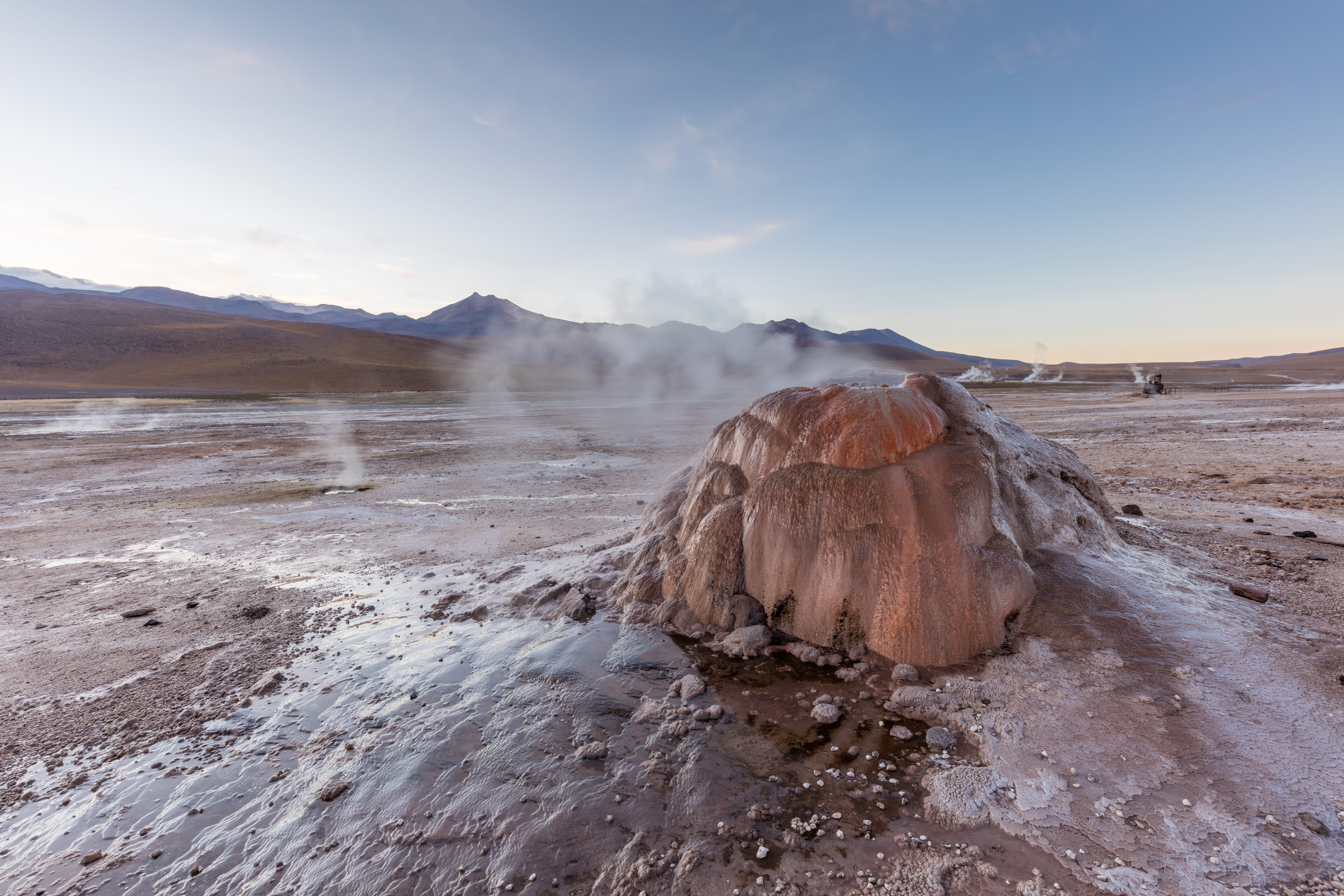
El Tatio
The name comes from the nearly extinct Kunza language, and its meaning has been debated for over a century. Some translate "tatio" as "oven." Others say it means "grandfather" -- a grandfather whose tears, according to tradition, rise as steam from the earth. At 4,320 meters above sea level in the Chilean Andes, El Tatio is the third-largest geyser field in the world and the largest in the Southern Hemisphere, a place where roughly 110 documented geothermal vents -- with an estimated total of 400 -- puncture the high desert floor at the foot of volcanoes that rise above 5,000 meters.
The Grandfather's Tears at Dawn
El Tatio is best witnessed at sunrise. In the freezing predawn darkness, visitors drive 89 kilometers north from San Pedro de Atacama on an unpaved road that climbs steadily into the altiplano. As the first light strikes the field, the temperature differential between the scalding water and the frigid air -- which can drop below minus twenty degrees Celsius -- produces towering columns of steam that catch the low sun and glow amber and gold. The geysers themselves are modest by Yellowstone standards: most eruptions reach no more than a meter in height, though some have historically exceeded ten meters. But what El Tatio lacks in individual drama it compensates with sheer density, dozens of vents hissing, bubbling, and spouting across a landscape of geyserite cones, terraced mineral pools, and bubbling mud pots edged in sulfur yellow.
A Field Between Volcanoes
The geothermal field sits at the western foot of a chain of stratovolcanoes straddling the Chile-Bolivia border. Cerro Deslinde rises to nearly 5,700 meters, the highest peak in the immediate area. These volcanoes belong to the Central Volcanic Zone of the Andes, part of the massive Altiplano-Puna volcanic complex -- a system of ancient calderas that produced supereruptions between ten million and one million years ago. Some of those calderas likely supply the heat that drives El Tatio today. The water that emerges from the geysers eventually feeds the Rio Salado, a major tributary of the Loa River, significantly increasing the river's arsenic content -- a reminder that the same geological forces that create spectacle also create hazard. Sinter deposits from the mineral-laden waters cover roughly 30 square kilometers, building cones, terraces, and crusts in formations that have drawn comparisons to Martian landscapes.
Earth's Mirror for Mars
El Tatio's extreme altitude, intense UV radiation, wide daily temperature swings, and low precipitation make it one of the closest terrestrial analogues to conditions on early Mars. Scientists have studied the extremophile microorganisms that thrive in its scalding, mineral-rich waters -- hyperthermophiles that build biogenic structures in the silica sinter surrounding the vents. When NASA's Spirit rover found similar microstructures in the Columbia Hills at the Home Plate formation on Mars, researchers pointed to El Tatio as a potential Earthly model. The resemblance does not prove Martian life, but it narrows the field of plausible explanations. For astrobiologists, El Tatio offers something no laboratory can: a living, breathing geothermal system operating under conditions that approximate another planet.
The Blowout That Changed Everything
Geothermal prospecting at El Tatio began remarkably early. In 1921, Italian engineers from Larderello -- the world's pioneering geothermal site in Tuscany -- probed the field on behalf of a private society founded in Antofagasta. Technical and economic problems halted that effort, but large-scale drilling resumed in the 1960s and 1970s. Then, on September 8, 2009, an older well being reused blew out, sending a 60-meter steam column into the sky. The plume was not capped until October 4. The incident ignited a political firestorm. The local Atacameno people had long opposed geothermal development, citing both environmental concerns and the spiritual significance of El Tatio's waters. The blowout vindicated their fears, and geothermal development at the site was effectively halted. Chile's broader geothermal ambitions have remained largely stalled since.
Sacred Water, Contested Ground
For the Atacameno communities of the surrounding altiplano, El Tatio is not a resource to be tapped but a place of deep cultural meaning. Water in the Atacama Desert is life itself, and the springs that feed the Rio Salado sustain ecosystems and communities downstream. The old Inca trail from San Pedro de Atacama to Siloli once crossed the geyser field, and the Inca maintained a mountain sanctuary on Volcan Tatio. Today, the field draws tens of thousands of tourists annually, making it one of northern Chile's most visited attractions. That tourism brings its own tensions -- between economic opportunity and preservation, between the spectacle visitors seek and the fragility of the geothermal features that provide it. El Tatio endures, as it has for millennia, exhaling the Earth's heat into thin, cold air.
From the Air
El Tatio is located at approximately 22.33S, 68.01W at 4,320 m elevation in the Atacama highlands of northern Chile. The steam plumes from the geyser field can be visible from altitude, especially at dawn. The field lies 89 km north of San Pedro de Atacama and 100 km east of Calama. Nearest major airport is El Loa Airport (SCCF) at Calama. Surrounded by stratovolcanoes exceeding 5,000 m -- excellent visibility in dry desert conditions. The Sol de Manana geothermal field lies 30 km east across the Bolivian border.