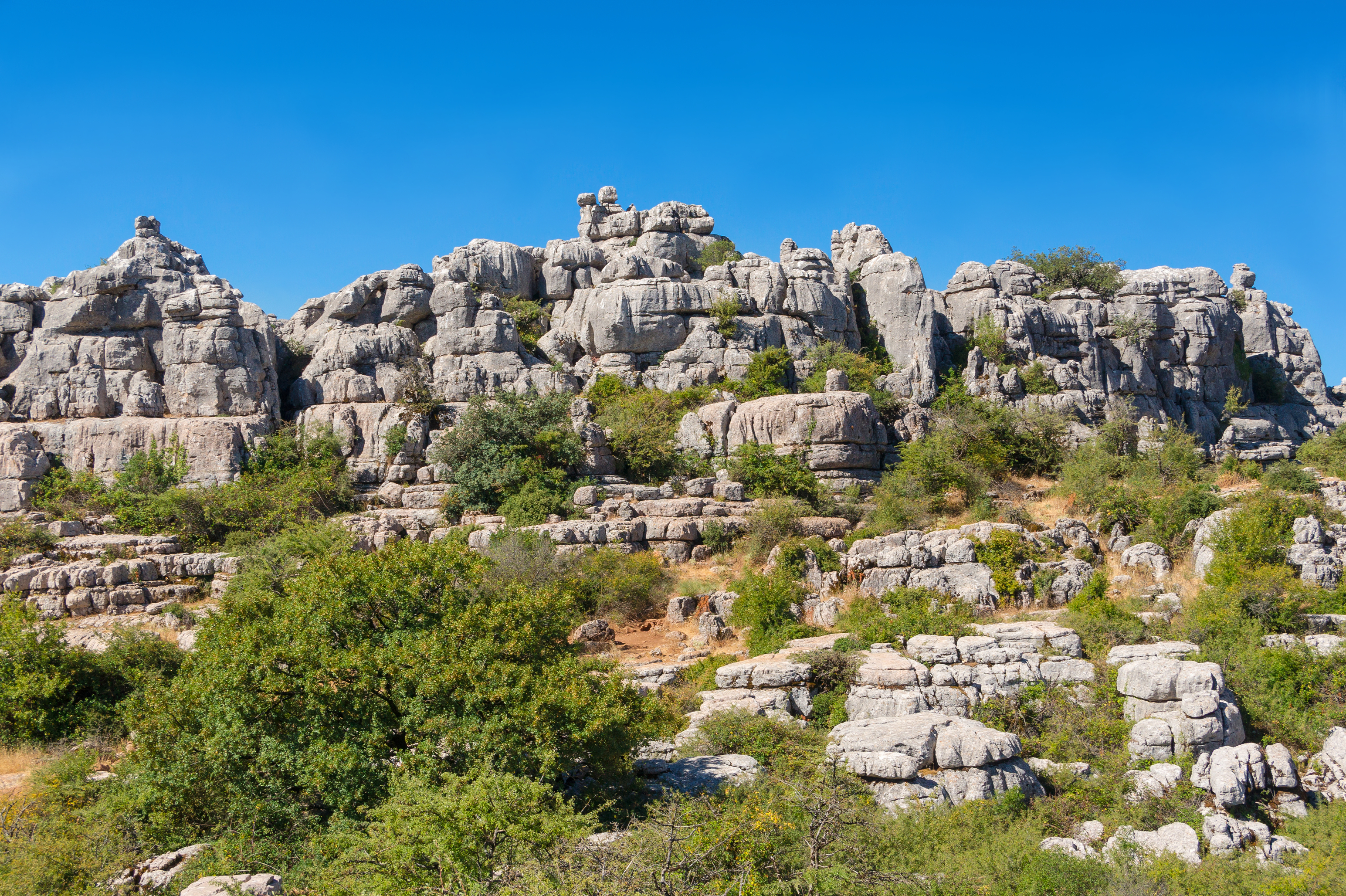
El Torcal de Antequera
Somewhere between Antequera and Malaga, the earth forgot how to be ordinary. The limestone of El Torcal rises in stacked, weathered columns that look like the abandoned game pieces of giants -- formations with names like the Sphinx, the Jug, the Camel, and the Screw. Walking the narrow corridors between these towers, you lose any sense of normal geology. The rock walls close in, open up, twist overhead into improbable balancing acts. This is one of Europe's most impressive karst landscapes, and it exists because a shallow sea that stretched from the Gulf of Cadiz to Alicante 150 million years ago left behind beds of Jurassic limestone that would eventually be lifted over 1,300 meters into the sky.
An Ancient Seabed, Standing on End
The story of El Torcal begins in the Jurassic period, when a marine corridor ran between what are now the Atlantic Ocean and the Mediterranean Sea. For millions of years, sediment accumulated on its floor, compressing into thick beds of limestone. During the Tertiary era, tectonic forces heaved these seabeds upward to an elevation of over 1,300 meters, creating a modest but unusual mountain range of flat-lying limestone -- something rare in Andalusia, where most mountain rock has been folded and tilted. The result is a landscape built on horizontal layers, each one eroding at its own pace. A network of fractures running roughly northwest-southeast and northeast-southwest provided water and ice with pathways into the rock. Over millennia, dissolution and freeze-thaw cycles carved the distinctive alleys, pillars, and mushroom-shaped formations that make El Torcal unlike anything else in the region.
Life Among the Stones
The labyrinthine rock formations create a surprisingly rich habitat. Griffon vultures ride thermals above the towers, their broad wings casting shadows over the corridors below. Spanish ibex -- the Andalusian mountain goat -- navigate ledges that seem impossible for anything larger than a lizard, and the ocellated lizard itself basks on sun-warmed stone surfaces, its jewel-toned scales catching the light. At night, the landscape belongs to badgers and weasels, creatures rarely seen but whose tracks mark the sandy passages between boulders. Wildflowers colonize every crack and shelf, and the rock-dwelling plants that cling to these formations have adapted to a life of extreme temperature swings -- scorching summer days and freezing winter nights that make the Torcal inhospitable for casual visitors much of the year.
What Lies Beneath
Like any massive limestone formation, El Torcal hides as much below ground as it reveals above. Caves riddle the interior, formed by the same dissolution process that carved the surface. The most significant is the Cueva del Toro -- the Cave of the Bull -- where Neolithic artifacts reveal that humans sheltered here thousands of years ago, long before anyone thought to name the rock formations or build hiking trails between them. The caves remain poorly explored, their full extent unknown, connected by passages that water has been widening since before recorded history.
Walking Through a Stone Forest
El Torcal was designated a Natural Site of National Interest in July 1929 and became a Natural Park Reserve of about 17 square kilometers in October 1978. Access is straightforward -- a paved road winds up from the village of Villanueva de la Concepcion to a parking area with an interpretive center. From there, three color-coded hiking trails of 1.5, 2.5, and 4.5 kilometers thread through the formations, each offering viewpoints that frame the limestone towers against the Andalusian sky. Spring and autumn draw the most visitors; summer heat and winter cold keep the crowds thin the rest of the year, leaving the stone corridors to the vultures, the ibex, and the slow work of water on rock.
From the Air
Located at 36.96N, 4.55W, between Antequera and Malaga in Andalusia. The karst formations are visible from moderate altitude as a distinctive pale rocky plateau south of Antequera. The nearest major airport is Malaga-Costa del Sol (LEMG), approximately 45 km to the south. At lower altitudes, the stacked limestone pillars and corridors become visible. Best viewed in clear conditions when the white rock contrasts sharply with surrounding vegetation.