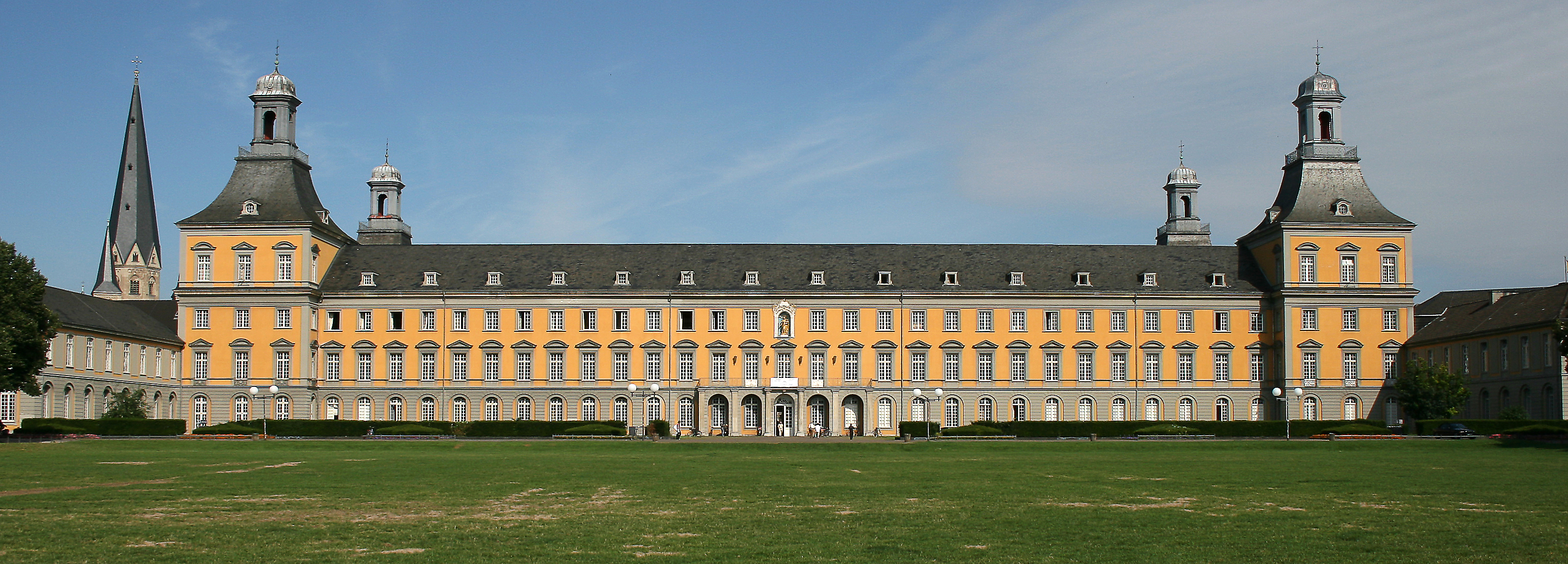
Electoral Palace, Bonn
On 10 October 1981, roughly a quarter of a million people pressed into the Hofgarten in front of a long pink-stuccoed palace in Bonn. They had come to protest the NATO Double-Track Decision and the planned stationing of Pershing II missiles on West German soil. The crowd was so dense that the photographs feel almost solid, a single textured surface of bodies and banners stretching the length of the lawn. Behind them stood a building that had spent the eighteenth century deciding the politics of the lower Rhine, the nineteenth century becoming a university, and the twentieth century burning down twice. The Electoral Palace had seen demonstrations before. It had simply never been one of the things being demonstrated past.
Joseph Clemens Rebuilds
An earlier palace stood here from 1567 to 1577, built for the Archbishop-Elector Salentin of Isenburg and pressed against Bonn's southern city wall. It did not survive the Siege of Bonn of 1689, when Joseph Clemens of Bavaria — Cologne's Wittelsbach prince-elector — fought his way back into the city. Joseph Clemens promptly hired Enrico Zuccalli, his Swiss-born court architect, and from 1697 to 1705 the new palace went up: a quadrangular block with four corner towers, an arcaded inner courtyard, and a cour d'honneur opening to the north-east. Between 1715 and 1723 the French architect Robert de Cotte — the same man designing Poppelsdorf Palace at the other end of the avenue — added the Buen Retiro wing and laid out the gardens. In 1744 a gilded Marian image, the Regina Pacis, was installed in the centre of the third storey. She is still there, watching the Hofgarten.
Fire and Reinvention
Then, in 1777, a fire started in the west wing. It spread through the roof and reached the powder chamber. The explosion killed scores of Bonn residents and, for a frightening few hours, threatened to consume the city. Rebuilding was slow, partial, and overtaken by history. In 1794 revolutionary French troops marched into the Rhineland, the Electorate of Cologne effectively ceased to exist, and the palace's life as a residence of the prince-electors ended. When the French withdrew, the building passed to the Prussian crown. King Frederick William III — who had a habit of inventing universities on properties that suddenly belonged to him — donated the palace in 1818 to the new Rhenish Friedrich Wilhelm University of Bonn. It has been the university's main building ever since.
Beethoven at the Organ
The most extraordinary surviving interior is the palace church in the north-east end, built in 1779 by Johann Heinrich Roth. As a young organist — he was born in Bonn in 1770 and was already a working musician by his early teens — Ludwig van Beethoven occasionally played here. By 1816 Frederick William III had donated the space to Bonn's Protestant community, and in 1844 Karl Friedrich Schinkel rebuilt the chancel. The church was destroyed by the Allied bombing that flattened the rest of the palace in 1944, then patiently reconstructed after the war, stucco and all. A new Klais organ was installed at the back of the nave in 2012. Practising students still rehearse here, which means that on a good afternoon you can still hear an organ filling a room where Beethoven once filled it himself.
Hofgarten and Koblenz Gate
The palace as you see it today is not quite what Zuccalli built. The exterior was painstakingly restored after 1944 — the bombing in October of that year had gutted the entire interior — but inside, most rooms were rebuilt in a stripped-down, university-friendly idiom. A handful of spaces survive in their original feel. The Aula, the ceremonial hall, occupies what was once the court church in the west wing. The Koblenz Gate, on the gallery wing toward the Rhine, is a wildly exuberant late-baroque set-piece designed by François de Cuvilliés and built by Michael Leveilly between 1751 and 1755, topped with a gilded Saint Michael. And out in front, the Hofgarten remains what it has always been: a long green rectangle where the university and the city overlap, where students nap on summer afternoons, and where, on the right October day in 1981, a quarter of a million people decided their government was wrong.
From the Air
50.7337 N, 7.1027 E in the centre of Bonn, with the long axis of the Poppelsdorfer Allee leading southwest toward Poppelsdorf Palace. Cologne-Bonn (EDDK / CGN) lies about 18 km north; Bonn-Hangelar (EDKB) is around 5 km northeast. From 2,000–3,000 feet the palace reads as a long, pale rectangle wrapped around a courtyard, with the green Hofgarten stretching to the north and the dead-straight tree-lined Allee running southwest toward Poppelsdorf's smaller, squarer block.