Elephanta Caves
Three faces emerge from the dark basalt. The central face is serene, eyes closed or nearly so, embodying the eternal calm of Shiva as creator. To the left, a feminine aspect -- gentle, holding a lotus. To the right, a mustachioed face of wrath, with a cobra in hand. The Trimurti of Elephanta stands over five meters tall, carved directly from the rock of a cave on a small island in Mumbai Harbor, and it has been gazing into the half-darkness for approximately 1,400 years. Portuguese sailors, arriving in the sixteenth century, named the island after a stone elephant they found near the shore. The sculptors who carved these caves never recorded what they called it.
The Island in the Harbor
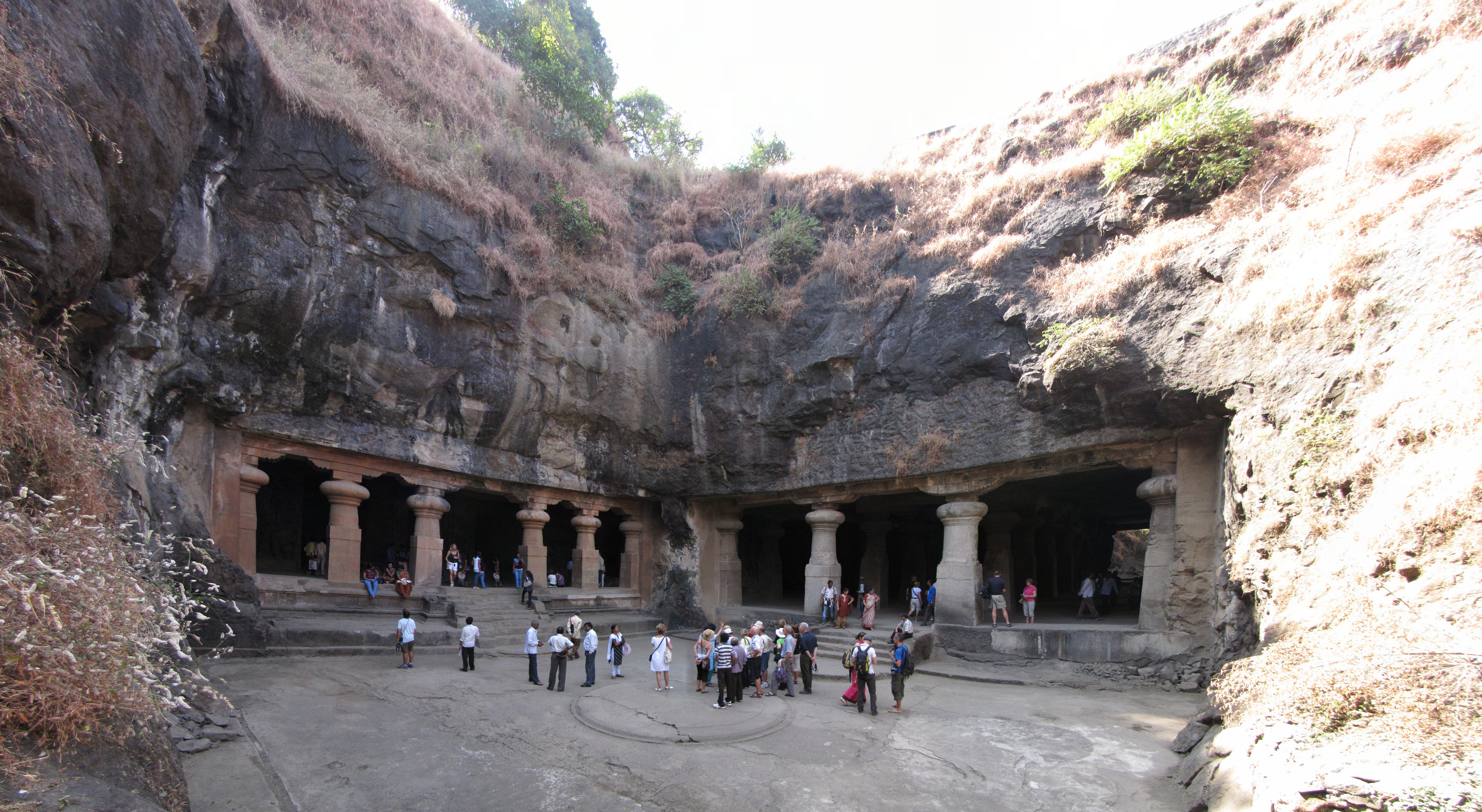
Elephanta Island -- known locally as Gharapuri, the "city of caves" -- sits in Mumbai Harbor, reachable by a one-hour ferry ride from the Gateway of India. The island holds seven cave excavations: five Hindu and two Buddhist. The Hindu caves are the main attraction, dominated by Cave 1, the Great Cave, a massive rock-cut temple dedicated to Shiva. To reach it, visitors climb 120 steep steps from the ticket counter near the pier, passing through a gauntlet of vendors, or take a small tourist train along a footpath before the ascent begins. At the top, four pillars frame the main entrance with three open porticoes and an aisle at the back. Inside, rows of six pillars divide the hall into smaller chambers, their capitals joining stone columns to a roof of concealed beams. The scale is deliberate: this space was designed to make a human being feel small.
Shiva in Every Form
Each wall of the Great Cave carries massive relief carvings of Shiva-related legends, each more than five meters high. The Trimurti Sadashiva, on the south wall opposite the main entrance, is the centerpiece -- three faces representing the creator, preserver, and destroyer aspects of the divine. But the cave holds far more than one masterpiece. To the left of the entrance, a damaged panel depicts Yogishvara, Shiva as Lord of Yoga; to the right, Nataraja, Shiva as Lord of Dance. Large friezes of Ardhanarishvara -- Shiva as half-male, half-female -- and Gangadhara -- Shiva receiving the descent of the River Ganges -- flank the Trimurti. Other panels show the wedding of Shiva and Parvati, Shiva slaying the demon Andhaka, and Shiva and Parvati on Mount Kailash. The eastern shrine features iconography from the Shaktism tradition, while smaller panels depict Kartikeya, the Matrikas, Ganesha, and guardian dvarapalas. Together, the carvings form a comprehensive theological statement in stone.
Who Built This, and When
Dating the Elephanta Caves has been a matter of scholarly debate for decades. Most historians now attribute the primary excavation to the mid-sixth century, during or shortly after the Kalachuri dynasty's period of influence in the region, though some scholars have argued for earlier Gupta-period origins based on stylistic analysis of certain panels. The two Buddhist caves on the island are generally considered older than the Hindu caves. What is clear is that the sculptors worked in a tradition of extraordinary technical command -- carving deep into the basalt hillside, leaving pillars and walls intact while excavating chambers and shaping figures that remain structurally sound after more than a millennium. The Portuguese, who controlled the island from the sixteenth century, used the caves for target practice, damaging many of the sculptures. The stone elephant that gave the island its European name was eventually moved to Mumbai's Victoria Gardens, where it deteriorated before being restored.
Damage and Recognition
Centuries of neglect and active destruction took their toll. The Portuguese damaged sculptures with musket fire. Weathering eroded exposed surfaces. The two flanking panels at the northern entrance -- the Yogishvara and Nataraja -- bear significant damage. Yet what survives is extraordinary enough that UNESCO designated the Elephanta Caves as a World Heritage Site in 1987, recognizing them as a masterpiece of rock-cut architecture and one of the finest surviving examples of Hindu cave temple art. The Archaeological Survey of India now maintains the site. Conservation efforts have stabilized the most vulnerable structures, though the basalt continues to weather in Mumbai's humid, salt-laden air. The caves remain an active pilgrimage site, not merely a museum piece -- visitors still leave offerings at the shrines.
The Ferry and the Silence
The contrast is the point. Mumbai, one of the densest and loudest cities on Earth, lies an hour away by ferry. The island is green and quiet, monkeys darting through the trees along the path from the pier to the caves. Inside the Great Cave, the sound drops to footsteps and murmured conversation. The Trimurti waits in the dim light at the far wall, indifferent to cameras and crowds, its three faces holding an expression that has outlasted the dynasties that carved it, the colonizers who shot at it, and the millions of visitors who have climbed those 120 steps to stand before it. The abstract linga form of Shiva occupies a separate shrine set in a mandala pattern -- the cave's spiritual center, where the figurative and the formless meet. Whatever the sculptors intended 1,400 years ago, the effect endures: a place carved from rock that feels carved from time itself.
From the Air
Elephanta Island is located at approximately 18.96N, 72.93E in Mumbai Harbor, Maharashtra, India. The island is visible from the air as a green, hilly landmass in the harbor east of Mumbai's peninsula. Best viewed at 2,000-4,000 feet AGL. The ferry route from the Gateway of India to the island's pier is often visible as a line of small boats. Nearest airport: Chhatrapati Shivaji Maharaj International Airport (VABB). The island sits roughly between Mumbai's eastern waterfront and the mainland city of Navi Mumbai across the harbor. Look for the distinctive forested hill rising from the harbor waters.