Elfstedentocht
Fifteen centimetres. Six inches of solid ice along nearly two hundred kilometres of canals, rivers and lakes - that is what Friesland needs to hold its national ritual. The province has not had it since 4 January 1997. In the twenty-eight years before that, the ice was thick enough only twice. In the twenty-eight years since, not once. The Elfstedentocht - the Eleven Cities Tour - is the largest skating race on Earth and probably its most endangered cultural event, dying not from indifference but from a warming climate that refuses to deliver the cold it requires.
The Course That Only Exists Some Years
The route is a loop drawn across the frozen veins of Friesland. From Leeuwarden it runs south to Sneek and IJlst, west through Sloten and Stavoren and Hindeloopen, north past Workum and Bolsward to the coast at Harlingen, inland through Franeker to Dokkum in the far north, and back to where it started. Eleven historic cities. Around fifteen thousand amateur skaters and three hundred racers - all of them members of the Association of the Eleven Frisian Towns - leave Leeuwarden together before sunrise. Each must collect a stamp in every city plus three at secret checkpoints, and each must finish before midnight. Where the ice grows thin, skaters lurch onto klunmats - carpets laid across the ground - and walk on their blades around the weak patches. The verb has its own Frisian name: klunje.
The Hell of '63
On 18 January 1963 the temperature dropped to minus eighteen Celsius and ten thousand skaters set off into a powder-snow blizzard and an east wind that ground them down all day. Only sixty-nine of them finished. Reinier Paping won, and by the end he was snow-blind and could not see the finish line as he crossed it. Other skaters came in with frostbite, broken bones, eyes damaged by ice crystals. The race became known as De Hel van '63, the Hell of '63, and Paping became something more than a champion - he became the human face of the tour's brutal mythology. People still speak of that day the way other nations speak of a war. To finish the Elfstedentocht in 1963 was to have survived something.
Elfstedenkoorts
When a cold spell settles over the Netherlands, the entire country starts watching the ice. Newspapers track temperatures hour by hour. The Royal Netherlands Meteorological Institute releases ice-thickness forecasts. Locks on the canals close. A mood seeps in that the Dutch call Elfstedenkoorts - eleven cities fever. In 2012, with the prospect tantalisingly close, Prime Minister Mark Rutte joked that once every fifteen years the country is not governed from The Hague but by twenty-two district heads in Friesland. The committee met for the first time in fifteen years. Ice grew to twenty centimetres in places, two centimetres in others. On 8 February the chairman, Wiebe Wieling, said the words the country dreaded: the race was off. The cold spell had been ten days. The 1997 tour had needed twelve.
If the Skating Cannot Be Held
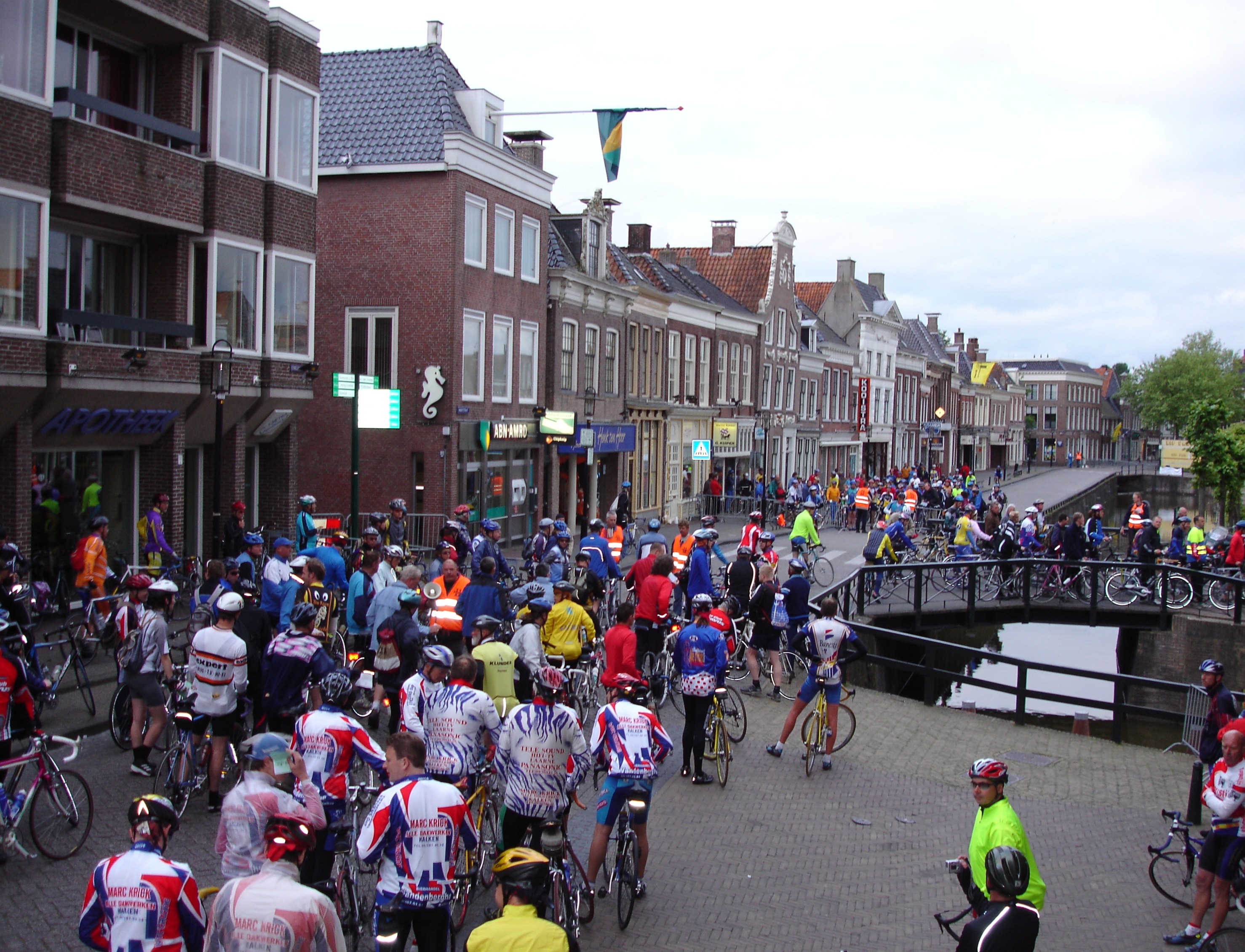
Frisians, who carry a reputation for surliness, are said to thaw when it freezes - but they have also stopped waiting for it. The bicycle Elfstedentocht runs every Whit Monday on the same route, 235 kilometres starting from Bolsward, capped at fifteen thousand riders. A swimming version exists too: in June 2019 the long-distance swimmer Maarten van der Weijden swam all eleven cities for cancer research, raising over six million euros. In 2022 Frisian triathlete Stefan van der Pal completed the entire tour as a triathlon - swimming five days, cycling seven hours, then running thirty-two and a half hours. Van der Weijden returned in 2023 to do the triathlon himself, walking the final segment instead of running it, and raised over four million euros more. The route refuses to die. Only its ice does.
A Frozen Country From the Air
On the rare day the tour is run, Friesland from altitude looks like a circuit board of frozen lines - canals and rivers radiating between the eleven dots of the cities, each dot ringed by skaters arriving and leaving. On any other winter day, those same waterways show the colour of unfrozen water cutting through green or brown polder. The most westerly stretch out to Stavoren on the IJsselmeer is the hardest to freeze; the sheltered eastern leg to Dokkum, the easiest. Pilots flying the Netherlands in January now look down on a province whose biggest ritual has become a memory waiting on the weather.
From the Air
The course loops through Friesland, north of the Netherlands. Leeuwarden lies at 53.20 N, 5.80 E. Nearest commercial airfields: Leeuwarden Air Base (EHLW) just west of the city, Groningen Airport Eelde (EHGG) 60 km east, Amsterdam Schiphol (EHAM) about 110 km southwest. The full route circles roughly between 52.9 and 53.4 N. Best altitude for tracing the course is 3,000 to 6,000 feet - low enough to see the canal grid, high enough to take in all eleven cities. In a cold snap, look for crowds and dark lines of skaters following the white ribbons of frozen canals. The Wadden Sea to the north and the IJsselmeer to the southwest are useful navigational anchors.