Elgin and Winter Garden Theatres
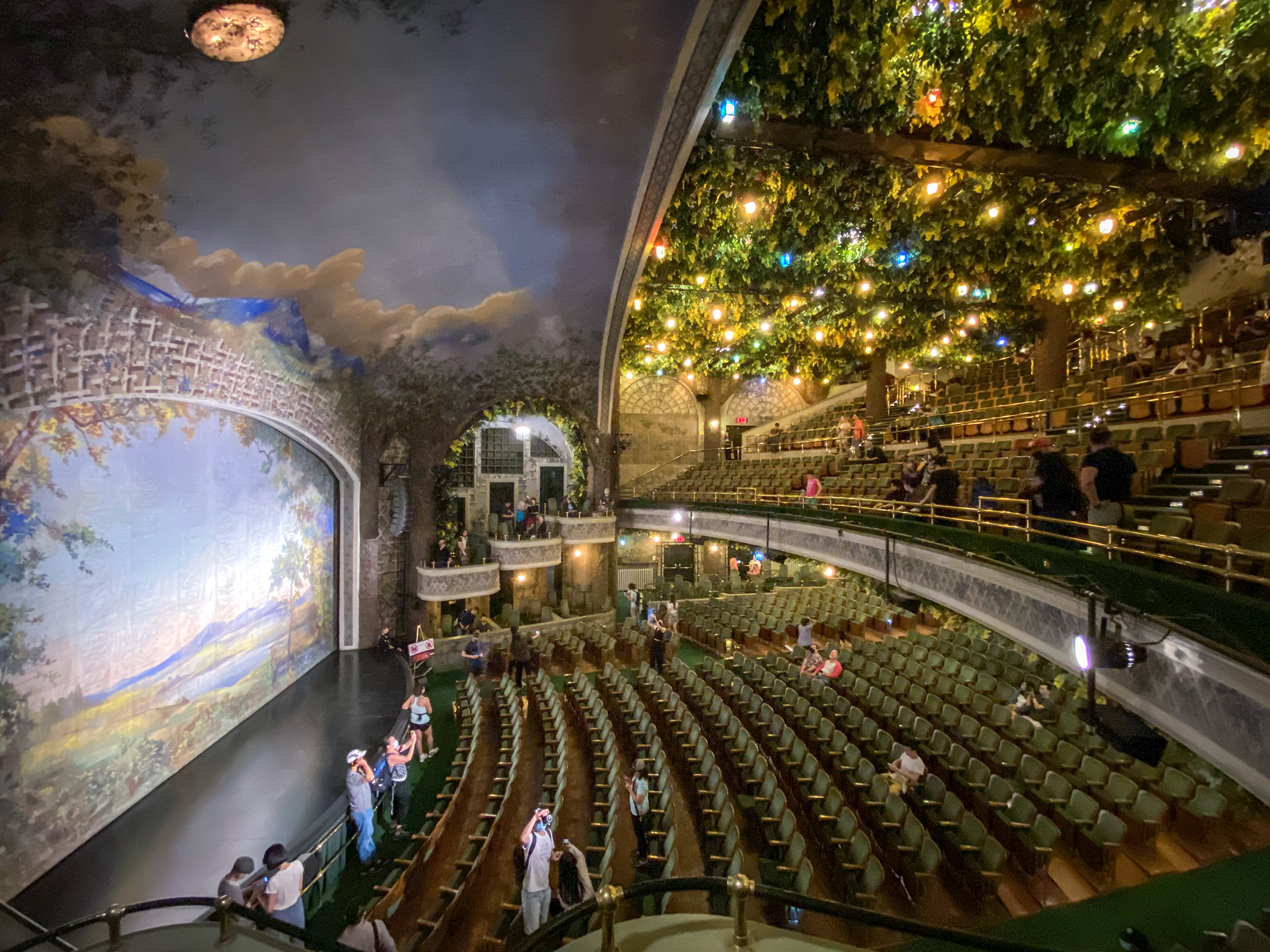
Look up through the ceiling of the Winter Garden Theatre and you will see real beech branches -- dried, preserved, and woven into a canopy overhead, with hand-painted lanterns glowing among them. The walls are watercolour garden scenes. The entire room was designed to make audiences feel they were watching a show outdoors, beneath a forest at dusk. Seven storeys below, the Elgin Theatre offers a different world entirely: gilded ornament and plush Edwardian grandeur. Together, these two auditoriums stacked one atop the other on Yonge Street form the last surviving double-decker theatres from the Edwardian era anywhere on Earth.
Two Stages, Two Classes
Marcus Loew built the theatres in 1913 as the flagship of his theatre chain. The design by architect Thomas Lamb was deliberately stratified: two complete theatres, one above the other, each targeting a different class of patron. The lower Elgin served the upscale crowd, while the Winter Garden upstairs was used for experimentation -- testing new vaudeville acts and silent film programs without risking the reputation of the main house below. Both stages ran simultaneously, filling the building with overlapping waves of applause and laughter separated by seven floors of concrete and steel.
Sixty Years of Silence
By 1928, feature-length sound films had arrived, and the lower Elgin was converted into a cinema. The Winter Garden, no longer needed, was simply locked shut. For roughly sixty years, the upper theatre sat in darkness -- its beech-leaf ceiling undisturbed, its painted garden walls untouched by renovation or demolition. When the Ontario Heritage Foundation purchased the building from Famous Players in 1981, they found the Winter Garden remarkably intact, a time capsule of Edwardian theatrical design preserved by neglect. The musical Cats ran in the essentially unrestored Elgin from 1985 to 1987, proving the venue could still draw audiences. Then the building closed for a full restoration and reopened in 1989, both theatres alive again for the first time in over half a century.
Stage and Screen
The restored theatres quickly reclaimed their place in Toronto's cultural life. The Elgin hosted the world premiere of the Napoleon musical in 1994 and The Who's Tommy in 1995. Ross Petty Productions staged Christmas pantomimes there for 26 consecutive years, from 1996 to 2022. In February 2004, Conan O'Brien taped four episodes of Late Night from the Elgin stage -- a visit underwritten by Toronto City Council with a $1 million payment to NBC, part of a campaign to revive tourism after the 2003 SARS epidemic. Mike Myers, Michael J. Fox, Jim Carrey, Stompin' Tom Connors, and the Barenaked Ladies all appeared. Bryan Adams recorded a Great Performances concert there for PBS in 2014.
Woven Into Fiction
The theatres have seeped into popular culture in ways that extend far beyond live performance. Rush shot the cover photos for their 1981 live album Exit...Stage Left at the Winter Garden. Emily St. John Mandel chose the Elgin's stage as the opening scene of her 2014 novel Station Eleven, a story about civilization's collapse that begins with an actor dying mid-performance of King Lear. Guillermo del Toro filmed scenes for The Shape of Water in the Winter Garden in 2017, and Sofia Coppola used it for her 2023 film Priscilla. The 1973 TV movie She Cried Murder placed a pivotal scene in the then-shuttered Winter Garden, capturing on film a space the public would not see again for another sixteen years.
From the Air
The Elgin and Winter Garden Theatres are located at 189 Yonge Street in downtown Toronto, at approximately 43.6531N, 79.3792W. The building sits in the dense urban core along Yonge Street, roughly 0.5 nm southeast of City Hall and Nathan Phillips Square, and 0.7 nm east of the CN Tower. Billy Bishop Toronto City Airport (CYTZ) is 2 nm to the south on the Toronto Islands. Toronto Pearson International (CYYZ) is 15 nm northwest. Best viewed at 2,000-3,000 feet AGL; look for the Yonge Street corridor running north-south through the downtown grid.