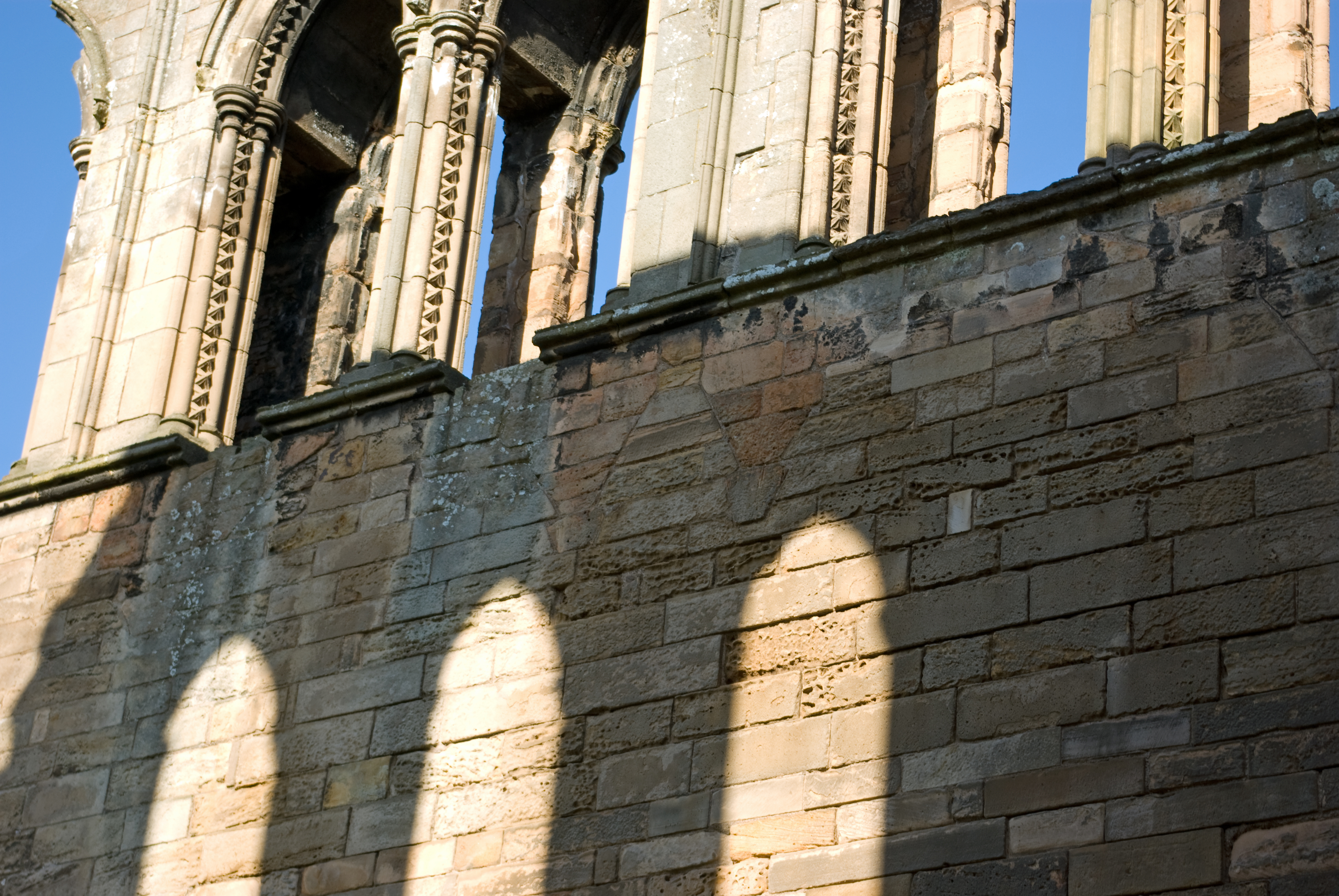
Elgin Cathedral
They called it the Lantern of the North. Founded in 1224, Elgin Cathedral was the seat of the Diocese of Moray and one of the finest Gothic buildings in Scotland -- a cruciform church with twin-towered west front, octagonal chapter house, and windows that caught the northern light in ways that earned the building its luminous nickname. Then, in June 1390, Alexander Stewart -- the Wolf of Badenoch, brother of King Robert III -- burned the cathedral, its manses, and the entire burgh of Elgin to the ground. The reasons were personal: the bishop had excommunicated him for abandoning his wife. Stewart's response was to set fire to the most beautiful church in Scotland.
The First Cathedral
The original church, begun in 1224, was markedly cruciform and smaller than the building that would replace it. The choir had no aisles and the nave had only single aisles on its north and south sides. A central tower rose above the crossing between the transepts. The south transept's southern wall survives nearly complete, displaying the fine workmanship of this first phase: Gothic pointed arches that had first appeared in France in the mid-12th century and reached Scotland only in the early 13th. Alongside these Gothic forms, the round-headed Norman window design continued in use -- a peculiarly Scottish blending of old and new. The west front featured two buttressed towers 27.4 metres high, originally topped with wooden spires sheathed in lead.
Fire and Reconstruction
A fire in 1270 prompted the first major rebuilding. Outer aisles were added to the nave. The choir and presbytery were doubled in length and given aisles on both sides. The octagonal chapter house was built off the new north choir aisle, measuring 10.3 metres high at its apex and 11.3 metres from wall to wall, its vaulted roof supported by a single central pillar. Then came Stewart's devastating attack in 1390. The central tower had to be completely rebuilt. The principal arcades of the nave were reconstructed. The entire western gable between the towers was refashioned, and the main west doorway was recarved with intricate late-medieval ornament: branches, vines, acorns, and oak leaves. The chapter house required substantial modifications and was not fully repaired until Bishop Andrew Stewart's episcopacy ended around 1501 -- more than a century after the fire.
The Long Decay
After the Scottish Reformation, the cathedral ceased to function as a Catholic church. Maintenance stopped. The lead was stripped from the roof in 1567 on orders of the Privy Council. Without its protective covering, the building began to rot from the top down. The central tower finally collapsed in 1711, taking the crossing with it. The chapter house, though still standing, lost its roof. Stone was quarried from the ruins for use in other buildings. By the 19th century, Elgin Cathedral was a ruin open to the sky -- but a magnificent one, its twin western towers still standing, its chapter house still supported by its single pillar, its Gothic tracery still catching the light.
Restoration of the Ruins
Serious conservation began in the early 20th century. The east gable's rose window was restored in 1904. Walls were repointed and waterproofed by 1913. In the 1930s, some 19th-century buttressing was removed and sections of the nave piers were reconstructed using recovered stones. The chapter house window tracery was gradually replaced between 1976 and 1988, and the roof was restored. The southwest and northwest towers received new floors, glazing, and roofing between 1988 and 2000. Today the cathedral is managed by Historic Environment Scotland. Walking through the ruins, past the tomb of Bishop John of Winchester in the south choir aisle, past the blue marble stone marking the burial of Andrew de Moravia, you can still feel the scale of what the Wolf of Badenoch destroyed -- and the stubborn persistence of the stone that survived him.
From the Air
Located at 57.65N, 3.31W in the town of Elgin, Moray. The cathedral ruins are visible as a large walled complex with twin western towers near the River Lossie. RAF Lossiemouth (EGQS) is approximately 5 miles north. Best viewed at 1,500-2,500 ft AGL. The town of Elgin surrounds the cathedral precinct.