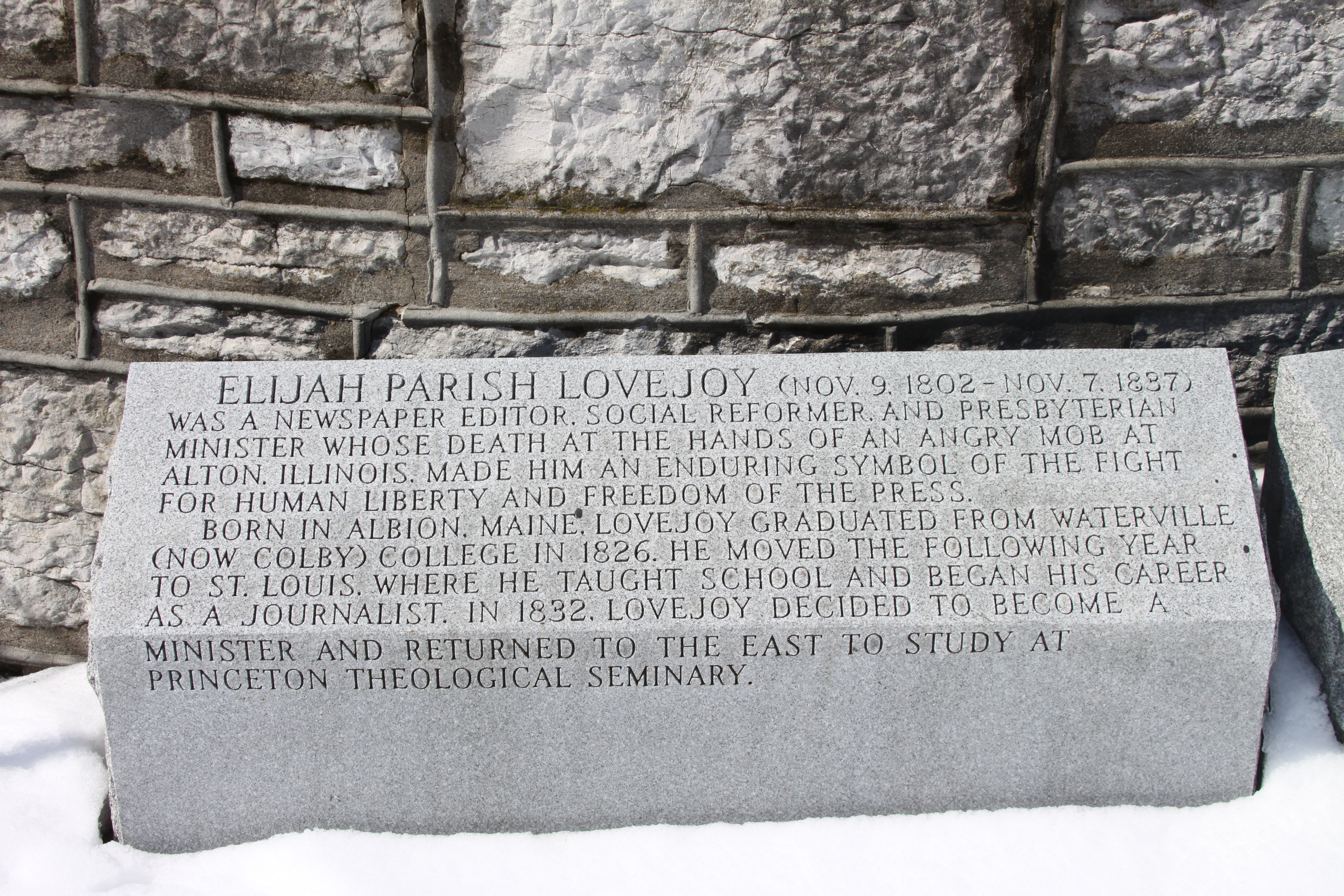
Elijah P. Lovejoy Monument
Abraham Lincoln called it 'the most important single event that ever happened in the new world.' He was talking about the murder of Elijah Parish Lovejoy, an abolitionist newspaper editor who was shot to death by a pro-slavery mob in Alton, Illinois, on November 7, 1837. Lovejoy had seen three of his printing presses destroyed by mobs before that night. When a fourth press arrived, he and his supporters guarded the warehouse where it was stored. The mob attacked, set the building on fire, and shot Lovejoy five times as he emerged. He was 34 years old. The monument that now marks his grave stands 93 feet tall, topped by a 17-foot bronze statue of winged Victory. It is the tallest structure in Alton Cemetery, visible for miles along the Mississippi River bluffs.
Four Presses Destroyed
Elijah Lovejoy was a Presbyterian minister from Maine who arrived in St. Louis in 1833 to edit the St. Louis Observer, a religious newspaper. When he began publishing anti-slavery editorials, the backlash was immediate and violent. In 1836, Lovejoy witnessed the lynching of Francis McIntosh, a free Black man who was chained to a tree and burned alive by a mob in downtown St. Louis. Lovejoy wrote a blistering condemnation of the killing and of the judge who instructed the grand jury not to indict anyone. The response was unambiguous: a mob destroyed his press and made clear he was no longer welcome in Missouri. Lovejoy moved across the river to Alton, Illinois, believing he would find more tolerance in a free state. He was wrong. Mobs destroyed three more of his presses between 1836 and 1837.
The Night of November 7
When Lovejoy's fifth printing press arrived in Alton in November 1837, he and a group of supporters stored it in the Godfrey and Gilman warehouse near the riverfront. Word spread quickly, and on the night of November 7, a mob gathered outside. The defenders barricaded themselves inside. Someone in the mob set the building's roof on fire. When Lovejoy stepped outside to prevent the fire from spreading, he was shot five times and killed. He became the first American journalist murdered for his writing, and the case crystallized the national debate over slavery and the First Amendment. The killing radicalized abolitionists across the North. John Quincy Adams, the former president, declared that Lovejoy's blood had been shed 'as a sacrifice to the cause of human freedom.'
Lincoln's 'Most Important Event'
Lovejoy's murder had an outsized impact on the American antislavery movement. Abraham Lincoln, then a 28-year-old Illinois state legislator, was deeply affected. Years later, he identified the killing as the pivotal event that pushed the nation toward its reckoning with slavery. For many Northerners who had been ambivalent about abolition, Lovejoy's death made the issue personal -- it demonstrated that slavery's defenders would use lethal violence to suppress free speech even in free states. The incident helped transform abolition from a fringe cause into a mainstream political movement. Lovejoy's brother Owen went on to become a U.S. congressman and prominent abolitionist. The murder in Alton echoed through the decades that followed, feeding the tensions that eventually erupted into the Civil War.
Ninety-Three Feet of Granite
The Elijah P. Lovejoy Monument was erected in Alton Cemetery in 1897, sixty years after the murder. The 93-foot granite column is topped by a 17-foot bronze statue of winged Victory, arms raised in triumph. The monument was designed to be seen from a distance -- from the Mississippi River bluffs, from the streets of Alton, from across the water in Missouri. Its scale is deliberate, matching the significance that Lincoln and others attached to Lovejoy's sacrifice. The monument stands in Alton Cemetery on a hillside overlooking the city and the river that brought Lovejoy to this place. It is both a grave marker and a statement: that the freedom of the press cost a man his life in a free state, and that the nation recognized, eventually, that his death changed the course of history.
From the Air
Located at 38.890°N, 90.166°W in Alton Cemetery on the bluffs above the Mississippi River in Alton, Illinois. The 93-foot granite column topped by a 17-foot winged Victory statue is the tallest structure in the cemetery and potentially visible from altitude on clear days. Alton sits 15 nm north of downtown St. Louis along the Mississippi. The Clark Bridge and the confluence area of the Missouri and Mississippi rivers are nearby landmarks. Nearest airports: KALN (St. Louis Regional/Alton, 3 nm NE), KSTL (St. Louis Lambert International, 15 nm S).