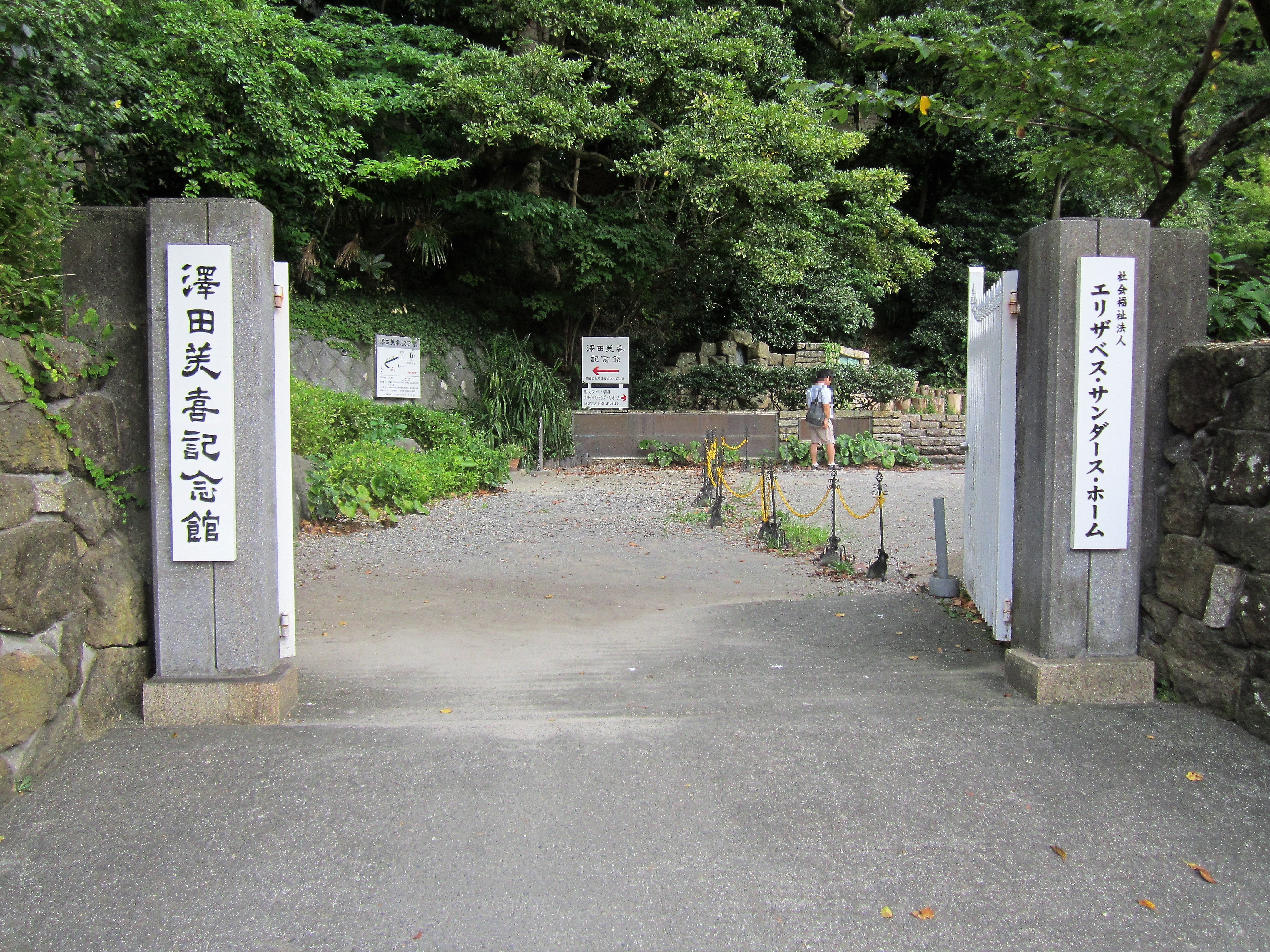
Elizabeth Saunders Home: The Mother of Two Thousand Children
On a train in Gifu Prefecture in early 1947, the dead body of a Black infant wrapped in layers of newspaper and cloth fell from an overhead compartment onto the lap of Miki Sawada. She was the granddaughter of Iwasaki Yataro, the founder of the Mitsubishi empire -- the oldest daughter of a man once called the richest in Japan. She had traveled the world as a diplomat's wife, volunteered at Dr. Barnardo's orphanages in England, and moved through the highest circles of prewar Japanese society. None of that had prepared her for what landed in her arms on that train. Within months, Sawada had begun gathering biracial children -- infants born to Japanese mothers and American occupation soldiers, abandoned by both parents and ostracized by a society that had no place for them. She sold her jewels, her kimono, her personal possessions. She bought back the confiscated Iwasaki family estate in the seaside town of Oiso, Kanagawa Prefecture, for four million yen. She opened an orphanage. Nearly two thousand children would pass through its doors.
The Children Nobody Wanted
The end of World War II left Japan occupied by hundreds of thousands of American soldiers. Relationships between GIs and Japanese women produced children -- known as konketsuji, or mixed-blood children -- who fit nowhere in the rigid social order of postwar Japan. Many were abandoned at train stations, temples, and police boxes. Children with Black fathers faced the harshest rejection in a society already struggling with its own devastation. Miki Sawada established her orphanage in 1948 with the explicit purpose of sheltering these children. The property itself carried its own weight of history: it had been the Iwasaki family's detached residence in Oiso, confiscated by the Japanese government during the war for unpaid property taxes. Sawada bought it back with money scraped together from the sale of her own belongings. She was a Mitsubishi heiress running an orphanage out of a repossessed Mitsubishi mansion, spending her family's industrial fortune on the children that industrial-era nationalism had produced.
An Englishwoman's Bequest
The orphanage nearly failed before it truly began. Sawada had spent everything on the land, and running a home for growing numbers of children required steady income she did not have. Then came word, through the intermediary Lewis Bush and Anglican bishops acting as executors, of a charitable bequest. Elizabeth Saunders had been an Englishwoman who spent forty years in Japan as a governess in the service of the Mitsui family -- through the prewar era and throughout the war itself. Before her death in Tokyo in 1946, she asked that her charitable legacy be administered through the Anglican Church in Japan. Sawada never met Saunders. But Elizabeth's money allowed Sawada to register the orphanage as a nonprofit for the first time, opening the door to future donations and institutional support. The groundbreaking ceremony was held on October 26, 1947, attended by Allied Church Club benefactors and supporters including Paul Rusch. Sawada named the home for the woman whose generosity had saved it.
Controversy Across the Pacific
Sawada's work was never comfortable for anyone. In her autobiography, titled "Black Skin, White Soul," she wrote frankly about race in ways that drew both criticism and praise from both sides of the Pacific. As scholar Yukiko Koshiro described in "Trans-Pacific Racisms and the U.S. Occupation of Japan," postwar Japan and America had tacitly agreed to suppress discussion of the racism each side had practiced during the war. Sawada broke that silence. She argued that the racism directed at biracial children -- especially those with Black fathers -- made it necessary to find ways to get them adopted back to the United States, their paternal country. Her comments were controversial. Some praised her directness; others accused her of reinforcing racial categories. But the children kept arriving, and Sawada kept taking them in. By the time her work was done, nearly two thousand children had lived at Elizabeth Saunders Home.
A School Named for a Lost Son
In 1953, Sawada opened St. Stephan's School on the orphanage grounds so the children would not have to attend local schools where they faced bullying and exclusion. The name carried personal grief: Stephan was the Christian name of her third son, who had died during a naval battle in Indonesia during World War II. The school expanded to include a middle school in 1959. In 1993 -- decades after the original crisis of occupation-era children had passed -- St. Stephan's began accepting students from the general public, joining the Association of Christian Schools in Japan. The orphanage itself was rebuilt in 2009. A documentary that same year, titled "Beyond the Tunnel Was Our Paradise," followed former residents as adults, exploring what their lives had become after leaving the shelter of those walls. The title refers to the tunnel one passed through to reach the home -- a passage from the outside world into a place where, for a time, being different was the norm rather than the exception.
From the Air
Located at 35.309°N, 139.314°E in the coastal town of Oiso, Kanagawa Prefecture, along the Shonan coast of Sagami Bay. The site sits on elevated ground roughly one kilometer inland from the shore, in a residential area surrounded by greenery. From altitude, Oiso is visible as a small coastal settlement between the larger urban sprawl of Hiratsuka to the west and Ninomiya to the east, backed by the Tanzawa Mountains to the north. Atami and the Izu Peninsula are visible to the southwest across the bay. The nearest major airport is Tokyo Haneda International Airport (RJTT), approximately 35 nautical miles to the northeast. Naval Air Facility Atsugi (RJTA) lies roughly 15 nautical miles to the north.