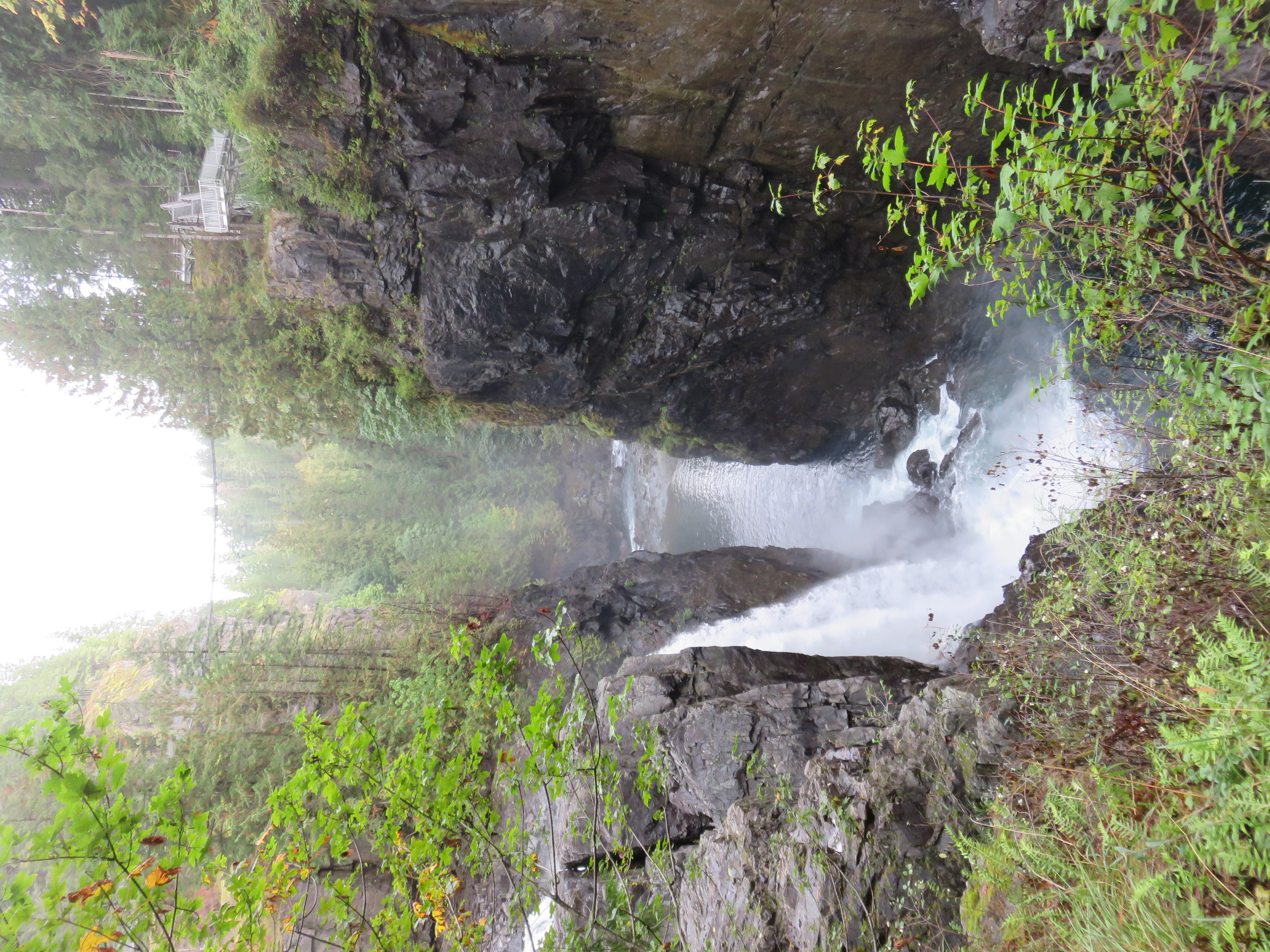
Elk Falls Provincial Park
The suspension bridge sways gently 60 metres above the canyon floor, and through the gaps in the wooden planking you can see the white thread of water that is Elk Falls. It is beautiful, undeniably, but it is also a fraction of what it once was. Since 1947, most of the Campbell River's flow has been diverted through penstocks and turbines upstream. What remains is a waterfall that tells two stories at once -- one about the raw power of Vancouver Island's rivers, and another about the choices a growing province made to harness them.
Saved Before It Was Tamed
British Columbia established Elk Falls Provincial Park in 1940, seven years before the John Hart Dam would fundamentally alter the river's flow. Whether the timing was prescient or coincidental, the result was that the waterfall and its canyon gained protected status while the river still ran wild. The park encompasses 1,807 hectares at the eastern end of John Hart Lake, on the northwest side of Campbell River. The falls themselves plunge into a narrow, basalt-walled canyon carved over millennia by the unimpeded force of snowmelt and rain draining from the mountains of central Vancouver Island.
Three Dams and a Diminished Roar
The John Hart Dam arrived in 1947, the first of three hydroelectric projects on the Campbell River system. Strathcona Dam and Ladore Dam followed upstream, and together the trio diverted the vast majority of the water that once poured over Elk Falls. The transformation was dramatic. Where a full river had once crashed into the canyon with enough force to shake the ground, a reduced flow now picks its way over the rock face. During periods of heavy rain or controlled releases, the falls briefly recover some of their former power, offering a glimpse of the spectacle that prompted the park's creation. But most days, the river's energy is elsewhere -- spinning turbines in the generating station downstream.
The Bridge That Changed the View
For decades, visitors viewed Elk Falls from a series of trails and lookouts along the canyon rim. In 2015, a suspension bridge spanning the canyon was completed, and it transformed the park experience. The bridge hangs directly over the gorge, offering a perspective that the old viewpoints never could -- straight down into the mist and spray where the falls meet the pool below. The 60-metre crossing is not for the faint of heart, but it has become the park's defining attraction, drawing hikers who might otherwise have driven past Campbell River without stopping. On clear days, the canyon walls glow green with moss and fern, framing the white ribbon of the falls against dark volcanic rock.
Where the River Meets the Sea
Elk Falls sits near the top of a watershed that feeds some of the Pacific Northwest's most productive salmon runs. The Campbell River, even diminished by its dams, still supports populations of chinook, coho, pink, and chum salmon that draw anglers from around the world. The city of Campbell River, just downstream, has long marketed itself as the Salmon Capital of the World. The park itself serves as a green buffer between the industrial reality of hydroelectric power and the recreational economy that depends on the river's remaining wildness -- a place where the tension between development and preservation is written into the landscape itself.
From the Air
Elk Falls Provincial Park is located at 50.050N, 125.317W, northwest of the city of Campbell River on Vancouver Island. The canyon and falls are nestled in dense forest and may be difficult to spot from altitude; look for John Hart Lake and the dam infrastructure as landmarks. Best viewed at 1,500-2,500 feet AGL. Campbell River Airport (YBL/CYBL) is approximately 8 nm to the southeast. The park sits within the broader Campbell River watershed system visible as a chain of lakes stretching inland.