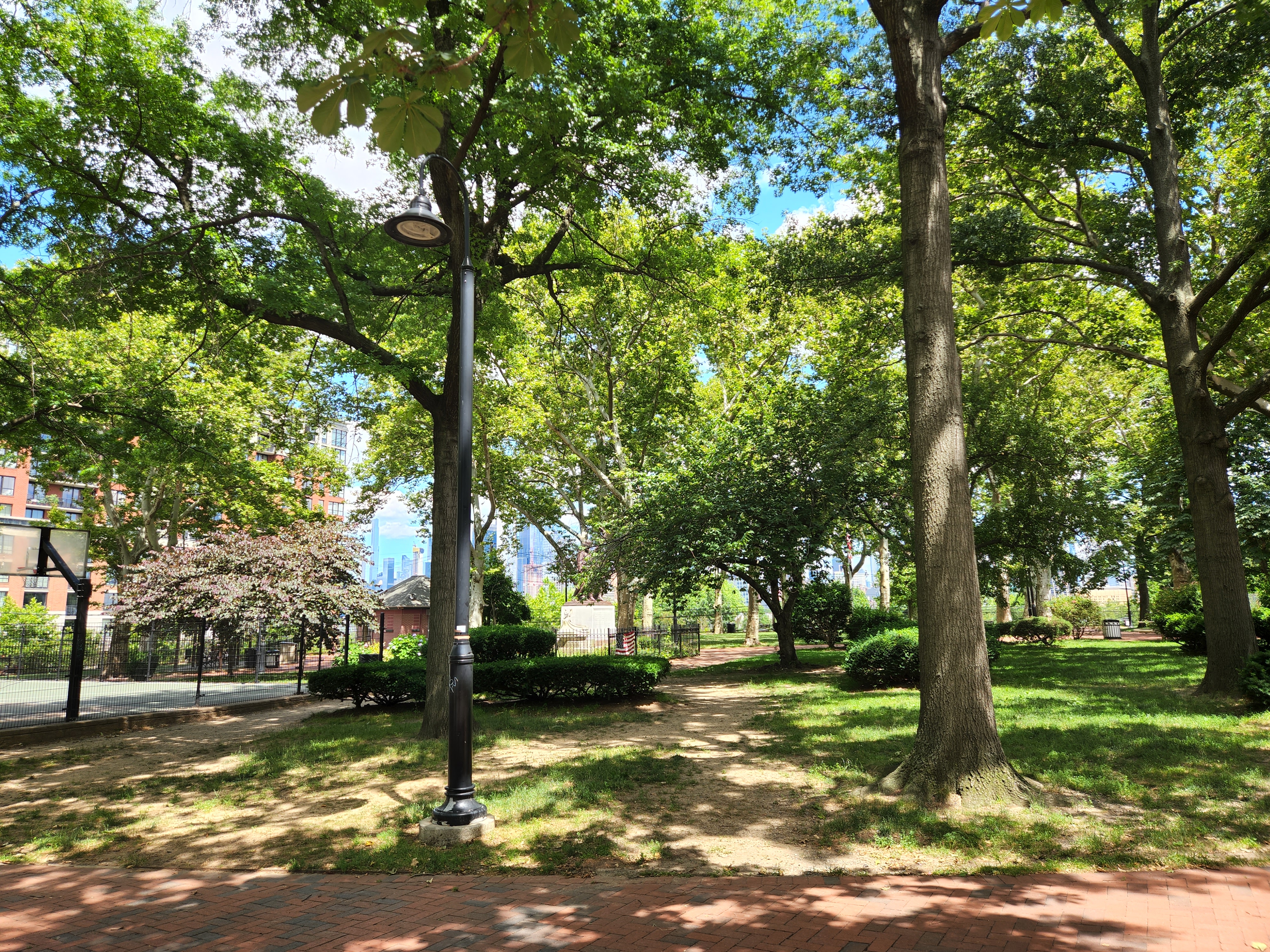
Elysian Fields (Hoboken, New Jersey)
Historian Tom Gilbert called the Elysian Fields "a kind of laboratory of transportation, leisure and recreation. Disneyland, Central Park, Coney Island and the modern baseball park can all claim the Elysian Fields as an ancestor." That is not hyperbole. On a strip of reclaimed swampland along Hoboken's Hudson River waterfront, the Stevens family built something unprecedented in the 1820s and 1830s: a pleasure garden with ferry service from Manhattan, a Grecian-style hotel devoted to what its founder cheerfully admitted was "the worship of Bacchus," a fake grotto selling allegedly healthful spring water, and enough open green space to incubate the sport that would become America's pastime.
From Turtle Swamp to Paradise
Before the Elysian Fields existed, the Hoboken waterfront was mosquito-infested wetland so thick with reptiles that the locals called it Turtle Grove. The Hoboken Turtle Club, founded in 1796, offered turtle soup and turtle steak to its members. Colonel John Stevens III acquired the estate in 1783 after it was confiscated from British loyalist William Bayard following the Revolutionary War. Stevens bought another 125 acres in Weehawken, giving his family more than a mile of Hudson River frontage -- including the notorious dueling ground where Aaron Burr fatally shot Alexander Hamilton in 1804. In the 1820s, the Stevens family drained the swamp, filled the marshes, and began shaping a recreational paradise for sweltering New Yorkers. When Stevens offered to sell the site to New York City as a public park -- decades before Central Park -- the city declined. So he built it himself.
The Colonnade, the Cave, and the Crowds
The Colonnade, a Grecian-style pavilion erected near Turtle Cove in 1830, opened for business the following year and became the social anchor of the Elysian Fields. Ball players made it their favorite post-game hangout. Nearby, Sybil's Cave -- carved from an old iron mine and named for the ancient Greco-Roman prophetesses -- sold glasses of allegedly magnesium-infused spring water for a penny, though a knowing wink to the waiter would get you hard liquor instead. Ferries from Barclay, Canal, and Christopher Streets brought waves of visitors. Charles Dickens came. So did Edgar Allan Poe, Martin Van Buren, Daniel Webster, and Washington Irving. By the 1830s, the Fields were drawing such massive crowds that the New York Herald declared the place overrun with "cigar-smoking blackguards" and "drunken vagabonds." The Elysian Fields had become both paradise and its own undoing.
Where Baseball Grew Up
Baseball was played at the Elysian Fields for roughly 50 years, from the 1830s through the late 1880s. The Magnolia Ball Club and the New York Club played there in the autumn of 1843, predating the more famous Knickerbocker Club. By 1845, rapid development in Manhattan had claimed most open playing space, and the Knickerbockers chose the Elysian Fields -- a 15-minute ferry ride from lower Manhattan -- as their home grounds. On June 19, 1846, the Knickerbockers faced the New York Ball Club in what is considered the first fully documented baseball game; New York won 23-1 in four innings. Pioneering sports journalist Henry Chadwick recalled watching a match between the Eagle and Gotham clubs in the 1850s and being struck by the realization that "base ball was just the game for Americans." Two dedicated diamonds were eventually set aside -- one reserved exclusively for newspaper reporters' teams. The last known published reference to baseball at the Fields dates to September 1889.
Decline and Disappearance
By the 1870s, the allure was fading. The Stevens patriarchs had all died. Central Park gave New Yorkers a Manhattan alternative. Enclosed ballparks in Brooklyn -- the Capitoline Grounds and Union Grounds -- let promoters charge admission, pulling competitive baseball away from Hoboken. The Elysian Fields also developed a grim reputation as a preferred suicide spot; the Jersey Journal reported in 1884 that more than 300 corpses had been found in the area over three decades. Sybil's Cave closed in 1880 over water quality concerns. A November 1893 New York Herald headline read: "Last of Famous Elysian Fields," followed by subheadings mourning the "Utter Obliteration" of grounds "almost held sacred." A Maxwell House Coffee plant rose on the site in 1939, its giant tilted-cup sign dominating the skyline until the factory closed in 1990. Today, a small playground called Elysian Park and bronze base markers at 11th and Washington Streets are all that remain of the grounds where baseball found its footing.
From the Air
The former Elysian Fields site is located at approximately 40.750N, 74.027W on Hoboken's northern Hudson River waterfront. From the air, look for the small Elysian Park along Frank Sinatra Drive, with the Stevens Institute of Technology campus immediately to the south. The site sits directly across the Hudson from Midtown Manhattan. Teterboro Airport (KTEB) is about 7 miles north. Newark Liberty International (KEWR) is roughly 8 miles south. Recommended viewing altitude: 2,000-3,000 feet AGL for the waterfront context.