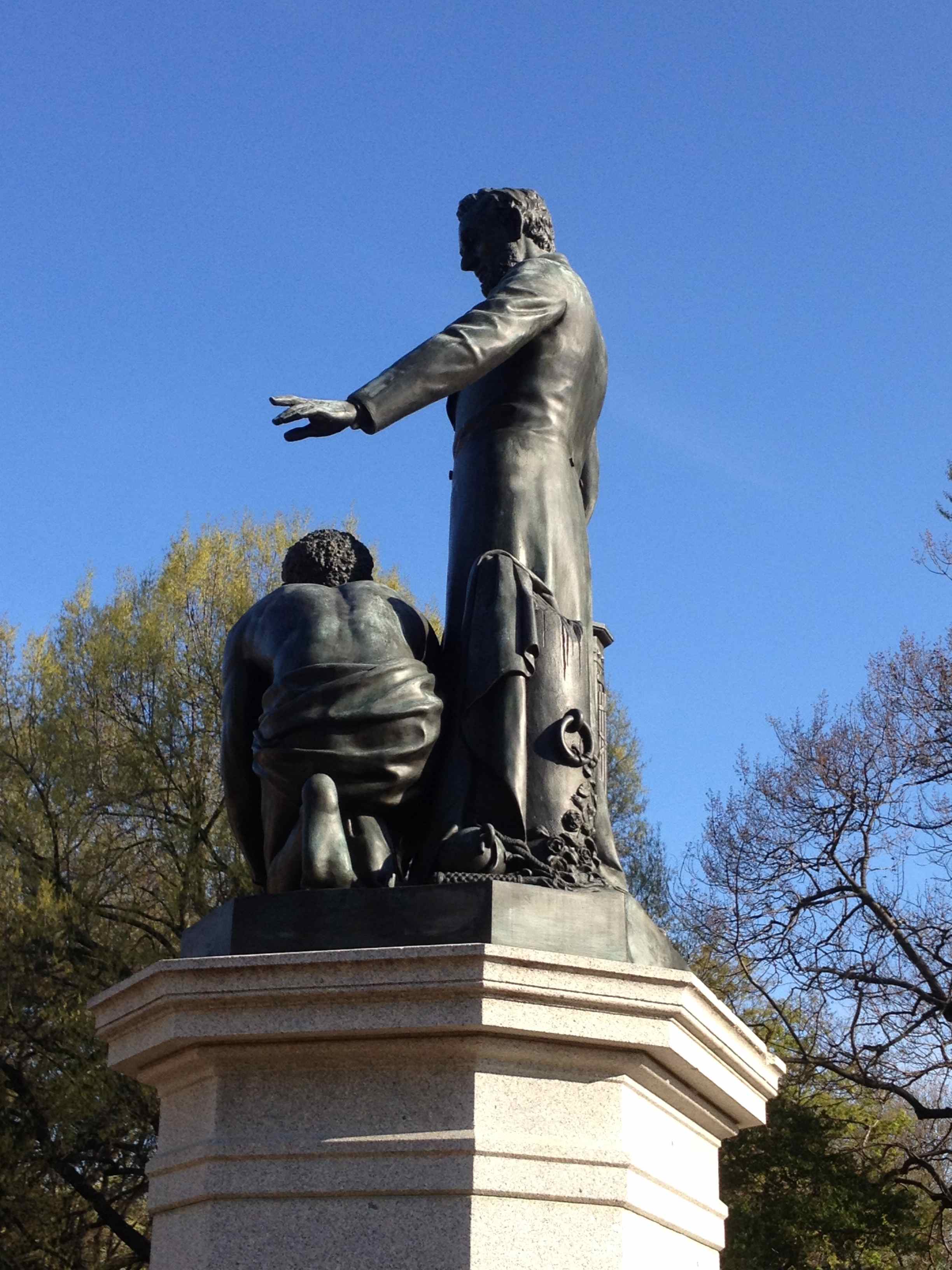
Emancipation Memorial
Five dollars started it. In April 1865, Charlotte Scott, a formerly enslaved woman from Virginia then living with the family of her former master in Marietta, Ohio, donated her first wages as a free person toward a monument honoring Abraham Lincoln. That five-dollar gift sparked a fundraising campaign among formerly enslaved people and Black veterans that eventually raised enough to commission sculptor Thomas Ball, have the statue cast in Munich in 1875, and ship it to Washington for dedication the following year. On April 14, 1876 -- the eleventh anniversary of Lincoln's assassination -- Frederick Douglass stood before the monument in Lincoln Park on Capitol Hill and delivered one of the most complex eulogies in American history. He praised Lincoln. He criticized Lincoln. And within days, he criticized the statue itself.
The Five-Dollar Monument
The Western Sanitary Commission, a St. Louis-based volunteer war-relief agency, managed the fundraising campaign, eventually raising over $20,000 before setting a new goal of $50,000. Congress accepted the finished monument as a gift from the "colored citizens of the United States" and appropriated $3,000 for the granite pedestal. The statue depicts Lincoln standing with his right hand extended over a kneeling man, a copy of the Emancipation Proclamation in his grip. The man at Lincoln's feet was originally generic -- but Ball re-sculpted the face to resemble Archer Alexander, a formerly enslaved man from Missouri whose life story had been popularized by a biography written by William Greenleaf Eliot. Alexander's figure is shirtless, one fist clenched, broken shackles at the president's feet, captured in the act of rising. Behind the two figures stands a whipping post draped with cloth, a vine growing around it.
Douglass at the Dedication
The dedication ceremony was declared a federal holiday. A grand procession wound through the streets of Washington to Lincoln Park, where Howard University law school dean John Mercer Langston attended among the dignitaries. Then Douglass spoke. His oration was no simple tribute. "Truth compels me to admit, even here in the presence of the monument we have erected to his memory," Douglass told the crowd. "Abraham Lincoln was not, in the fullest sense of the word, either our man or our model." He reminded the audience that Lincoln had told African American leaders visiting the White House in 1862, "But for your presence amongst us, there would be no war." He recounted Lincoln's famous letter to the New York Tribune declaring he would save the Union with or without freeing a single enslaved person. But Douglass ultimately judged Lincoln on his achievement: "It was enough for us that Abraham Lincoln was at the head of a great movement, and was in living and earnest sympathy with that movement."
A Letter Five Days Later
What came after the ceremony proved equally significant. Five days following his oration, Douglass published a letter in the National Republican newspaper in Washington that directly criticized the statue's design. "The negro here, though rising, is still on his knees and nude," he wrote. "What I want to see before I die is a monument representing the negro, not couchant on his knees like a four-footed animal, but erect on his feet like a man." That letter was lost for over a century, rediscovered by historians Jonathan White and Scott Sandage, who published their findings in Smithsonian Magazine in June 2020. They proposed a solution: add statues of Charlotte Scott, whose donation started the fundraising, and Frederick Douglass himself, creating a more complete "Emancipation Group." Lincoln biographer Sidney Blumenthal noted that the kneeling figure was a widespread abolitionist motif, appearing on the masthead of William Lloyd Garrison's newspaper The Liberator.
A Monument Still Debated
The Emancipation Memorial has never stopped generating argument. In June 2020, during nationwide protests over racial injustice, D.C. Delegate Eleanor Holmes Norton introduced legislation to remove the statue from Lincoln Park. Protesters vowed to tear it down themselves, and a barrier fence was temporarily installed for protection. A replica of the statue that had stood in Boston's Park Square since 1879 was removed by the Boston Art Commission on December 29, 2020, after a public vote. Other versions survive: a white marble copy at the Chazen Museum of Art at the University of Wisconsin-Madison, and a miniature demonstration model in the atrium of Methuen, Massachusetts Town Hall. The Washington original remains standing, a monument that invites not reverence but reckoning -- with Lincoln's legacy, with the limits of liberation, and with the question of who gets to define what freedom looks like in bronze.
From the Air
Located at 38.890N, 76.990W in Lincoln Park, Capitol Hill neighborhood, Washington, D.C. The park is a long, narrow green rectangle on East Capitol Street between 11th and 13th Streets NE. Recommended viewing altitude: 2,000-3,000 feet AGL. CAUTION: This location is within the Washington D.C. Special Flight Rules Area (SFRA) and the Flight Restricted Zone (FRZ). Nearby airports: KDCA (Ronald Reagan National), approximately 4 nm southwest; KADW (Joint Base Andrews), approximately 9 nm southeast. Visual landmarks include the U.S. Capitol dome to the west and the Anacostia River to the east.