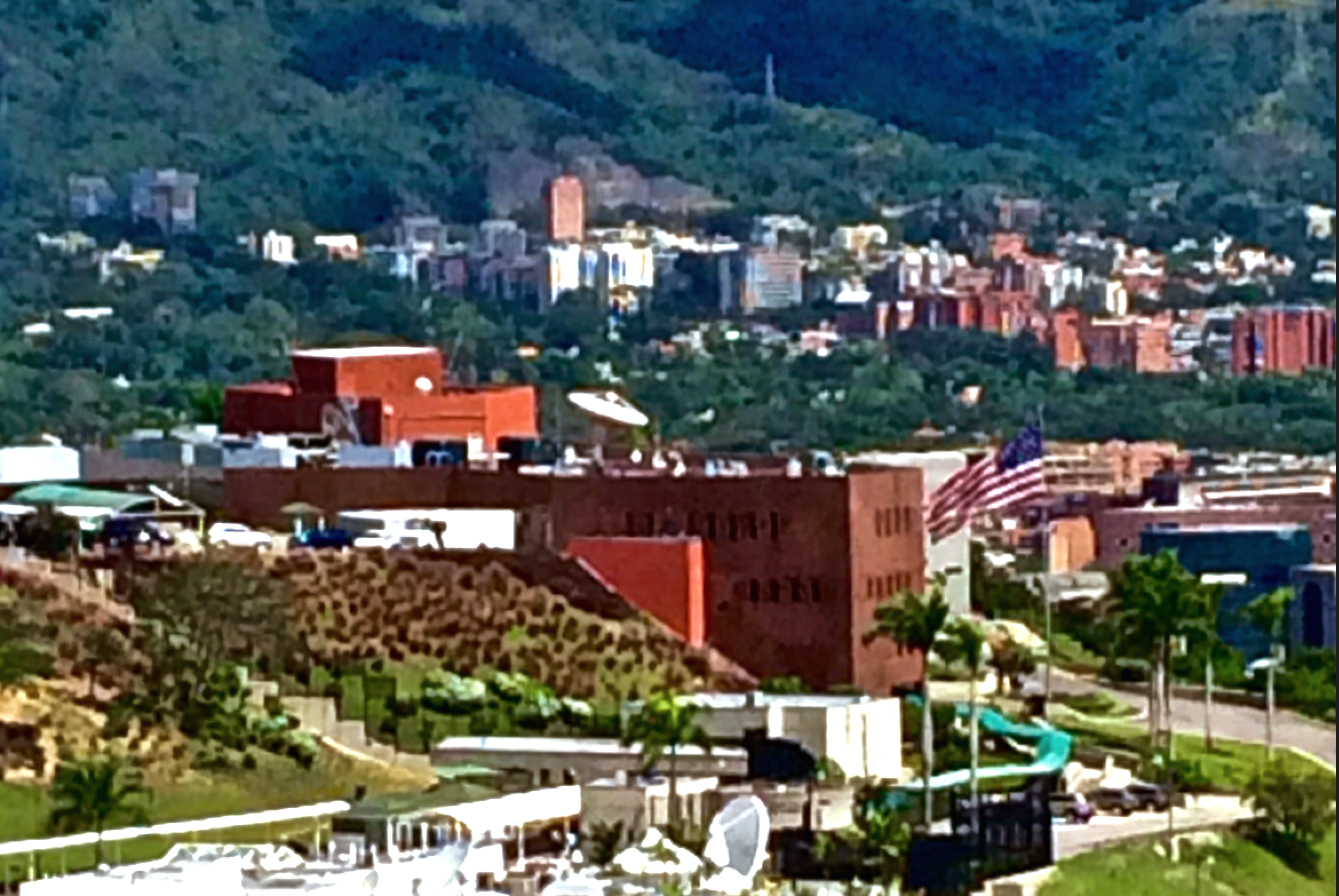
Embassy of the United States, Caracas
On May 13, 1958, an angry crowd surrounded Vice President Richard Nixon's motorcade on the streets of Caracas, rocking his car, smashing windows, and spitting through the gaps. Nixon's entourage fought its way to the U.S. Embassy, where the Venezuelan army arrived to fortify the building with bayonets fixed. That harrowing afternoon set the tone for what would become one of the most turbulent diplomatic relationships in the Western Hemisphere -- a relationship whose physical symbol, the embassy compound itself, now sits empty and silent on the hillside above Caracas.
A Motorcade Under Siege
Nixon had come to Caracas in 1958 on a goodwill tour of South America, arriving just weeks after the overthrow of Venezuelan dictator Marcos Perez Jimenez. The political atmosphere was volatile, and the vice president walked straight into it. As his motorcade moved through the city, a mob blocked the road and attacked his car. Accounts differ on what happened next -- one version credits a press corps flatbed truck with clearing a path, while Nixon himself remembered Associated Press photographer Hank Griffin swinging his camera at a protester trying to climb aboard. What is certain is that Nixon reached the embassy shaken but unharmed. The Venezuelan army ringed the chancellery, reinforcing the small Marine guard. That afternoon, members of the ruling junta lunched with Nixon at the embassy in an awkward display of diplomacy. The next morning, labor union leaders came to apologize. Nixon left Caracas seven hours ahead of schedule, his motorcade to the airport flanked by infantry and armored vehicles on streets that had been tear-gassed empty.
The Slow Unraveling
For decades after the Nixon incident, the embassy functioned as a normal diplomatic mission, processing hundreds of thousands of visa applications annually. But the election of Hugo Chavez in 1998 began a slow erosion of the relationship. In September 2008, Chavez accused Ambassador Patrick Duddy of involvement in a plot to remove him from power and expelled him from the country. Duddy returned the following July, but when his assignment ended in 2010, Chavez refused to accept a replacement. The ambassador's residence went quiet. Under Nicolas Maduro, the situation accelerated downward. In March 2015, Maduro accused the United States of plotting a coup and demanded the embassy slash its staff from over 200 to just 17 -- a staggering reduction for a mission that had processed roughly 232,500 applications the previous year. Venezuelan citizens who needed visas watched with growing alarm as their primary channel to the United States narrowed to almost nothing.
Doors Closing
The final chapter came quickly. In May 2018, Maduro expelled the top U.S. diplomat and his deputy as persona non grata. By January 2019, the relationship had reached its breaking point: Maduro announced a unilateral severing of diplomatic ties after President Donald Trump recognized opposition leader Juan Guaido as interim president, giving American officials 72 hours to leave. Secretary of State Mike Pompeo confirmed on social media that all remaining personnel would withdraw. The embassy gates closed. The United States signed a protecting power agreement with Switzerland to represent its interests, though the arrangement stalled when Maduro's government proposed Turkey as its own protecting power -- a proposal Washington rejected because it did not recognize Maduro's authority to make it. In the meantime, consular services for Venezuelans migrated to the U.S. Embassy in Bogota, Colombia, where a new Venezuela Affairs Unit opened as a kind of diplomatic office in exile.
What Remains Behind
The shuttered embassy stands as a physical archive of a relationship that went from strained courtesy to complete rupture over six decades. Despite the diplomatic void, connections between the two countries have not disappeared entirely. Programs like the English Access Microscholarship bring English language classes to Venezuelan high school students from modest backgrounds, while the Youth Ambassadors Program sends selected students to the United States for three weeks of study. The International Visitor Leadership Program hosts Venezuelan professionals alongside their American counterparts. Demand for these programs remains intense -- a reminder that the relationship between peoples often outlasts the relationship between governments. For Venezuelans seeking visas, the process now begins online, routed through Bogota, a bureaucratic detour that adds distance and delay to what was once a local errand. The empty compound in Caracas waits, its Marine guard post unmanned, a monument to the proposition that diplomacy, once broken, is slow and difficult to rebuild.
From the Air
Located at 10.478N, 66.871W in the Colinas de Valle Arriba area of southeastern Caracas. The embassy compound sits on elevated terrain above the valley floor. Simon Bolivar International Airport (SVMI) lies approximately 25 km to the northwest along the coast near Maiquetia. Caracas itself is nestled in a narrow valley at roughly 900 meters elevation, surrounded by the steep slopes of El Avila National Park to the north. Best viewed below 5,000 feet AGL for compound detail; the broader urban setting is visible from higher altitudes.