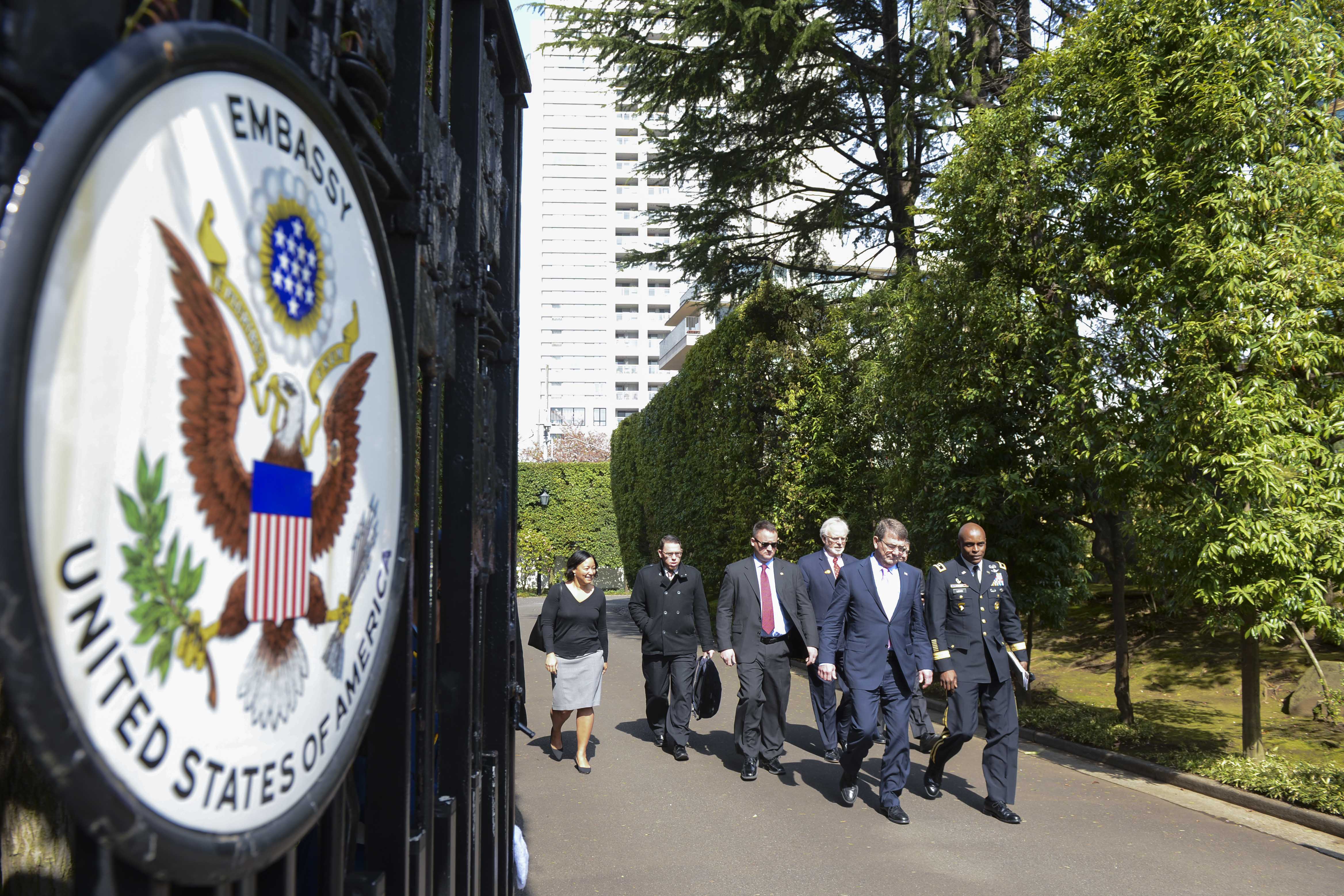
Embassy of the United States, Tokyo
For nearly a decade, the most powerful nation on Earth stiffed its closest Asian ally on the rent. Between 1998 and 2007, the United States simply stopped paying for the land beneath its Tokyo embassy -- a 3.21-acre parcel in the Akasaka neighborhood of Minato ward, steps from the Japanese Diet and the Prime Minister's residence. The annual bill, when they finally settled up, came to just 7 million yen -- roughly $60,000 at the time -- for some of the most valuable real estate in the world. The absurdly low figure is an artifact of a lease dating to 1896, negotiated in an era before Tokyo became one of Earth's great metropolises. But then, almost everything about this embassy tells a story of two nations bound together by history far stranger than diplomacy usually produces.
Temples and Black Ships
The American diplomatic presence in Japan did not begin with marble lobbies and security checkpoints. It began in a Buddhist temple. In 1856, Consul General Townsend Harris established the first U.S. consulate at Gyokusen-ji in Shimoda, Shizuoka -- a temple that also served as the burial ground for American sailors who died while serving in Commodore Matthew Perry's Black Ship fleet from 1854 onward. Harris negotiated the landmark Treaty of Amity and Commerce, signed at nearby Ryosen-ji in 1858. The following year, the first U.S. legation opened in Tokyo at Zenpukuji, yet another Buddhist temple, this one in the Motoazabu neighborhood. American diplomacy in Japan literally grew from sacred ground. The legation moved to a site near Tsukiji on the Sumida River in 1875, then to the current Akasaka location in 1890. In January 1906, following Japan's victory in the Russo-Japanese War, the two countries elevated their diplomatic representatives to the rank of ambassador -- a signal that the Western powers now regarded Japan as an equal.
The Emperor and the General
The ambassador's official residence, completed in 1931 alongside the original embassy building designed by Harold Van Buren Magonigle and Antonin Raymond, was one of the first structures specifically built by the U.S. to house an ambassador abroad. Its most consequential moment came on September 27, 1945, barely six weeks after Japan's surrender. Emperor Showa -- known in the West as Hirohito -- arrived at the residence to meet General Douglas MacArthur. The photograph taken that day, showing the towering MacArthur in an open-collared uniform standing beside the formally dressed, diminutive emperor, shocked Japan. It was a visual declaration that the old imperial order had ended. In 2001, the U.S. Department of State designated the residence an important cultural asset. In 2021, First Lady Jill Biden dedicated a room in the residence to the late Senator Daniel K. Inouye and his wife Irene, honoring the Japanese American war hero who had spent a lifetime bridging the two cultures.
Wartime Internment on Embassy Grounds
When Japan attacked Pearl Harbor on December 7, 1941, the embassy and its staff became prisoners overnight. Ambassador Joseph Grew and his personnel, including military attaches, were interned on the embassy grounds. They remained confined there until June 1942, when they were sent by ship to Portuguese East Africa and exchanged for Japanese diplomats who had been held in the United States. The embassy stayed closed throughout the Allied occupation that followed the war -- an unusual situation in which the U.S. had no embassy in a country it was governing. On April 18, 1946, SCAP General Order 18 created a Diplomatic Section staffed by State Department employees to handle relations during the occupation. The embassy formally reopened on April 28, 1952, the same day the Treaty of San Francisco restored Japanese sovereignty. Robert D. Murphy arrived as the first postwar ambassador. On that same day, the Embassy of Japan in Washington, D.C. reopened as well, marking the simultaneous restoration of normal diplomacy between the two nations.
Pelli, Sklarek, and the Bargain Lease
The current embassy building, completed in 1976, was designed by an architectural team that deserves its own story. Cesar Pelli, the Argentine-American architect who would later design the Petronas Towers in Kuala Lumpur, collaborated with Norma Merrick Sklarek, who in 1954 had become the first African American woman licensed as an architect in New York State. Their embassy replaced the 1931 Magonigle-Raymond building on the same 13,000-square-meter site that the U.S. has leased from the Japanese government since 1896. That lease, negotiated when Tokyo was still a fraction of its current size, contained no escalation or adjustment provisions -- which is why the annual rent remained absurdly modest. When the U.S. stopped paying in 1998 during a disagreement over lease renewal terms, the bill barely registered. The 2007 settlement set the rent at 15 million yen per year through 2027 -- a pittance for a prime Akasaka address overlooking the political heart of Japan.
From the Air
Located at 35.669N, 139.743E in the Akasaka district of Minato ward, central Tokyo. The embassy compound sits adjacent to the Hotel Okura and near the Nagatcho government district containing the National Diet building. Nearest airports: Tokyo Haneda (RJTT) approximately 8 nm south, Narita International (RJAA) approximately 37 nm east. Best viewed at 3,000-4,000 feet AGL. The surrounding area includes the Imperial Palace grounds, clearly visible as a large green space in central Tokyo's dense urban landscape.