Embry-Riddle Aeronautical University
John F. Kennedy learned to fly here. That detail alone would secure Embry-Riddle a place in aviation lore, but the university's story runs deeper than any single famous alumnus. Founded at Lunken Field in Cincinnati in 1926 by T. Higbee Embry and John Paul Riddle, the school began modestly: a handful of students learning to pilot biplanes and wrench on radial engines. It closed during the Depression, reopened in Miami in 1939 just as war loomed, and grew so fast training military pilots that it took over an entire hotel. Today, from its main campus adjacent to Daytona Beach International Airport, Embry-Riddle operates the largest accredited university system in the world dedicated to aviation and aerospace, enrolling over 32,000 students across two residential campuses and more than 130 locations worldwide.
Born in a Barnstorming Era
The 1920s were aviation's wild youth. Charles Lindbergh crossed the Atlantic in 1927, and suddenly every young American wanted wings. Embry and Riddle sensed the moment. Their Cincinnati school trained both pilots and mechanics, understanding that aviation needed hands on engines as much as hands on yokes. But the Aviation Corporation absorbed the school in a merger, and by 1930 it was shuttered. The name survived in memory until 1939, when John Paul Riddle, along with John Graham McKay and his wife Isabel, resurrected the school in Miami. They partnered with the University of Miami under the Civilian Pilot Training Program, rushing pilots through training as war gathered over Europe and the Pacific. The school expanded so rapidly it commandeered the Fritz Hotel in downtown Miami.
Cessnas on the Ramp
The Daytona Beach campus, Embry-Riddle's academic headquarters since 1965, is built for one purpose: making people fly. Adjacent to Daytona Beach International Airport, the campus connects directly to a university-owned aircraft ramp where 88 Cessna 172 Skyhawks and 14 Diamond DA42-VI twin-engine trainers sit ready. The Eagles Flight Team parks its own planes there too. Students walk from classrooms to cockpits in minutes. The campus serves roughly 6,740 undergraduates and 781 graduate students from nearly 100 countries, offering 52 majors. Its engineering physics program is the largest in the nation specializing in aerospace. The Air Force ROTC detachment here is the largest at any university in the country, producing more commissioned pilots for the U.S. Air Force than any institution except the Air Force Academy itself.
Desert Wings in Prescott
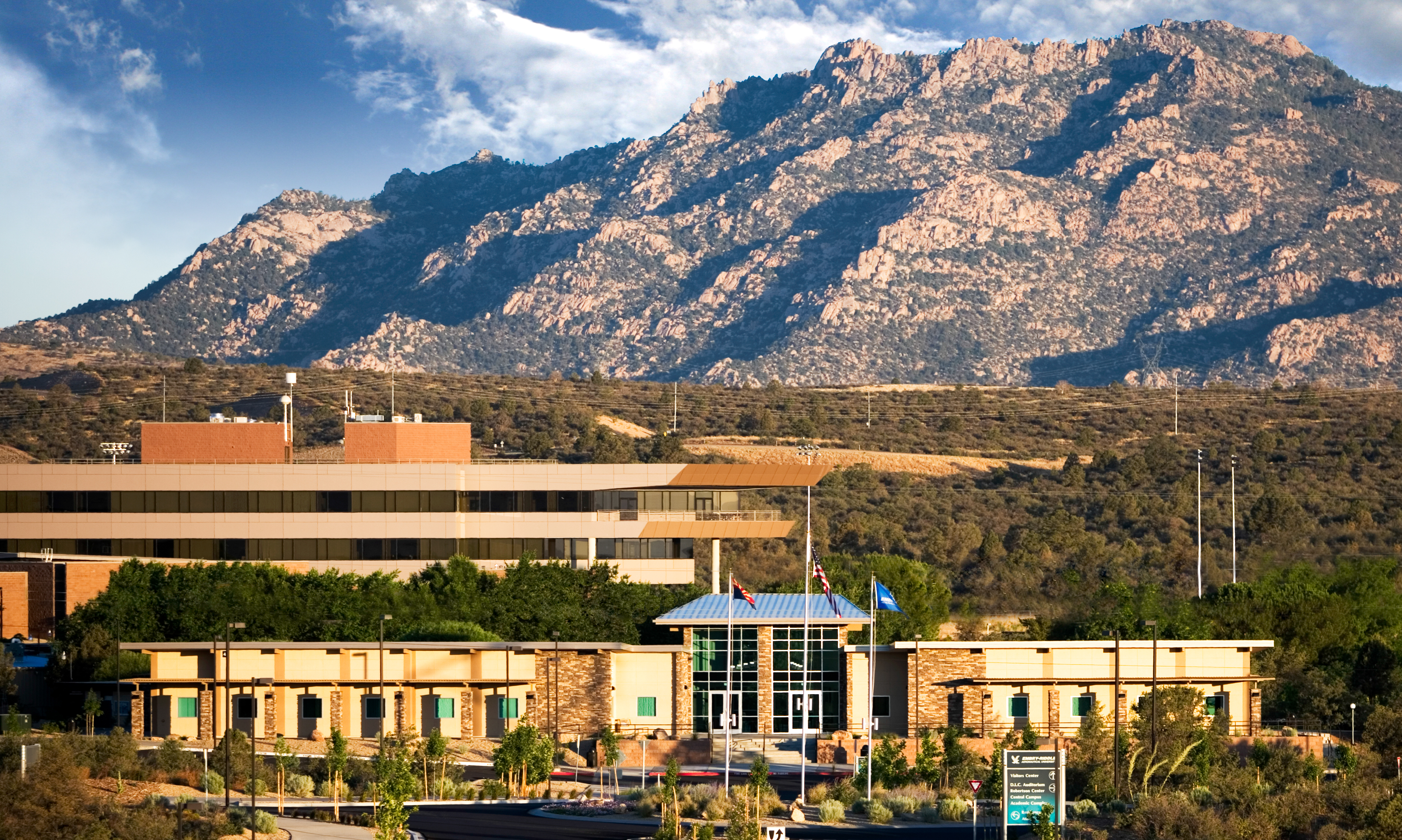
In 1978, Embry-Riddle opened a second residential campus in Prescott, Arizona, set among western terrain north of Phoenix. The flight training center operates from Ernest A. Love Field. Facilities include a wind tunnel lab with one supersonic and four subsonic tunnels, an accident investigation lab, and the Robertson Crash Lab, where students study wreckage to understand failure. The Prescott campus offers the only Global Security and Intelligence Studies program in the United States. Its Golden Eagles Flight Team has won the National Intercollegiate Flying Association regional championship for 31 consecutive years and claimed 13 national titles, earning induction into the San Diego Air and Space Museum's Hall of Fame.
A Campus Without Borders
Beyond Daytona Beach and Prescott, Embry-Riddle's Worldwide campus network reaches more than 22,000 students through over 130 locations, including more than 100 on U.S. military bases. Established in 1970, the network extends to Singapore, where the university's largest international location operates. Students can earn 40 different degrees online or face-to-face in fields from unmanned systems to aviation business. U.S. News and World Report ranked Embry-Riddle the number-one online bachelor's program in 2016, and the university has ranked first or second as an online educator for veterans every year since. For service members stationed on bases worldwide, Embry-Riddle brings the campus to them.
Runway Threshold in View
From the air, the Daytona Beach campus is unmistakable: a cluster of academic buildings pressed against the airport boundary, with rows of white Cessnas gleaming on the ramp. The nearby Daytona International Speedway dominates the landscape to the west. In 2014, Embry-Riddle became the first FAA-approved training provider for student airline certification, a milestone that underscored its position at the center of American flight training. The university manages the FAA NextGen Florida Test Bed, developing technology for the nation's future air transportation system. A century after two entrepreneurs opened a flight school beside an Ohio airfield, their name still means one thing: sky.
From the Air
Located at 29.19N, 81.05W in Daytona Beach, Florida, directly adjacent to Daytona Beach International Airport (KDAB). The campus and its aircraft ramp are visible on the southeast side of the airport. Rows of white Cessna trainers on the ramp are distinctive from altitude. Daytona International Speedway is visible roughly 1 mile to the west. Recommended viewing altitude: 2,000-4,000 ft AGL. Other nearby airports include Ormond Beach Municipal (KOMN) 7nm north and Spruce Creek (7FL6) 5nm south. Clear weather typical in central Florida.