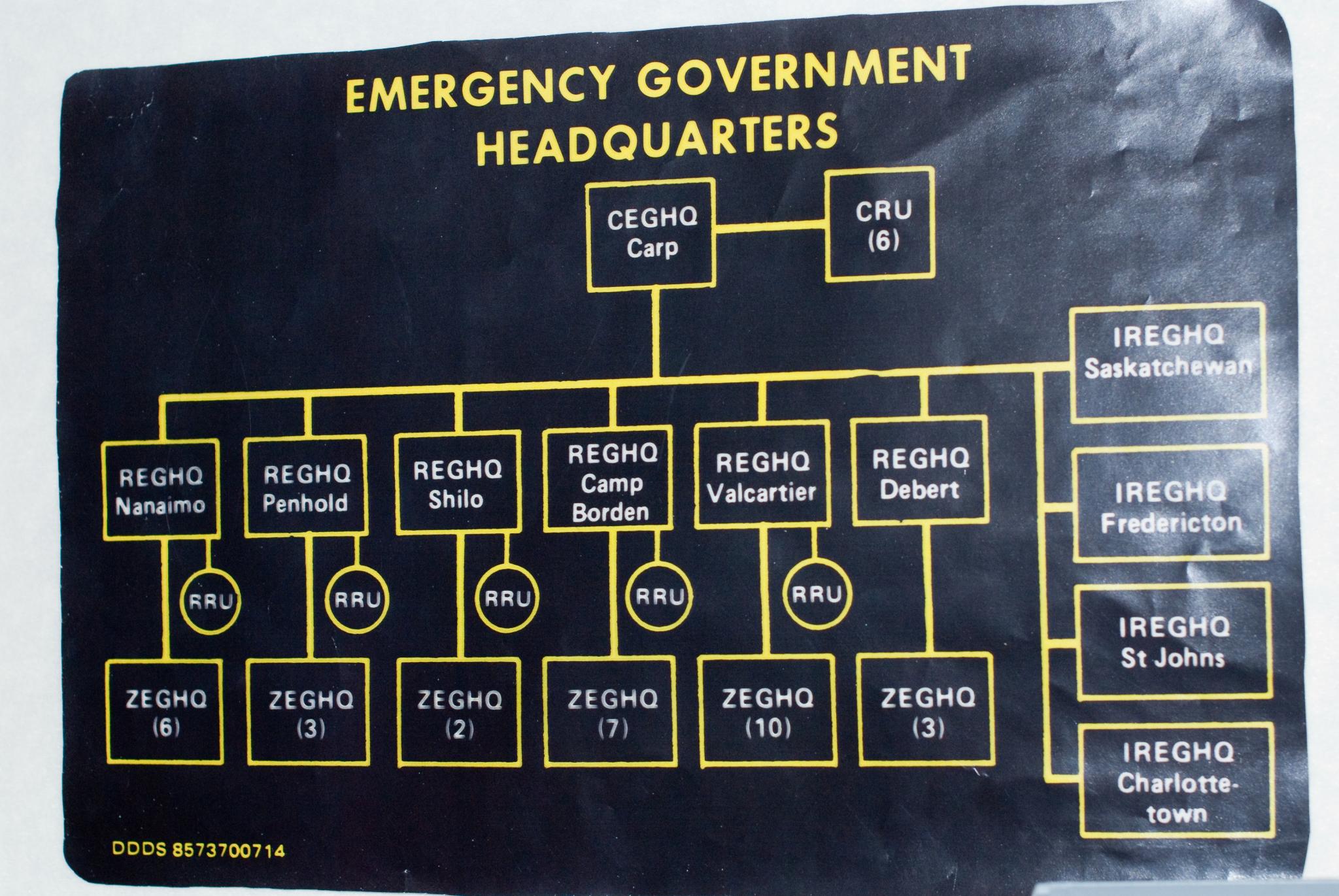
Emergency Government Headquarters
They called them Diefenbunkers, and the name was not a compliment. When federal opposition politicians in the early 1960s learned that Prime Minister John Diefenbaker had authorized the construction of a sprawling network of nuclear fallout shelters across Canada, they fused his surname with the word 'bunker' and gave the facilities a nickname that stuck for decades. What began as deadly serious continuity-of-government planning at the height of the Cold War became, over time, something stranger -- a story of secret construction, massive blast doors, Hells Angels real estate bids, and escape rooms where tourists now play inside structures once meant to survive atomic war.
Built for the Unthinkable
Beginning in the 1950s, the Government of Canada quietly constructed more than fifty nuclear fallout shelters at strategic locations across the country. The program was part of continuity-of-government planning -- ensuring that essential federal operations could survive a Soviet nuclear strike. Most facilities were built in great secrecy at rural sites outside major cities, their construction hidden from the public. The majority were two-storey underground bunkers, but the largest, at CFS Carp near Ottawa, sprawled across four subterranean floors. Every facility was engineered to withstand a near-miss from a nuclear explosion. Massive blast doors sealed each entrance. Extensive air filtration systems maintained positive pressure to keep radioactive fallout from seeping inside. Underground storage held food, fuel, fresh water, and supplies sufficient for several dozen occupants to survive for weeks. The bunkers were operated by personnel from the Royal Canadian Corps of Signals, later renamed Communications Command after the 1968 unification of the Canadian Armed Forces.
The Crown Jewel at Carp
The four-storey facility at Canadian Forces Station Carp, just west of Ottawa, served as the Central Emergency Government Headquarters -- the place where the Prime Minister, cabinet, and senior military officials would have retreated if missiles crossed the Arctic. Deep beneath the Ottawa Valley farmland, the bunker housed conference rooms with teletype terminals, communications equipment, situation displays, and enough provisions to keep the government functioning underground while the surface world burned. The sheer scale of the facility -- designed to coordinate national defence and governance during nuclear war -- stands in surreal contrast to the peaceful agricultural landscape above it. CFS Carp was decommissioned in 1994, three years after the Cold War officially ended, and has since been converted into a year-round museum dedicated to Cold War history, where visitors can walk through the very rooms once reserved for apocalyptic contingency planning.
Decommissioned, Demolished, and Sold Off
When the Cold War thawed, all but one of the Diefenbunkers were decommissioned and either covered over, demolished, or sold to private buyers. Only the facility at CFB Valcartier in Quebec remained in government use, repurposed as accommodation barracks. The fates of the others ranged from dignified to bizarre. CFS Debert in Nova Scotia opened for public tours, then became summer housing for an air cadet gliding school, then was sold and resold for use as a secure data storage facility. In 2018, it reopened as a tourist attraction featuring historical tours, escape rooms, and laser tag. But perhaps no Diefenbunker had a stranger afterlife than the one at CFS Penhold in Alberta. Decommissioned in 1994, it was sold to two businessmen from Red Deer for $472,000. Almost immediately, rumors surfaced that the Hells Angels had expressed interest -- the businessmen later claimed the motorcycle gang offered them $1.3 million. White supremacist groups and a Miami car theft ring were also said to have eyed the property. The government, alarmed by the security implications, repurchased the bunker in 1998 for $1.25 million and demolished it in 2001.
Hidden Shelters, Hidden Stories
The Diefenbunker network extended beyond the major military installations. In February 2020, a Toronto Star investigation revealed a previously little-known nuclear bunker hidden inside a residential home on Old Yonge Street in Aurora, Ontario. Built during the Cuban Missile Crisis, this concrete-reinforced room was intended to serve as a control centre for Toronto politicians and emergency personnel in the event of nuclear attack. The bunker still contained maps, status boards for recording casualties, one hundred telephone lines, water tanks, and an escape route. It was a miniature version of the grand Carp facility -- a time capsule from the era when ordinary-looking houses concealed extraordinary preparations for catastrophe. These scattered shelters speak to just how deeply the fear of nuclear war penetrated Canadian society, shaping not only military infrastructure but the very buildings where civilians lived and worked.
Cold War Relics in a Warming World
Today, two Diefenbunkers welcome the public. The CFS Carp museum remains the most complete, its conference rooms, blast doors, and communications equipment preserved as they were during the facility's operational years. The site even appeared in the film The Sum of All Fears, where the bunker doubled as a US presidential war room, and in the second season finale of The Amazing Race Canada. At CFS Debert, visitors can explore the bunker through historical tours or test their wits in escape rooms built inside the very chambers designed to shelter officials from nuclear fallout. These Cold War relics sit quietly beneath the Canadian landscape -- monuments to an era when governments prepared for the end of civilization by digging deep into the earth and hoping the concrete would hold.
From the Air
The primary Emergency Government Headquarters (CFS Carp / Diefenbunker museum) is located at 45.35N, 76.05W, roughly 30 km west of downtown Ottawa in rural Ontario. From altitude, the site appears as a low-profile complex amid farmland near the village of Carp. The bunker is largely underground, so surface features are minimal -- look for the museum parking area and entrance structure. The nearest major airport is Ottawa Macdonald-Cartier International (CYOW), approximately 35 km east. Carp Airport (CYRP) is a small general aviation field just a few kilometers away. Best viewed at 2,000-4,000 feet AGL. The Ottawa River and Gatineau Hills to the north provide good visual orientation.