Emmen, Netherlands
Ben Feringa was born here in 1951. Sixty-five years later, working in Groningen up the road, he started winning prizes for synthetic molecular machines so small that the rules of motion had to be rewritten to describe them. In 2016 he shared the Nobel Prize in Chemistry for it. Emmen has produced a striking number of people who go elsewhere to do important things - the actress Maruschka Detmers, the writer Frank Westerman, the jurist Jaap Doek who chaired the UN Committee on the Rights of the Child, the harpist and composer Anne Vanschothorst. The city itself is harder to characterize. It was not so much built as planned: a deliberate twentieth-century knit-together of peat-cutters' hamlets, suburb by suburb, into the largest urban area in Drenthe. There are about 56,000 people in the city proper now and 107,000 in the municipality, almost all of them living in neighborhoods that did not exist before the Second World War.
From Peat to Pattern
For most of its history Emmen was not a city. It was a scatter of small farming and peat-harvesting communities on the Drenthe plateau, mentioned in church records back to the Middle Ages but never amounting to much. Old hamlets like Westenesch, Noordbarge and Zuidbarge still survive as distinct neighborhoods inside the city, their original lanes and farmhouse layouts visible if you know where to look. Real expansion only began after 1945. The suburbs went up in waves: Emmermeer to the north, then Angelslo and Emmerhout to the east - the latter famous for being separated from the city center by an existing forest the planners refused to cut down. Bargeres came next, then the Rietlanden and Parc Sandur to the southwest. The final addition, Delftlanden, is still being built. The Grote of Pancratiuskerk on the market square, the old court of law building and the original post office are nearly the only pre-twentieth-century buildings inside the modern city limits.
The Zoo That Built the Town
Since the 1980s, the engine of Emmen's economy has been an animal. The Dierenpark Emmen opened modestly in the 1930s and was fully redesigned in the 1970s, growing into one of the most-visited zoos in the Netherlands. By the time it closed and was replaced by the larger Wildlands Adventure Zoo in 2016, it was drawing more than 1.5 million visitors a year - serious traffic for a city of fifty-six thousand. The old zoo site, on the edge of the historic center, has been reborn as the Rensenpark, named for the Rensen family who founded the original Dierenpark. It now houses, among other things, the Museum of Contemporary Tibetan Art. The municipality co-owns Wildlands. Tourism aside, the local industrial base is built on advanced materials: Teijin Aramid, DSM Engineering Plastics, the Senbis polymer plant. There are 38,000 jobs in the municipality. A lot of them involve chemistry.
A Stone Age Boulder and a Smithson
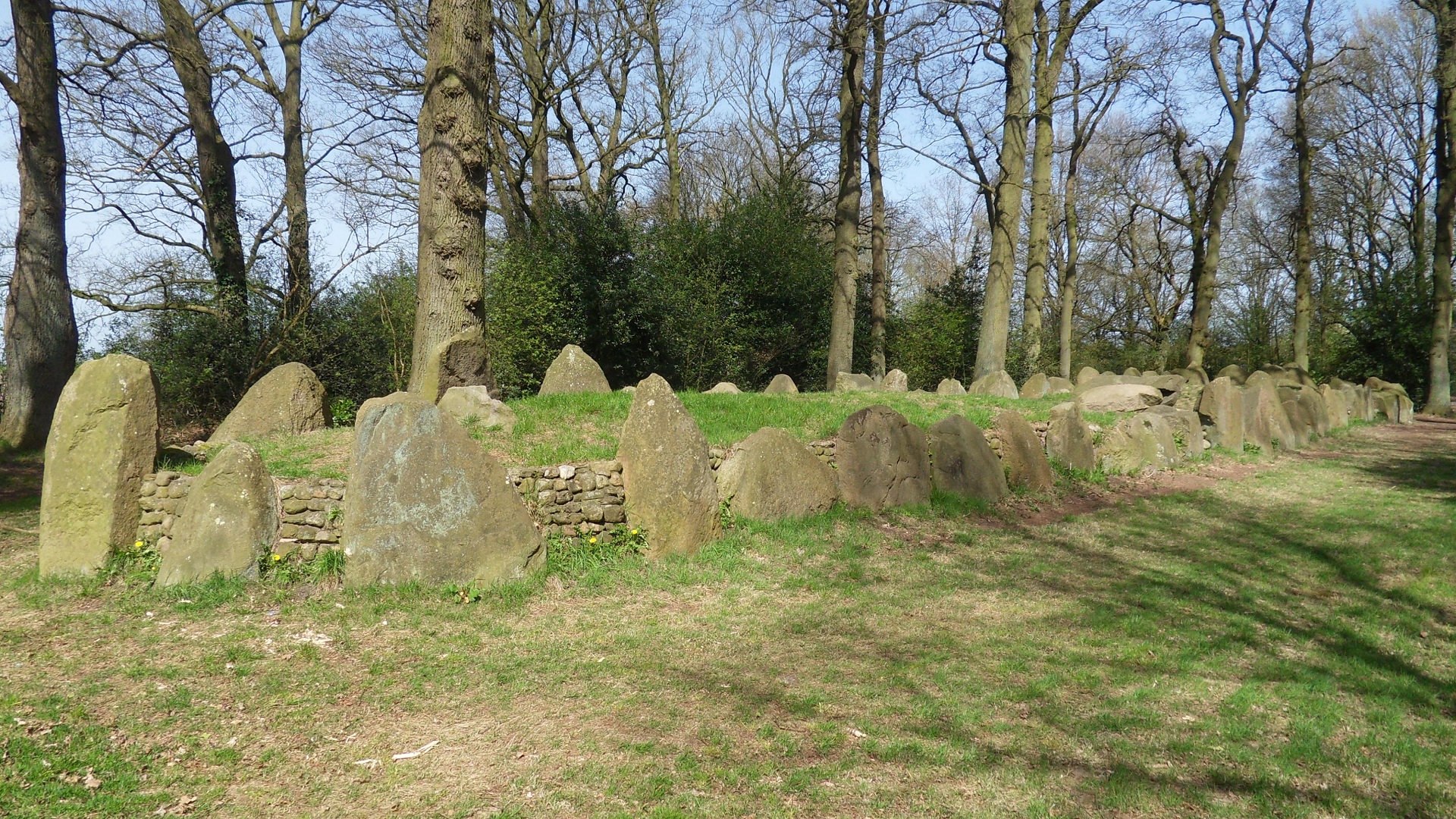
Within the built-up area of Emmen, in a stand of pines called the Emmerdennen, sits Hunebed D45 - one of the prehistoric stone tombs that mark this corner of Drenthe. Most of the country's hunebedden are out in the heath. This one is in the suburbs, a five-thousand-year-old assembly of glacial erratics surrounded by walking paths and homeowners. A few kilometers east of the city, in an old De Boer family sand quarry, stands Robert Smithson's Broken Circle/Spiral Hill - the American artist's only large-scale earthwork outside the United States, built in 1971 for the Sonsbeek exhibition. The two works belong to the same landscape and almost to the same vocabulary. Smithson knew about the hunebedden when he chose the site; he said so in his notes. Emmen quietly hosts one of the densest single-spot concentrations in Europe of prehistoric and contemporary land art. Most tourists arrive without realizing it.
Tunnels and Triangles
Emmen plays football at De Oude Meerdijk, the 8,600-seat ground in the business park 3 km east of the center, where FC Emmen still pulls a passionate following. Every summer the city hosts the Gouden Pijl, a road-cycling criterium that brings the sport's biggest names and a series of pop concerts to the streets in one weekend. Speedway Emmen hosts the Oliebollen Race every December - the name comes from the deep-fried New Year's pastries the Dutch eat by the bagful. Below the city, the Hondsrugtunnel carries traffic under the center with an interior light installation called Dolmen Light, by the Dutch artist Titia Ex, that nods back to the stone monuments above. The shopping in the city center is large by regional standards and is one reason locals from across northern Drenthe drive in on Saturdays. Emmen is sometimes preferred to Assen, the provincial capital, for being more cosy.
From the Air
Emmen sits at 52.78 degrees north, 6.90 degrees east, in the southeast of Drenthe province roughly 10 km west of the German border. From the air the city reads as a compact gridded core surrounded by clearly delineated suburban districts - Angelslo, Emmerhout, Bargeres, the Rietlanden - separated in places by deliberate green belts of forest and parkland. The A37 motorway runs east-west south of the city, crossing into Germany as the B402 and European route E233. The N34 expressway connects north to Groningen and south to Coevorden. Two railway stations - Emmen central and Emmen Zuid - serve the regional line from Zwolle. The De Oude Meerdijk stadium and the Smithson earthwork lie immediately east. Nearest airport: Groningen Airport Eelde (EHGG) lies 50 km north. Recommended viewing altitude 3,000 to 5,000 feet for the clearest read of the planned suburban geometry.