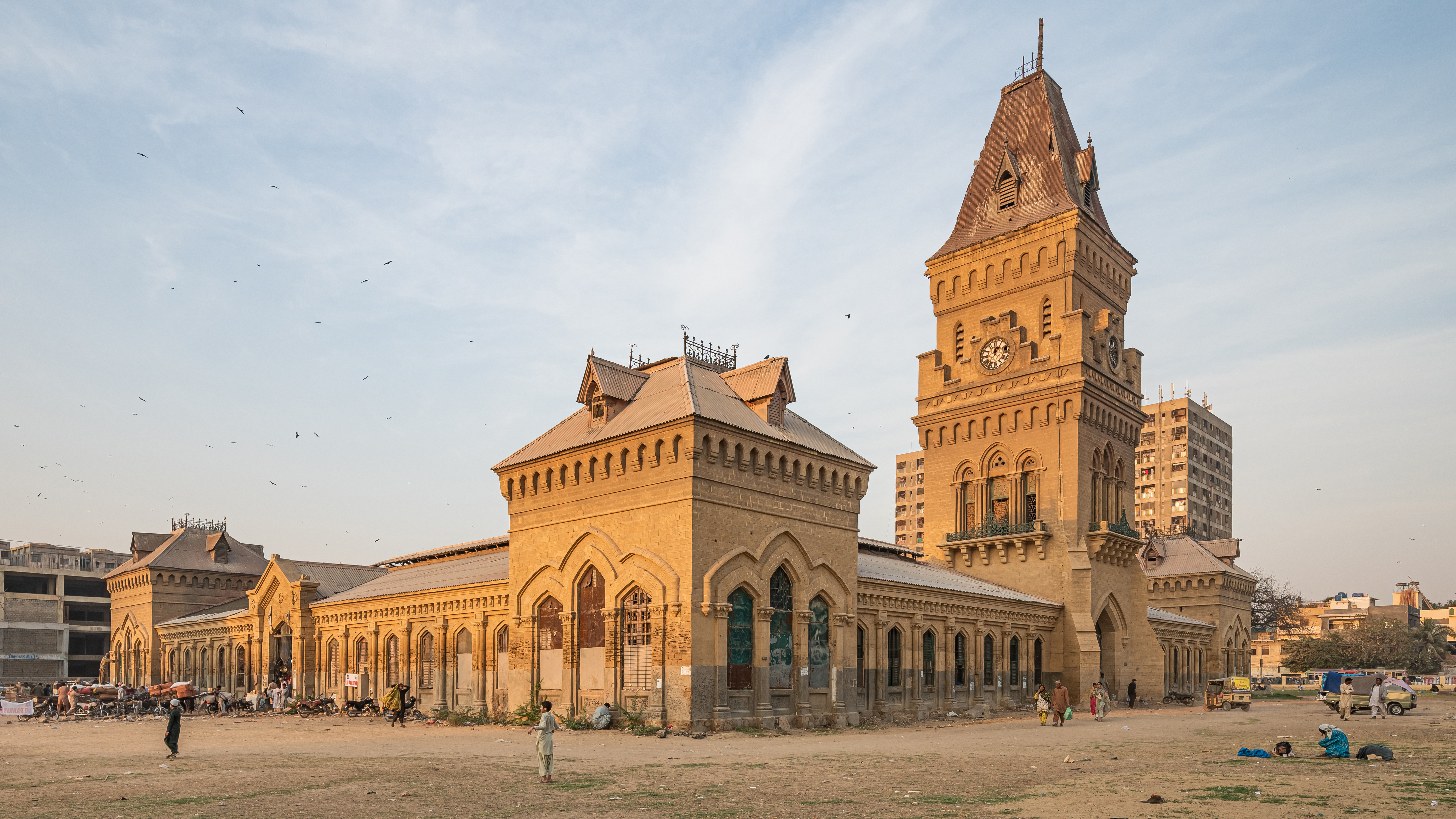
Empress Market
The British knew exactly what they were doing when they chose the site. The ground where Empress Market stands in Karachi's Saddar Town was the same ground where, after the failed 1857 uprising, native sepoys were executed by having their heads blown off with cannonballs -- a spectacle designed to terrify the local population into submission. Fearing that Karachiites would eventually build a monument to honor the dead rebels, the British instead erected a grand marketplace between 1884 and 1889 and named it for Queen Victoria, Empress of India. It was imperial erasure disguised as civic improvement, and it became one of the most beloved buildings in the city.
Indo-Gothic Grandeur
Empress Market is an architectural statement. Built in the Indo-Gothic style, it features vaulted roofs, cusped arches, and a 140-foot-high clock tower studded with carved leopard heads. The structure was designed to be visible from a great distance, a landmark that announced British permanence in the landscape. The yellow stone walls have weathered monsoons and political upheavals for over a century. Inside, the market is organized into sections for different commodities -- condiments, fruits, vegetables, and meat in one wing; textiles, stationery, and pets in another. The nearby Jahangir Park provides a rare patch of green in the surrounding urban density.
Exotic Birds and Uncomfortable Commerce
Empress Market gained notoriety for another trade that flourished within its stalls: the sale of exotic and endangered animals. Macaws, falcons, and other protected birds were sold openly without licenses. On August 24, 2015, a wildlife department raid confiscated 50 protected animals -- 20 Chukar partridge, 18 wild doves, eight black partridges, four grey partridges, two flamingos, and a pair of monkeys. The illegal wildlife trade at Empress Market operated in plain sight for years, a reminder that in a market this large and this crowded, regulation is more aspiration than enforcement.
The Encroachment War
Over the decades, Empress Market disappeared behind itself. More than 1,000 informal shops were constructed on encroached land surrounding the building, obscuring its facades and blocking its approaches. Some of these small businesses had operated for over 50 years. In November 2018, following a Supreme Court order, authorities launched a major demolition operation that destroyed the encroachments and an estimated 4,000 livelihoods in the process. The resulting cleanup revealed the market's architectural grandeur to a generation of Karachiites who had never seen the building's full profile. Social commentators were divided: some celebrated the restoration of a heritage site, while others mourned the destruction of a working-class economic ecosystem that had grown organically around the market for half a century.
Marketplace as Memory
Today, Empress Market remains one of Karachi's busiest and most popular shopping destinations. Small stands have already begun to reappear outside its premises. The clock tower still keeps time. The leopard heads still stare down from the tower's face. And beneath the market floor, the ground still holds the memory of its original purpose -- a killing ground turned into a monument to the crown that ordered the killing. That layering of violence and commerce, imperial ego and daily necessity, is quintessentially Karachi: a city that builds the future on top of the past without bothering to resolve the contradictions.
From the Air
Located at 24.863°N, 67.029°E in Saddar Town, central Karachi. The market's clock tower may be identifiable from lower altitudes against the surrounding commercial district. Jinnah International Airport (OPKC) is approximately 10 km to the north. The area is one of Karachi's most densely commercial neighborhoods.