Ename Abbey
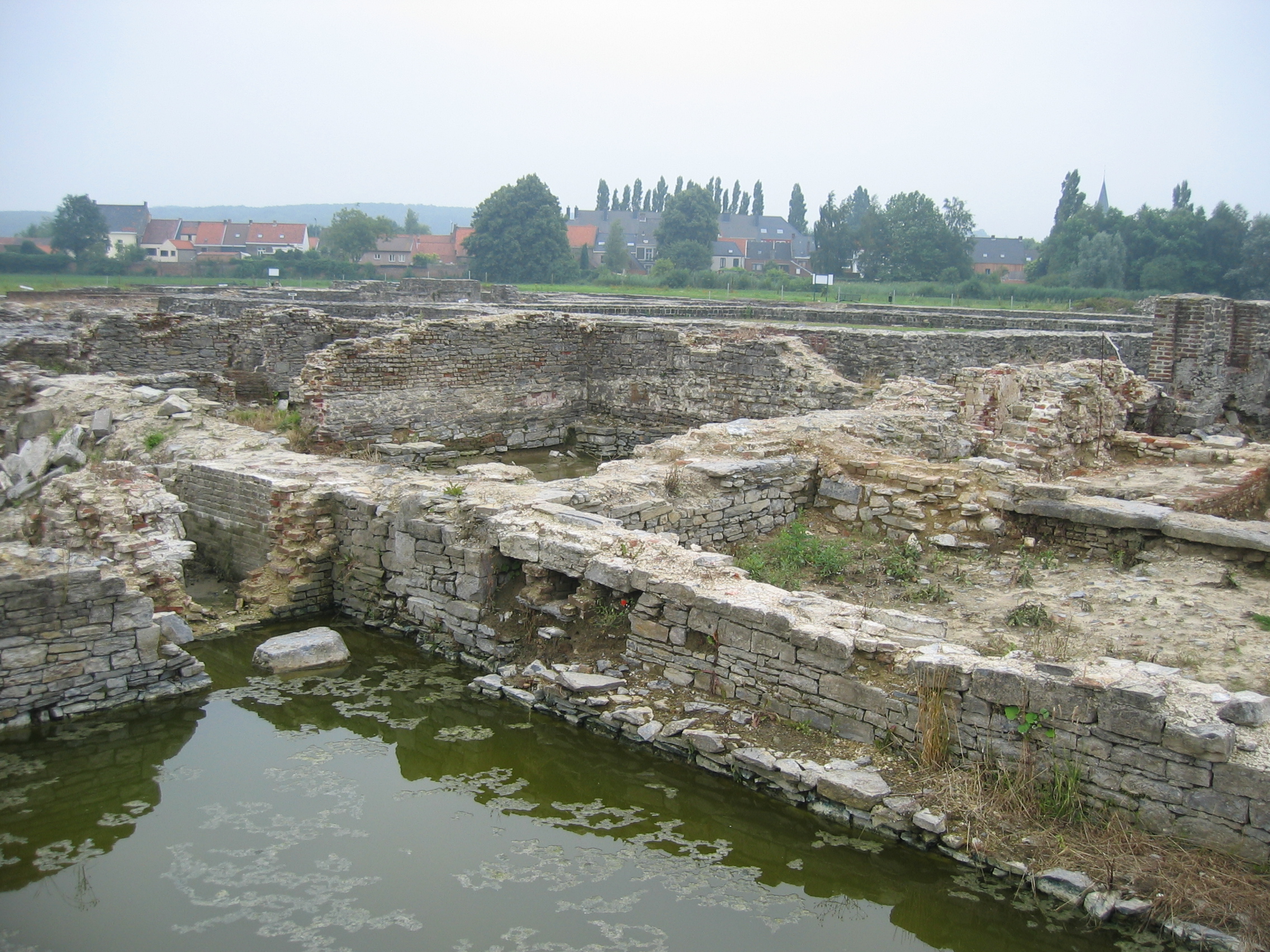
Walk into the village of Ename today and you can stand inside the abbey church without entering any building at all. There are no walls. There are foundations laid bare in mowed grass, a perimeter of stones the height of your knees, and tablets that tell you what stood here. Hold up a tablet and the building reassembles itself on the screen - a Romanesque nave, then a Gothic addition, then a French baroque orangery, then nothing. Ename Abbey existed from 1063 to 1795, and its disappearance was so thorough that the only honest way to show it is virtually. The archaeologists who excavated it spent decades documenting what had been lost, and then they built it back in pixels.
An Abbey to Replace a Fortress
In the first half of the eleventh century, Ename was a military stronghold - the eastern frontier post of the Holy Roman Empire, built to watch the river Scheldt where the Empire ended and Francia began. In 1033 Baldwin V, Count of Flanders, seized the keep and destroyed it, and by 1047 he held the territory definitively. Holding it was one problem; demilitarizing it was another. To turn a contested fortress into something stable, Baldwin's wife Adele of France founded a Benedictine abbey on the site in 1063. The abbey received the village of Ename and other properties as financial endowment. The first monks came from the Saint Vedastus abbey in Arras, and the new community settled into the old Ottonian palace buildings, with the previous palace converted to a chapel of Our Lady. Crucially, the abbey answered directly to the Pope rather than the local bishop, a kind of legal independence that protected it from local power struggles. Around 1070 a new church to Saint Salvator was finished, and the abbey was, in effect, founded a second time.
Six Centuries of Rebuilding
Ename Abbey rebuilt itself every century or two as fashion and money allowed. The original Ottonian church to Saint Salvator was replaced in 1139 with a bigger Romanesque structure inspired by Cluny in Burgundy, Hirsau in Swabia, and Affligem in nearby Brabant - the great Benedictine houses whose architecture Ename's monks wanted to echo. Around 1165 the residential buildings were rebuilt again in the new Gothic style. In the second half of the thirteenth century the monks added a hospital and an infirmary. They also did something unusual: facing a shortage of timber from the surrounding forest, they began a deliberate program of tree planting and managed harvesting. The current understanding is that this is the oldest documented case of reforestation in Europe. The monks were not romantics about nature. They simply wanted to keep cutting wood forever, and they realized that meant planting more than they cut.
Iconoclasm, Quarry, Rebuild
The sixteenth century was hard on Ename, as it was on every monastic house in the Low Countries. The 1566 Iconoclastic Fury caused minor damage - the abbey was off the main route of the wave of statue-smashing - but in 1578 the Protestant troops of Ghent occupied Oudenaarde, just across the Scheldt, and turned their attention to the abbey across the water. The monks fled. The buildings were plundered. For nearly twenty years the abbey ruins served as a stone quarry for the surrounding villages, and by the time the monks returned in 1596 more than half of Ename's villagers had also left their homes. The seventeenth century brought wealth again. Abbot Antoon de Loose enlarged the abbot's quarters in 1657 and commissioned the famous Dutch bell-founder Pieter Hemony to cast bells and carillon chimes for a tower at the abbey entrance. Because monks were forbidden to discuss politics inside the walls, the abbots built a French garden in front of the abbey - with fountains and pavilions - where they could meet politicians and discuss affairs of state.
Erased and Reconstructed
The French Revolutionary armies reached Flanders in 1795 and dissolved the abbey along with hundreds of others across the southern Netherlands. The buildings were sold and dismantled, and the stones found their way into farmhouses and barns for kilometers around. For nearly a century and a half almost nothing visible remained. Then in the 1940s the archaeologist Adelbert Van de Walle began excavating the site, and his work continued through the late twentieth century. Since 1998 the foundations have formed the heart of the Provincial Archaeological Park, attached to the museum PAM Ename in the village. The data from the digs were fed into a project called TimeScope: 3D reconstructions of the abbey at multiple points in its history - 1065, 1085, around 1290, and in 1730 at its baroque peak. You can see them on tablets the museum hands out, walking among the foundations. As a curious afterlife, Brewery Roman still brews a range of beers under the name Ename Abbey Beer, drawing on a real connection to a real place that no longer exists.
From the Air
Ename Abbey lies at 50.86°N, 3.63°E in the village of Ename, now a suburb of Oudenaarde, on the eastern bank of the Scheldt river in East Flanders. From the air the archaeological site is a distinctive rectangular pattern of low stone outlines visible just east of the river bend. Oudenaarde's Gothic town hall and Belfry, three kilometers southwest, make the easiest visual anchor. Nearest airports are Brussels (EBBR) approximately 50 km east-northeast and Lille-Lesquin (LFQQ) roughly 40 km southwest. The Scheldt valley is broad and flat here, with the Flemish Ardennes hills rising to the south.