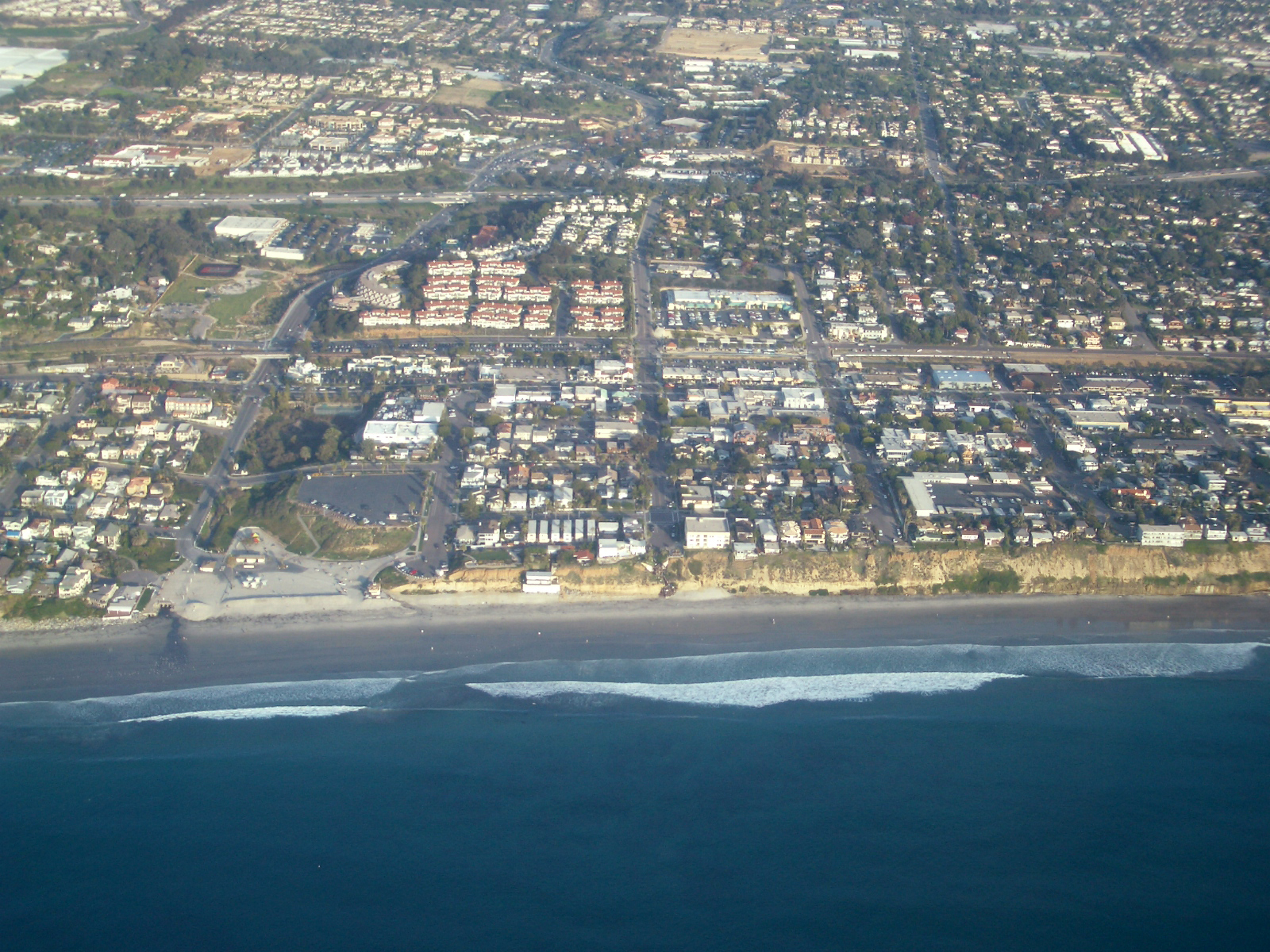
Encinitas, California
Encinitas wears its identity lightly: a beach town that didn't bother to incorporate as a city until 1986, content for more than a century to simply exist along its stretch of California coastline. The name comes from 'encinos' — little oaks — a nod to the scrubby trees that once shaded the inland hills before waves of settlers arrived and began planting poinsettias, avocados, and ambition in their place. Today five distinct communities share the city limits, each with its own character, yet all within earshot of the Pacific.
First Peoples, First Roots
Long before Jabez Pitcher filed his subdivision plat in 1881 and invited the Southern California Railway to come calling, the Kumeyaay people lived along this coast. Their villages occupied the lagoons and blufftops, their seasonal rounds tied to the productivity of the shore and the inland valleys. The Spanish mission system disrupted those patterns in the late eighteenth century, and the rancho era that followed rearranged land and labor in ways that displaced the Kumeyaay from most of their territory. By the time Anglo settlers arrived with their railroad and their lots for sale, the landscape already carried layers of history that the new arrivals rarely paused to acknowledge.
Pitcher founded the community of Encinitas proper in 1881, and the railroad's arrival that same year connected the village to the broader California economy. Residents grew flowers — the city would become a center for poinsettia cultivation — and slowly built the infrastructure of small-town life: a post office, a school, eventually a theater.
Five Communities, One Coastline
What distinguishes Encinitas from most California cities is that incorporation came so late. By 1986, when residents finally voted to create a formal municipal government, five separate communities had already developed distinct identities and resisted any suggestion that they were simply one place.
Old Encinitas lines South Coast Highway 101 with its surf shops, vintage storefronts, and the La Paloma Theatre — a 1928 Spanish Colonial Revival cinema where Mary Pickford attended opening night and where the Rocky Horror Picture Show still screens on weekends. Leucadia, to the north, has long attracted artists and the kind of people who prefer bougainvillea-draped fences to manicured lawns. Cardiff-by-the-Sea sits just south, its lagoon and reef break drawing both birdwatchers and surfers to the same stretch of coast. Olivenhain, inland and semi-rural, preserves the quiet of horse properties and dirt roads. And New Encinitas, developed from the 1980s onward, is the more conventionally suburban face of the city — the tract homes and shopping centers that financed the region's growth.
Swami's, the reef break at the southern end of Old Encinitas, is perhaps the city's most famous single feature. Named for Paramahansa Yogananda, the Indian spiritual teacher whose Self-Realization Fellowship ashram overlooks the break from the bluffs, Swami's is the only right point break in North County San Diego. The Beach Boys mentioned it in 'Surfin' U.S.A.' in 1963, cementing its place in California mythology. Professional surfers Rob Machado and Taylor Knox count it among their home breaks.
The Mediterranean at the Pacific
Encinitas enjoys the climate that real estate agents call Mediterranean — warm, dry summers and mild, occasionally wet winters — with an ocean influence that keeps temperatures more moderate than the inland valleys just a few miles east. The result is a year-round growing season that made the city a center of flower farming for much of the twentieth century. The San Diego Botanic Garden preserves some of that horticultural tradition while adding native plants and garden design to its mission.
The city's arts and culture scene punches above its weight for a community of roughly 60,000. The La Paloma Theatre, built in 1927-28, is one of the last single-screen movie houses on the California coast still operating in its original form. The Lux Art Institute brings working artists to a dedicated residency facility. And the city's commitment to preserving its older commercial district along Coast Highway 101 has made Old Encinitas one of the more walkable stretches of street-level retail in the county — the kind of place that resists the homogenizing pressure of chain stores with genuine local character.
Encinitas remains, at its core, a town shaped by proximity to the ocean. The blufftop parks, the surf breaks, the flower fields that still bloom in season, the yoga studios clustered near the Self-Realization Fellowship grounds — all of it reflects a community that has chosen, deliberately and repeatedly, to organize its identity around the fact of the Pacific at its front door.
From the Air
Encinitas occupies the coast at approximately 33.04°N, 117.29°W, between Solana Beach to the south and Leucadia/Carlsbad to the north. Flying southbound along the coast at 3,000–5,000 feet MSL on a clear day, the city is identifiable by the coastal bluffs, the distinctive Cardiff reef visible in the water during low tide, and the Swami's break just north of the San Elijo Lagoon mouth. The Self-Realization Fellowship golden domes are a landmark on the blufftop. Nearest airports: KCRQ (McClellan-Palomar, Carlsbad, 5 miles north) for general aviation, KMYF (Montgomery-Gibbs, 18 miles southeast). The coastal rail line (Amtrak Surfliner and Coaster) is visible as a thin corridor between the bluffs and the highway.