Engaku-ji
A railway bisects the entrance. Trains on the Yokosuka Line rattle across the formal approach to Engaku-ji several times an hour, a jarring modern intrusion into a temple compound founded in 1282. But then, contradiction has always been part of this place's character. Engaku-ji was built to honor the dead of a war Japan won, yet its founder was a Chinese monk. Its purpose was to spread Zen across the country, yet its most famous relic is claimed to be a tooth of Shakyamuni himself. Ranked second among Kamakura's Five Mountains, the great Zen temple complexes that once governed Buddhist intellectual life in medieval Japan, Engaku-ji has survived fires, earthquakes, and centuries of shifting fortune to remain one of the most important centers of Zen practice in the country.
Born from Invasion
The temple owes its existence to the Mongol invasions of Japan between 1274 and 1281. Hojo Tokimune, the regent who effectively ruled the country, had long been committed to Zen Buddhism. After repelling the second Mongol assault, he invited the Chinese monk Mugaku Sogen to found a temple that would honor the war dead of both sides, Japanese and Mongol alike, and serve as a center for spreading Zen influence. During the initial construction, workers unearthed a copy of the Sutra of Perfect Enlightenment, the engaku-kyo, sealed in a stone chest within the hillside. The discovery gave the temple its name. Tokimune himself is buried on the grounds, in a thatched building called the Butsunichian that still stands among the 18 temples of the complex.
National Treasures on the Hillside
Two objects at Engaku-ji carry the highest cultural designation Japan can bestow. The Shariden, a reliquary hall, is the only National Treasure building in all of Kanagawa Prefecture. The original structure was built in 1285 by Hojo Sadatoki, but fire destroyed it in 1563. The current building, transferred from the Taiheiji convent, dates from the Muromachi period and is a pristine example of kara-yo, the Chinese-style architecture introduced during the Kamakura period, with a style close to that of the Song dynasty. It is covered in hinoki cypress bark shingles and houses what is said to be a tooth of Shakyamuni, presented by the Noninji Temple in China to Minamoto no Sanetomo. The second National Treasure is the Ogane, the great bell cast by Mononobe Kunimitsu in 1301. Standing 2.6 meters tall, it is the largest temple bell in Kamakura and the largest in the entire Kanto region.
The Gate That Survived
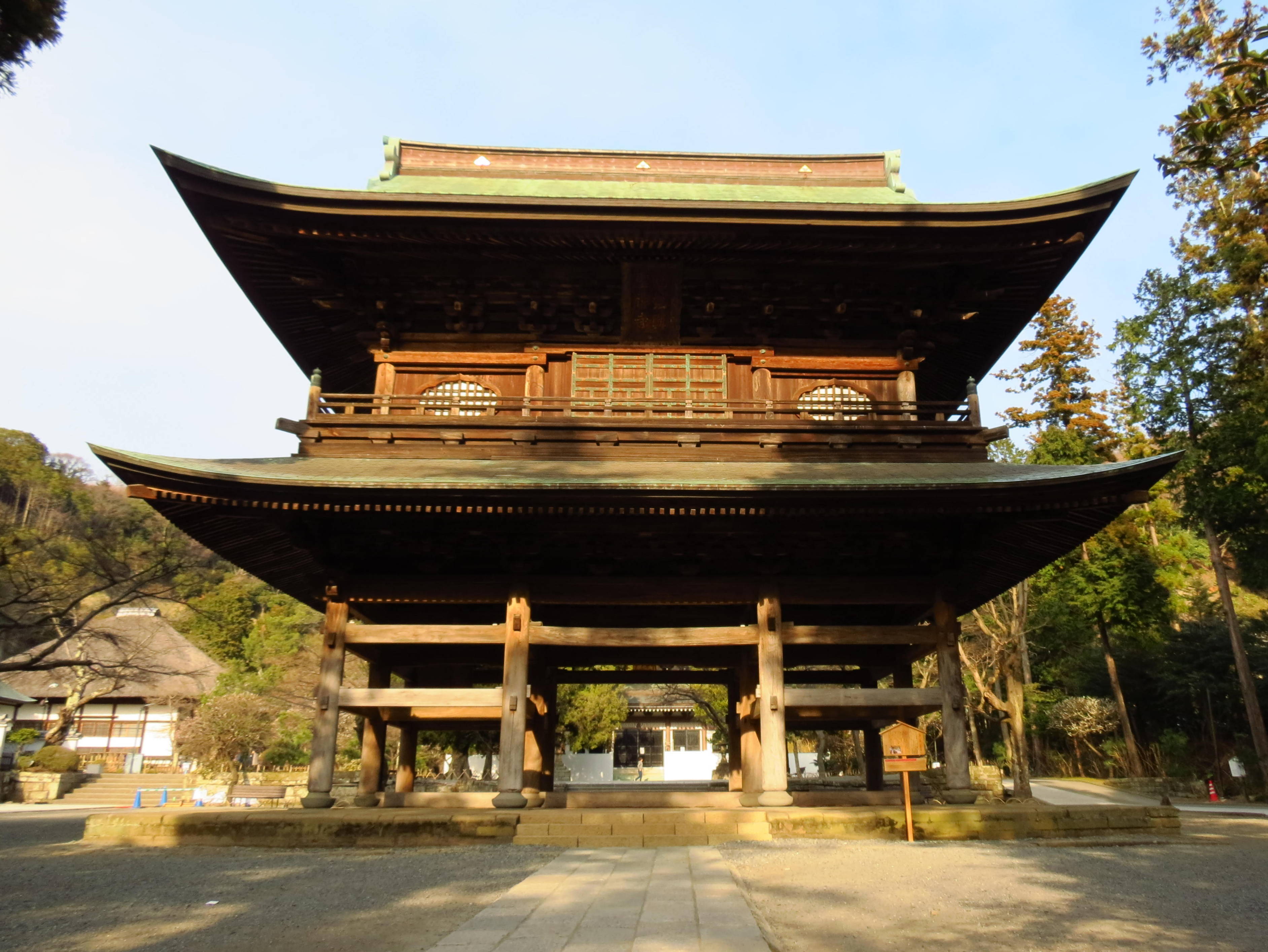
Fire has shaped Engaku-ji as much as any architect. Buildings have been damaged and rebuilt repeatedly over the centuries, and the temple's present form is largely the work of the Zen priest Seisetsu Shucho, who reconstructed and consolidated the complex toward the end of the Edo era. The two-storied Sanmon gate, rebuilt by Seisetsu in 1785 to mark the 500th anniversary of the temple's founding, carries a wooden plaque of calligraphy by Emperor Fushimi and shelters statues of Bodhisattva, the Sixteen Arhats, and the Twelve Heavenly Generals behind its copper roof. The main hall, the Butsuden, was destroyed by the Great Kanto Earthquake of 1923 and rebuilt in 1964 following a plan from 1573. Inside, a crowned Shakyamuni statue from the late Kamakura period presides, while a dragon painted on the ceiling by Tadashi Moriya watches from above.
Where Suzuki Sat
In the Meiji era, Engaku-ji became the chief center for Zen instruction in the Kanto region. Two successive abbots, Imakita Kosen and Soyen Shaku, transformed it into a place where traditional practice met the modern world. Among their students was Daisetz Teitaro Suzuki, who would become the single most influential figure in introducing Zen Buddhism to the West. The temple still offers zazen courses: open meditation sessions run every morning except during New Year's and early October, and every Saturday afternoon except in August. A Summer Lecture Series fills four days each July. The grounds also hold the grave of the film director Yasujiro Ozu, whose quiet, contemplative cinema seems perfectly suited to a resting place among Zen gardens and cypress-bark rooftops.
Bells and Benzaiten
Legend credits the goddess Benzaiten with the successful casting of the great bell. Hojo Sadatoki had confined himself in the Benzaiten shrine on the island of Enoshima before commissioning the work in 1301, and the Bentendo hall at Engaku-ji is dedicated to that same shrine. Once every 60 years, a grand ceremony links the two sites. From the bell platform, visitors look out across the Kita-Kamakura valley toward other temple complexes, including Jochi-ji and Tokei-ji, the latter also belonging to the Engaku-ji school. The view integrates centuries of Zen architecture into a single forested landscape, austere buildings rising up a wooded hillside in a perpendicular arrangement that blends structure and nature into a satisfying whole.
From the Air
Located at 35.3377N, 139.5475E in the Kita-Kamakura valley, Kanagawa Prefecture, south of Tokyo. The temple complex sits in a wooded hillside with buildings arranged in a line uphill. Look for the forested valley between Kita-Kamakura Station and the surrounding ridges. Best viewed below 2,000 feet to distinguish individual buildings. Nearest airports: RJTT (Tokyo Haneda) approximately 40 km northeast, RJTF (Chofu) about 35 km north. The Yokosuka Line rail corridor is a strong visual reference cutting through the approach to the temple.